Download
1 / 5
50 likes | 154 Vues
This guide explores the development and application of cosine formulas for angle differences and sums, specifically cos(A - B) and cos(A + B). We will evaluate specific cases, including cos(60° - 30°) and cos(60° + 30°), using both angle difference and angle sum formulas. The document provides homework exercises to reinforce learning. By using the formulas cos(A - B) = cosAcosB + sinAsinB and cos(A + B) = cosAcosB - sinAsinB, students can find exact values, such as cos(15°) and other scenarios involving angles in various quadrants.

E N D
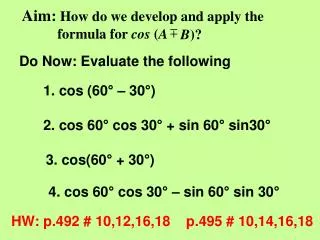
Aim: How do we develop and apply the formula for cos (A B)? Do Now: Evaluate the following 1. cos (60° – 30°) 2. cos 60° cos 30° + sin 60° sin30° 3. cos(60° + 30°) 4. cos 60° cos 30° – sin 60° sin 30° HW: p.492 # 10,12,16,18 p.495 # 10,14,16,18
Difference of two angles of cosine cos(A – B) = cos A cos B + sin A sin B Sum of two angles of cosine cos (A + B) = cos A cos B – sin A sin B
We can use these formulas to find the exact values of non special angles Example: Find exact value of cos 75 cos 75 = cos(120 – 45) = cos 120 cos 45 +sin 120 sin 45 = • If Sin A = 3/5 with Example: in quadrant II and cos B = 5/13 with is in quadrant I, find cos (A – B). * First of all, find cos A and sin B cos A = – 4/5, sin B = 12/13 cos (A – B) = cos A cos B + sin A sin B = (- 4/5)(5/13) + (3/5)(12/13) = -20/65 + 36 /65 = 16/65
Example: If is not in quadrant I ,and Is not in quadrant IV Find the value of
APPLICATION: 1. Find the exact value of cos 15° 2. Use cos (A – B) to show cos(270° – x ) = – sin x 3. If and both A and B are in quadrant III. Find cos(A – B)