ALTERATIONS IN THE CENTRAL NERVOUS SYSTEM
200 likes | 343 Vues
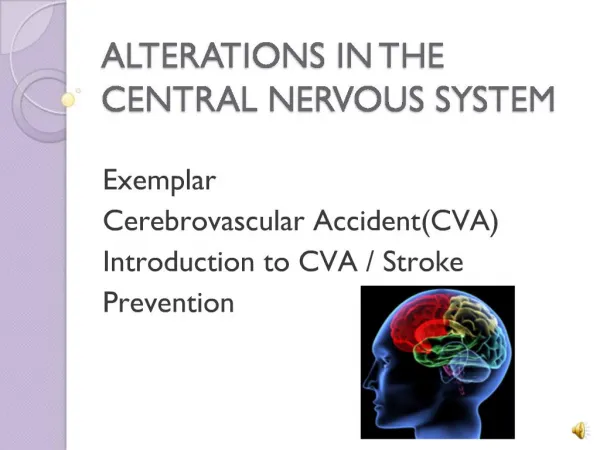
Cerebrovascular accidents (CVAs), commonly known as strokes, are a major health concern, causing approximately 800,000 cases annually in the USA. They result from interrupted blood flow to the brain, leading to ischemia or hemorrhage. CVAs are the third most common cause of death and the leading cause of disability. This overview outlines the types of strokes, including ischemic and hemorrhagic, as well as risk factors such as age, race, and medical history. Prevention strategies emphasize lifestyle changes, early medical intervention, and managing underlying health conditions.


ALTERATIONS IN THE CENTRAL NERVOUS SYSTEM
E N D
Presentation Transcript
ALTERATIONS IN THE CENTRAL NERVOUS SYSTEM Exemplar Cerebrovascular Accident(CVA) Introduction to CVA / Stroke Prevention
Stroke (Brain Attack) • Definition -Blood flow interrupted to an area of the brain -Ischemia to the part of the brain -Bleeding into brain tissue -The brain doesn’t store oxygen/ glucose and needs a constant flow of blood
Cerebrovascular Accident • Approximately 800,000 in USA annually • (425,000=F; 370,000=M) * • Third most common cause of death • #1 leading cause of disability • Physical, cognitive, emotional, & financial impact • *http://www.stroke.org/site/News2?page=NewsArticle&id=9015&news_iv_ctrl=1222
Transient Ischemic Attack (TIA) • Temporary focal loss of neurologic function • Caused by ischemia of one of the vascular areas of the brain • Most resolve within 3 hours • Difference of TIA vs. CVA is infarction* *Easton,JD, Saver,JL, Albers, GW, et al. Definition and evaluation of transient ischemic attack.Stroke. 2009; 40(6)2276-2293.
Types of Strokes • Ischemic stroke (87%) -Thrombotic stroke: atherosclerosis of blood vessel wall -Embolic stroke: dislodged clot from other area of body • Hemorrhagic stroke (13%) Bleeding into brain tissue r/t rupturedaneurysm, arteriovenous malformation
Cerebrovascular Accident: Ischemic Thrombotic • Lumen of the blood vessels narrows (atherosclerosis) - becomes occluded -infarction occurs • Associated with HTN and Diabetes Mellitus
Cerebrovascular Accident: Ischemic Embolic Stroke • Embolus lodges in/ occludes a cerebral artery • Infarction & cerebral edema develop • Emboli R/T : atrial fibrillation -MI -valvular prostheses • Severe symptoms occur rapidly– no collateral circulation • Any age group • Recurrence common if underlying cause not treated
Cerebrovascular Accident Hemorrhagic • Subarachnoid Hemorrhage -Intracranial bleeding -Increases with age and more common in women • Intracerebral Hemorrhage - rupture within the brain tissue • Aneurysm -abnormal blood vessel wall which ruptures
Cerebrovascular AccidentHemorrhage Stroke Intracerebral Hemorrhage
Cerebrovascular AccidentPopulations at Risk • Age – Occurrence doubles each decade >55 years • Gender – Almost equal for men & women • Race – African Americans, Hispanics, Native Americans, Asian Americans -- higher incidence • Heredity – family history, prior transient ischemic attack, or prior stroke increases risk • http://www.stroke.org/site/PageServer?pagename=RISK
Pediatric Strokes • Populations at Risk M>F; African American>White, Asian • Medical Hx -sickle cell disease -heart disease (congenital or acquired) Signs & Symptoms -infant may have one sided seizure -older child has weakness/numbness
Video on Pediatric Stroke • http://abcnews.go.com/Health/video/year-stroke-survivor-10139867
Cerebrovascular AccidentRisk Factors Controllable Risks with Medical Treatment & Lifestyle Changes: High blood pressure DiabetesCigarette smoking TIA (Aspirin)High blood cholesterol ObesityHeart Disease Atrial fibrillation Oral contraceptive use Physical inactivity Sickle cell disease Asymptomatic carotid Hypercoagulability stenosis
Prevention • Maintain healthy lifestyle -exercise -don’t smoke/alcohol in moderation • Diet -low sodium, low cholesterol • Control underlying medical problems -hypertension -diabetes mellitus -atrial fibrillation