Understanding Instruction Set Architecture in Low-Level Programming (ICOM 4036)
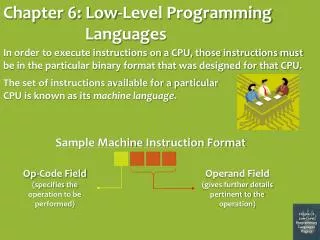
In this lecture, Prof. Bienvenido Velez explores the fundamentals of Instruction Set Architecture (ISA) and its impact on low-level programming. We revisit the concept of virtual machines, the translation from high-level languages to machine code, and the implementation of language abstractions. Key topics include control structures, data structures, procedures, and functions. A hands-on example illustrates integer division in C++. The session emphasizes the relation between ISA, processor implementation, and how programs interact with hardware in computing systems.

Understanding Instruction Set Architecture in Low-Level Programming (ICOM 4036)
E N D
Presentation Transcript
Low-Level Programming ICOM 4036 Lecture 2 Prof. Bienvenido Velez ICOM 4036 Programming Laguages Lecture 2
What do we know? To From Instruction Set Architecture Processor Implementation What Next? Instruction Set Design How do we get here in the first place? ICOM 4036 Programming Laguages Lecture 2
Outline • Virtual Machines: Interpretation Revisited • Example: From HLL to Machine Code • Implementing HLL Abstractions • Control structures • Data Structures • Procedures and Functions ICOM 4036 Programming Laguages Lecture 2
Virtual Machines (VM’s) ICOM 4036 Programming Laguages Lecture 2
Computer Science in Perspective People Computer Human Interaction, User Interfaces ICOM 4036 CS1/CS2, Programming, Data Structures Programming Languages, Compilers Computer Architecture INTERPRETATION A CORE theme all throughout Computer Science computers People ICOM 4036 Programming Laguages Lecture 2
Computing Integer DivisionIterative C++ Version int a = 12; int b = 4; int result = 0; main () { if (a >= b) { while (a > 0) { a = a - b; result ++; } } } We ignore procedures and I/O for now ICOM 4036 Programming Laguages Lecture 2
DefinitionInstruction Set Architecture • What it is: • The programmers view of the processor • Visible registers, instruction set, execution model, memory model, I/O model • What it is not: • How the processors if build • The processor’s internal structure ICOM 4036 Programming Laguages Lecture 2
15 14 10 9 0 I opcode X Easy IA Simple Accumulator Processor Instruction Set Architecture (ISA) Instruction Format (16 bits) I = Indirect bit ICOM 4036 Programming Laguages Lecture 2
Easy IA Simple Accumulator Processor Instruction Set Architecture (ISA) Instruction Set ICOM 4036 Programming Laguages Lecture 2
Easy IMemory Model 8 bits 8 bits ICOM 4036 Programming Laguages Lecture 2
Computing Integer DivisionIterative C++ Version int a = 12; int b = 4; int result = 0; main () { if (a >= b) { while (a > 0) { a = a - b; result ++; } } } C++ HLL Easy-I Assembly Language ICOM 4036 Programming Laguages Lecture 2
Translate Data: Global Layout Computing Integer DivisionIterative C++ Version 0: andi 0 # AC = 0 addi 12 storei 1000 # a = 12 (a stored @ 1000) andi 0 # AC = 0 addi 4 storei 1004 # b = 4 (b stored @ 1004) andi 0 # AC = 0 storei 1008 # result = 0 (result @ 1008) int a = 12; int b = 4; int result = 0; main () { if (a >= b) { while (a > 0) { a = a - b; result ++; } } } • Issues • Memory allocation • Data Alignment • Data Sizing C++ HLL Easy-I Assembly Language ICOM 4036 Programming Laguages Lecture 2
Issues • Must translate HLL boolean expression into ISA-level branching condition Translate Code: Conditionals If-Then Computing Integer DivisionIterative C++ Version 0: andi 0 # AC = 0 addi 12 storei 1000 # a = 12 (a stored @ 1000) andi 0 # AC = 0 addi 4 storei 1004 # b = 4 (b stored @ 1004) andi 0 # AC = 0 storei 1008 # result = 0 (result @ 1008) main: loadi 1004 # compute a – b in AC comp # using 2’s complement add addi 1 add 1000 brni exit # exit if AC negative exit: int a = 12; int b = 4; int result = 0; main () { if (a >= b) { while (a > 0) { a = a - b; result ++; } } } C++ HLL Easy-I Assembly Language ICOM 4036 Programming Laguages Lecture 2
Translate Code: Iteration (loops) Computing Integer DivisionIterative C++ Version 0: andi 0 # AC = 0 addi 12 storei 1000 # a = 12 (a stored @ 1000) andi 0 # AC = 0 addi 4 storei 1004 # b = 4 (b stored @ 1004) andi 0 # AC = 0 storei 1008 # result = 0 (result @ 1008) main: loadi 1004 # compute a – b in AC comp # using 2’s complement add addi 1 add 1000 brni exit # exit if AC negative loop: loadi 1000 brni endloop jump loop endloop: exit: int a = 12; int b = 4; int result = 0; main () { if (a >= b) { while (a > 0) { a = a - b; result ++; } } } C++ HLL Easy-I Assembly Language ICOM 4036 Programming Laguages Lecture 2
Translate Code: Arithmetic Ops Computing Integer DivisionIterative C++ Version 0: andi 0 # AC = 0 addi 12 storei 1000 # a = 12 (a stored @ 1000) andi 0 # AC = 0 addi 4 storei 1004 # b = 4 (b stored @ 1004) andi 0 # AC = 0 storei 1008 # result = 0 (result @ 1008) main: loadi 1004 # compute a – b in AC comp # using 2’s complement add addi 1 add 1000 brni exit # exit if AC negative loop: loadi 1000 brni endloop loadi 1004 # compute a – b in AC comp # using 2’s complement add addi 1 add 1000 # Uses indirect bit I = 1 jumpi loop endloop: exit: int a = 12; int b = 4; int result = 0; main () { if (a >= b) { while (a > 0) { a = a - b; result ++; } } } C++ HLL Easy-I Assembly Language ICOM 4036 Programming Laguages Lecture 2
Translate Code: Assignments Computing Integer DivisionIterative C++ Version 0: andi 0 # AC = 0 addi 12 storei 1000 # a = 12 (a stored @ 1000) andi 0 # AC = 0 addi 4 storei 1004 # b = 4 (b stored @ 1004) andi 0 # AC = 0 storei 1008 # result = 0 (result @ 1008) main: loadi 1004 # compute a – b in AC comp # using 2’s complement add addi 1 add 1000 brni exit # exit if AC negative loop: loadi 1000 brni endloop loadi 1004 # compute a – b in AC comp # using 2’s complement add addi 1 add 1000 # Uses indirect bit I = 1 storei 1000 jump loop endloop: exit: int a = 12; int b = 4; int result = 0; main () { if (a >= b) { while (a > 0) { a = a - b; result ++; } } } C++ HLL Easy-I Assembly Language ICOM 4036 Programming Laguages Lecture 2
Translate Code: Increments Computing Integer DivisionIterative C++ Version 0: andi 0 # AC = 0 addi 12 storei 1000 # a = 12 (a stored @ 1000) andi 0 # AC = 0 addi 4 storei 1004 # b = 4 (b stored @ 1004) andi 0 # AC = 0 storei 1008 # result = 0 (result @ 1008) main: loadi 1004 # compute a – b in AC comp # using 2’s complement add addi 1 add 1000 brni exit # exit if AC negative loop: loadi 1000 brni endloop loadi 1004 # compute a – b in AC comp # using 2’s complement add addi 1 add 1000 # Uses indirect bit I = 1 storei 1000 loadi 1008 # result = result + 1 addi 1 storei 1008 jumpi loop endloop: exit: int a = 12; int b = 4; int result = 0; main () { if (a >= b) { while (a > 0) { a = a - b; result ++; } } } C++ HLL Easy-I Assembly Language ICOM 4036 Programming Laguages Lecture 2
Computing Integer DivisionEasy I Machine Code Data Program Challenge Make this program as small and fast as possible ICOM 4036 Programming Laguages Lecture 2
Revised Version Optimization at the HLL level Computing Integer DivisionIterative C++ Version 0: andi 0 # AC = 0 addi 12 storei 1000 # a = 12 (a stored @ 1000) andi 0 # AC = 0 addi 4 storei 1004 # b = 4 (b stored @ 1004) andi 0 # AC = 0 storei 1008 # result = 0 (result @ 1008) main: loop: loadi 1004 # compute a – b in AC comp # using 2’s complement add addi 1 add 1000 brni exit # exit if AC negative loadi 1004 # compute a – b in AC comp # using 2’s complement add addi 1 add 1000 # Uses indirect bit I = 1 storei 1000 loadi 1008 # result = result + 1 addi 1 storei 1008 jumpi loop endloop: exit: int a = 12; int b = 4; int result = 0; main () { while (a >= b) { a = a - b; result ++; } } C++ HLL Easy-I Assembly Language ICOM 4036 Programming Laguages Lecture 2
Translating Conditional Expressions Translating Logical Expressions loop exit condition ~(a >= b) ~((a – b) >= 0) ((a – b) < 0) int a = 12; int b = 4; int result = 0; main () { while (a >= b) { a = a - b; result ++; } } What if Loop Exit Condition was: ~(a < b) ICOM 4036 Programming Laguages Lecture 2
Peephole Optimization Optimization at Assembly level Computing Integer DivisionIterative C++ Version 0: andi 0 # AC = 0 addi 12 storei 1000 # a = 12 (a stored @ 1000) andi 0 # AC = 0 addi 4 storei 1004 # b = 4 (b stored @ 1004) andi 0 # AC = 0 storei 1008 # result = 0 (result @ 1008) main: loop: loadi 1004 # compute a – b in AC comp # using 2’s complement add addi 1 add 1000 brni exit # exit if AC negative storei 1000 loadi 1008 # result = result + 1 addi 1 storei 1008 jumpi loop endloop: exit: 0: andi 0 # AC = 0 addi 12 storei 1000 # a = 12 (a stored @ 1000) andi 0 # AC = 0 addi 4 storei 1004 # b = 4 (b stored @ 1004) andi 0 # AC = 0 storei 1008 # result = 0 (result @ 1008) main: loop: loadi 1004 # compute a – b in AC comp # using 2’s complement add addi 1 add 1000 brni exit # exit if AC negative loadi 1004 # compute a – b in AC comp # using 2’s complement add addi 1 add 1000 # Uses indirect bit I = 1 storei 1000 loadi 1008 # result = result + 1 addi 1 storei 1008 jumpi loop endloop: exit: int a = 12; int b = 4; int result = 0; main () { while (a >= b) { a = a - b; result ++; } } C++ HLL Easy-I Assembly Language ICOM 4036 Programming Laguages Lecture 2
The MIPS ArchitectureISA at a Glance • Reduced Instruction Set Computer (RISC) • 32 general purpose 32-bit registers • Load-store architecture: Operands in registers • Byte Addressable • 32-bit address space ICOM 4036 Programming Laguages Lecture 2
The MIPS Architecture32 Register Set (32-bit registers) ICOM 4036 Programming Laguages Lecture 2
The MIPS ArchitectureMain Instruction Formats • Simple and uniform 32-bit 3-operand instruction formats • R Format: Arithmetic/Logic operations on registers • I Format: Branches, loads and stores • J Format: Jump Instruction funct 6 bits opcode 6 bits rs 5 bits rt 5 bits rd 5 bits shamt 5 bits opcode 6 bits rs 5 bits rt 5 bits Address/Immediate 16 bits opcode 6 bits rs 5 bits rt 5 bits Address/Immediate 16 bits ICOM 4036 Programming Laguages Lecture 2
The MIPS ArchitectureExamples of Native Instruction Set ICOM 4036 Programming Laguages Lecture 2
The SPIM AssemblerExamples of Pseudo-Instruction Set Pseudo Instructions: translated to native instructions by Assembler ICOM 4036 Programming Laguages Lecture 2
The SPIM AssemblerExamples of Assembler Directives Assembler Directives: Provide assembler additional info to generate machine code ICOM 4036 Programming Laguages Lecture 2
Handy MIPS ISA References • Appendix A: Patterson & Hennessy • SPIM ISA Summary on class website • Patterson & Hennessy Back Cover ICOM 4036 Programming Laguages Lecture 2
The MIPS ArchitectureMemory Model 32-bit byte addressable address space ICOM 4036 Programming Laguages Lecture 2
MIPS/SPIM Version Computing Integer DivisionIterative C++ Version int a = 12; int b = 4; int result = 0; main () { while (a >= b) { a = a - b; result ++; } } } .data # Use HLL program as a comment x: .word 12 # int x = 12; y: .word 4 # int y = 4; res: .word 0 # int res = 0; .globl main .text main: la $s0, x # Allocate registers for globals lw $s1, 0($s0) # x in $s1 lw $s2, 4($s0) # y in $s2 lw $s3, 8($s0) # res in $s3 while: bgt $s2, $s1, endwhile # while (x >= y) { sub $s1, $s1, $s2 # x = x - y; addi $s3, $s3, 1 # res ++; j while # } endwhile: la $s0, x # Update variables in memory sw $s1, 0($s0) sw $s2, 4($s0) sw $s3, 8($s0) C++ MIPS Assembly Language ICOM 4036 Programming Laguages Lecture 2
MIPS/SPIM Version Input/Output in SPIM Computing Integer DivisionIterative C++ Version int a = 12; int b = 4; int result = 0; main () { while (a >= b) { a = a - b; result ++; } } printf("Result = %d \n"); } .data # Use HLL program as a comment x: .word 12 # int x = 12; y: .word 4 # int y = 4; res: .word 0 # int res = 0; pf1: .asciiz "Result = " .globl main .text main: la $s0, x # Allocate registers for globals lw $s1, 0($s0) # x in $s1 lw $s2, 4($s0) # y in $s2 lw $s3, 8($s0) # res in $s3 while: bgt $s2, $s1, endwhile # while (x >= y) { sub $s1, $s1, $s2 # x = x - y; addi $s3, $s3, 1 # res ++; j while # } endwhile: la $a0, pf1 # printf("Result = %d \n"); li $v0, 4 # //system call to print_str syscall move $a0, $s3 li $v0, 1 # //system call to print_int syscall la $s0, x # Update variables in memory sw $s1, 0($s0) sw $s2, 4($s0) sw $s3, 8($s0) C++ MIPS Assembly Language ICOM 4036 Programming Laguages Lecture 2
SPIM Assembler Abstractions • Symbolic Labels • Instruction addresses and memory locations • Assembler Directives • Memory allocation • Memory segments • Pseudo-Instructions • Extend native instruction set without complicating arquitecture • Macros ICOM 4036 Programming Laguages Lecture 2
ENDICOM 4036 Lecture 2 ICOM 4036 Programming Laguages Lecture 2
Implementing Procedures • Why procedures? • Abstraction • Modularity • Code re-use • Initial Goal • Write segments of assembly code that can be re-used, or “called” from different points in the main program. • KISS: Keep It Simple Stupid: • no parameters, no recursion, no locals, no return values ICOM 4036 Programming Laguages Lecture 2
Procedure LinkageApproach I • Problem • procedure must determine where to return after servicing the call • Solution: Architecture Support • Add a jump instruction that saves the return address in some place known to callee • MIPS: jal instruction saves return address in register $ra • Add an instruction that can jump to return address • MIPS: jr instruction jumps to the address contained in its argument register ICOM 4036 Programming Laguages Lecture 2
Function Call Computing Integer Division (Procedure Version)Iterative C++ Version int a = 0; int b = 0; int res = 0; main () { a = 12; b = 5; res = 0; div(); printf(“Res = %d”,res); } void div(void) { while (a >= b) { a = a - b; res ++; } } .data x: .word 0 y: .word 0 res: .word 0 pf1: .asciiz "Result = " pf2: .asciiz "Remainder = " .globl main .text main: # int main() { # // main assumes registers sx unused la $s0, x # x = 12; li $s1, 12 sw $s1, 0($s0) la $s0, y # y = 5; li $s2, 5 sw $s2, 0($s0) la $s0, res # res = 0; li $s3, 0 sw $s3, 0($s0) jal d # div(); lw $s3, 0($s0) la $a0, pf1 # printf("Result = %d \n"); li $v0, 4 # //system call to print_str syscall move $a0, $s3 li $v0, 1 # //system call to print_int syscall la $a0, pf2 # printf("Remainder = %d \n"); li $v0, 4 # //system call to print_str syscall move $a0, $s1 li $v0, 1 # //system call to print_int syscall jr $ra # return // TO Operating System C++ MIPS Assembly Language ICOM 4036 Programming Laguages Lecture 2
Computing Integer Division (Procedure Version)Iterative C++ Version int a = 0; int b = 0; int res = 0; main () { a = 12; b = 5; res = 0; div(); printf(“Res = %d”,res); } void div(void) { while (a >= b) { a = a - b; res ++; } } # div function # PROBLEM: Must save args and registers before using them d: # void d(void) { # // Allocate registers for globals la $s0, x # // x in $s1 lw $s1, 0($s0) la $s0, y # // y in $s2 lw $s2, 0($s0) la $s0, res # // res in $s3 lw $s3, 0($s0) while: bgt $s2, $s1, ewhile # while (x <= y) { sub $s1, $s1, $s2 # x = x - y addi $s3, $s3, 1 # res ++ j while # } ewhile: # // Update variables in memory la $s0, x sw $s1, 0($s0) la $s0, y sw $s2, 0($s0) la $s0, res sw $s3, 0($s0) enddiv: jr $ra # return; # } C++ MIPS Assembly Language ICOM 4036 Programming Laguages Lecture 2
Pending Problems With Linkage Approach I • Registers shared by all procedures • procedures must save/restore registers (use stack) • Procedures should be able to call other procedures • save multiple return addresses (use stack) • Lack of parameters forces access to globals • pass parameters in registers • Recursion requires multiple copies of local data • store multiple procedure activation records (use stack) • Need a convention for returning function values • return values in registers ICOM 4036 Programming Laguages Lecture 2
Recursion Basics int fact(int n) { if (n == 0) { return 1; else return (fact(n-1) * n); } n = 0 n = 1 fact(3) n = 2 n = 3 fact(2) n = 3 3 * 2 = 6 n = 2 fact(1) 2 * 1 = 2 n = 1 fact(0) 1 * 1 = 1 n = 0 1 ICOM 4036 Programming Laguages Lecture 2
Solution: Use Stacks of Procedure Frames • Stack frame contains: • Saved arguments • Saved registers • Return address • Local variables OS main stack frame div stack frame stack growth ICOM 4036 Programming Laguages Lecture 2
function arguments Anatomy of a Stack Frame caller’s stack frame frame pointer return address saved registers local variables of static size stack pointer work area Contract: Every function must leave the stack the way it found it ICOM 4036 Programming Laguages Lecture 2
Example: Function Linkage using Stack Frames int x = 0; int y = 0; int res = 0; main () { x = 12; y = 5; res = div(x,y); printf(“Res = %d”,res); } int div(int a,int b) { int res = 0; if (a >= b) { res = div(a-b,b) + 1; } else { res = 0; } return res; } • Add return values • Add parameters • Add recursion • Add local variables ICOM 4036 Programming Laguages Lecture 2
Example: Function Linkage using Stack Frames ICOM 4036 Programming Laguages Lecture 2
MIPS: Procedure LinkageSummary • First 4 arguments passed in $a0-$a3 • Other arguments passed on the stack • Return address passed in $ra • Return value(s) returned in $v0-$v1 • Sx registers saved by callee • Tx registers saved by caller ICOM 4036 Programming Laguages Lecture 2
![[Low-level] Programming of NXT Robots](https://cdn0.slideserve.com/1257924/slide1-dt.jpg)