Exploring Surface Tension Dynamics in Microgravity: A NASA RSGFO Experience
80 likes | 239 Vues
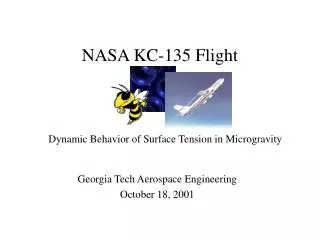
In October 2001, Georgia Tech students conducted a NASA-sponsored experiment aboard the KC-135, also known as the "Vomit Comet," to investigate the dynamic behavior of liquids with varying surface tensions in microgravity. This experiment aimed to determine the oscillation frequencies and dampening effects of different liquids, including water, milk, and olive oil, deployed through popped balloons. Comprehensive preparations involved a readiness review, hypoxia simulations at 25,000 feet, and hands-on testing. This program exemplifies the unique opportunity for students to engage in real-world aerospace science.


Exploring Surface Tension Dynamics in Microgravity: A NASA RSGFO Experience
E N D
Presentation Transcript
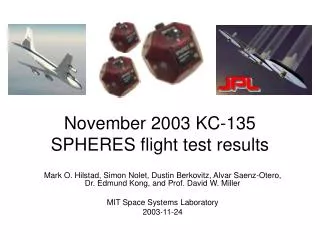
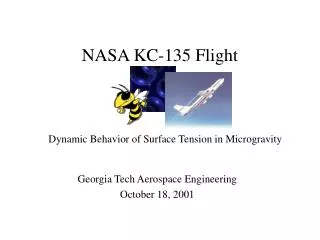
NASA KC-135 Flight Georgia Tech Aerospace Engineering October 18, 2001 Dynamic Behavior of Surface Tension in Microgravity
NASA’s Reduced Gravity Student Flight Opportunities (RSGFO) Program College and high school students submit scientific experiment proposals If selected, fly experiment aboard KC-135 What is the KC-135? • KC-135 Weightless Wonder • a.k.a the “Vomit Comet” • Flies in parabolas to simulate weightlessness • Used primarily for astronaut training
Our Experiment Dynamic Behavior of Surface Tension in Microgravity • Basic idea • View the dynamic motion of liquids of varying surface tension in zero-g • Objectives • Determine the frequency at which liquids oscillate • Determine a dampening effect
Experimental Setup • Liquids used Water, water and soap, milk, olive oil, and Jello • Liquid deployment Popped balloons with needles • Liquid Containment Housed in a sealed container with access by gloves
Pre-Flight • Test Readiness Review • Lectures • Chamber Ride Taken to simulated altitude of 25,000 ft to experience hypoxia • Tours of NASA
Flight Day 1 • Flyers • Robbie Coffman • Daniel Uhlig • Tested • Balloon size • Found • Large balloons popped the best
Flight Day 2 • Flyers • Courtney Spells • Alisa Hawkins • Tested • Liquids of different surface tension
Plane Motion Variables: a – acceleration t – time v – velocity g – gravity y – position What shape must the plane’s trajectory be in order to match the acceleration of gravity? Equations of Motion: a = -g ∫ a dt = - ∫ g dt ∫ a dt = - g ∫ dt v = - gt + Vo ∫ v dt = - g ∫ (t + Vo)dt y = -gt2/2 + Vo t + yo