Protecting Individual Liberties: Freedom of Expression and Its Limits
This chapter explores the essential right to freedom of expression, balancing individual liberties with the necessity of national security. It discusses landmark cases like Schenck v. U.S. and examines the limits of symbolic speech. The text covers the criteria for lawful restrictions on speech, including the concepts of imminent lawless action, libel and slander, obscenity, and the implications of the Establishment and Free Exercise Clauses. It also addresses critical topics like abortion rights and surveillance measures under the U.S. Patriot Act, emphasizing the ongoing tension between individual freedom and government authority.

Protecting Individual Liberties: Freedom of Expression and Its Limits
E N D
Presentation Transcript
Civil Liberties Chapter 4: Protecting Individual Liberties
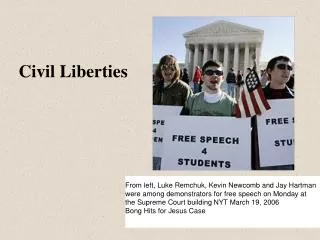
Freedom of Expression • The right of an individual to hold and communicate views of their choosing. • EXCEPT: • Endangers national security • Wrongly damages the rep of others • Deprives others of basic freedom.
Schenck v. U.S. (1919) • 1917 Espionage Act Upheld. Schenck could not distribute antiwar leaflets. • Congress can restrict speech that was “of such a nature as to create a clear and present danger” to the nation’s security.
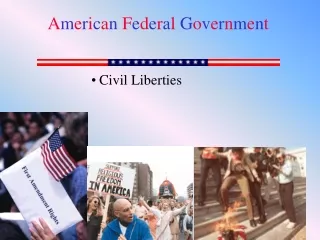
Does the government allow this? • Can you burn an American flag? • Can I fly the stars and bars? • Can the KKK march in public? • Content-neutral restrictions: Time, manner, place.
Imminent Lawless Action • When words cause others to engage in lawless action. • Before government can lawfully prevent a speech or rally, it must demonstrate that the event will cause harm and also must demonstrate the lack of alternative ways to prevent the harm from happening.
Libel and Slander • Libel: False info that greatly harms a person’s reputation is published. • Slander: If it is spoken
Obscenity • Roth v. United States (1957) • “Taken as a whole…” is there any “redeeming social value?” • This was to be judged by “the average person, applying contemporary community standards.” • Who is the “average person?” • What community? • Public v. Private
Religion • Establishment Clause: • Government may not favor one religion over another or support religion over no religion. • Engel v. Vitale (1962): Banned prayer in public schools. • Prayer at football games? • Ten commandments at Courthouse? • Statue installed half-century earlier • Paid by nonreligious group
Free-exercise clause • Americans are free to believe what they want. However, are not always free to act on their beliefs. • Child with life-threatening illness? Parent’s beliefs are to refuse medical attention.
Abortion • Roe v Wade (1973): gave women full freedom to choose abortion during the first three months of pregnancy. • Prohibit the use of government funds for abortion? • Planned Parenthood v. Casey (1992): principle upheld that women have right to abortion. • State can impose regulations that do not place an “undue burden” on women seeking an abortion.
Surveillance of Suspected Terrorists • U.S. Patriot Act: • Wiretapping • Information from intelligence surveillance could be shared with criminal investigators; even without suspected terrorist connections. • Increased authority to examine medical, financial, and student records. • In specific situations, could secretly search homes and offices. • War-time Powers? Tapping phone lines for international calls?