Simulations of Shocks in Galaxy Clusters: Insights for ALMA Observations
This workshop presentation discusses the simulations of shocks in galaxy clusters and their implications for ALMA observations. It covers observational data from notable clusters like Coma and the bullet cluster, emphasizing 3D FLASH simulations. Key topics include the Rankine-Hugoniot jump conditions, gas dynamics, and the role of processes such as thermal viscosity and turbulence in cluster gas. The presentation aims to understand and model these shocks for precise cosmology, highlighting the importance of achieving arc-second resolution in observations.

Simulations of Shocks in Galaxy Clusters: Insights for ALMA Observations
E N D
Presentation Transcript
ALMA Users Workshop 8 February, 2010 Sándor M. Molnár, Patrick Koch Institute of Astronomy and Astrophysics, Academia Sinica, Taipei, Taiwan PART II Simulations of ShocksinClusters of Galaxies
Collaborators for FLASH Simulations: Nathan Hearn (Univ. of Chicago) Joachim Stadel (Univ. of Zurich)
Outline • I. Shocks in Clusters of Galaxies: Observations • II. Shocks in Clusters of Galaxies: FLASH 3D Simulations • III. Applications to ALMA: work in progress • IV. Summary
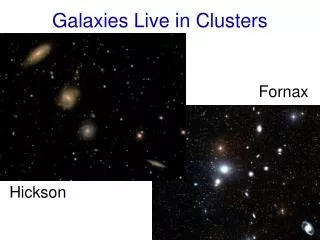
Coma Cluster of Galaxies (z=0.025, 2x10¹⁵ M⦿); optical image (Kitt Peak National Observatory).
The bullet cluster: 1E0657-56: Mach ~ 3; Markevitch & vikhlinin (2007); Clowe et al. (2006).
Shocks in Clusters of Galaxies • Rankine-Hugoniot jump conditions ρ2 / ρ1 = (γ+1) M12 / ((γ-1) M1 2 +2) P2 / P1 = 1 + 2 γ (M12 -1)/ (γ+1) T2 / T1 = (1+γ (2 M12 -1))(2+(γ-1) M12)/((γ+1)2 M12)M1 = ( 2 r / (γ + 1 – r (γ-1) )-1 Compression: r = ρ2 / ρ1
FLASH Simulations of clusters of galaxies total mass: 1014 M⦿ - 1015 M⦿ • dark matter NFW from Navarro at el. (1997):ρgas ~ ( r/rs )-1 (1 + r/rs)-2 R < Rcut σrfrom Lokas & Gamon (2001) • ICG model • density: β model: ρ ~ (1 + r2/r2core)-3β/2 R < Rcut • temperature: from hydrostatic equilibrium • previous simulations: GADGET2 (SPH): Springel & Farrar (2007); GASOLINE (SPH): Mastropietro & Burkert (2008); FLASH 2D: Milosavljevic et al. (2007) FLASH 3D: ZuHone et al. (2009a, b)
FLASH Simulations of clusters of galaxies • Simulations for high resolution SZ-X-ray observations: RXJ1347
High-resolution multi-wavelength observations of RXJ1347 • (Mason et al. 2010; submitted to ApJ.)
FLASH 3D simu- • lations for RXJ1347 • (Molnar et al. 2010; • in prep.)
Why arc second resolution? • To understand the physics of the cluster gas: • The role of transport proceses Thermal viscosity Conduction • Turbulence • Magnetic fields • Can we model clusters well enough to do precision cosmology? • Example: arc second resolution in X-ray: • Turbulent intra-cluster gas with disturbed struct. • shock physics: below the Coulomb mean free path • Arc sec SZ (ALMA) • Accurate pressure distribution: same as X-ray resol.
Work in progress • Accretion shocks in clusters of galaxies: hard to observe but important (Molnar et al 2009) • Merger shocks in clusters of galaxies: CASA simulations based on images from FLASH 3D simulations
IV. Summary • Arc minute scale: Clusters of galaxies for cosmology • numbers counts • scaling relations (e.g., AMiBA) • Few arc second to (sub)arc second: Cluster physics • 10 arc second: shock features appear (e.g., Mustang) • 1 arc second: detailed maps comparable to X-ray (ALMA)