Early Learning Curriculum Guide for Early Education
0 likes | 1 Vues
guide to early childhood education approaches, curriculum methods, and developmentally appropriate learning strategies for young children.


Early Learning Curriculum Guide for Early Education
E N D
Presentation Transcript
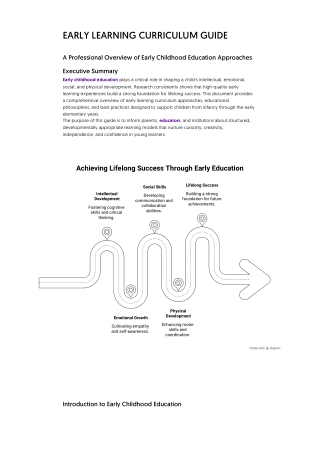
EARLY LEARNING CURRICULUM GUIDE A Professional Overview of Early Childhood Education Approaches Executive Summary Early childhood education plays a critical role in shaping a child’s intellectual, emotional, social, and physical development. Research consistently shows that high-quality early learning experiences build a strong foundation for lifelong success. This document provides a comprehensive overview of early learning curriculum approaches, educational philosophies, and best practices designed to support children from infancy through the early elementary years. The purpose of this guide is to inform parents, educators, and institutions about structured, developmentally appropriate learning models that nurture curiosity, creativity, independence, and confidence in young learners. Achieving Lifelong Success Through Early Education Lifelong Success Social Skills Intellectual Development Building a strong foundation for future achievements. Developing communication and collaboration abilities. Fostering cognitive skills and critical thinking. Physical Development Emotional Growth Enhancing motor skills and coordination. Cultivating empathy and self-awareness. Introduction to Early Childhood Education
Early childhood education refers to structured learning experiences provided to children from birth to approximately eight years of age. During this stage, brain development occurs rapidly, making it a crucial period for cognitive growth, language acquisition, emotional regulation, and social skill development. Unlike traditional academic models that emphasize memorization, early learning curriculums focus on exploration, play, hands-on activities, and guided discovery. These approaches promote meaningful engagement and encourage children to become active participants in their own learning process. Core Objectives of Early Learning Curriculums Effective early education programs are built around holistic development. The primary objectives include: • Strengthening cognitive and problem-solving abilities • Developing communication and language skills • Encouraging emotional intelligence and empathy • Building physical coordination and motor skills • Fostering creativity and imagination • Promoting independence and self-confidence A well-balanced curriculum ensures that academic readiness develops naturally through engaging, age-appropriate experiences. Foundations of Early Learning Emotional Intelligence Physical Coordination Cultivating empathy and understanding of Improving motor skills and physical abilities emotions Communication Skills Creativity Developing effective verbal and non-verbal communication Fostering imagination and artistic expression Cognitive Development Independence Enhancing problem- solving and critical thinking skills Promoting self-reliance and confidence Early Learning Curriculums Key Early Learning Approaches Several established educational philosophies guide early childhood curriculum design. Each offers unique principles while sharing a commitment to child-centered development. Montessori Approach
This method emphasizes independence, self-directed learning, and hands-on exploration. Children use specially designed materials that encourage concentration, responsibility, and problem-solving skills. Play-Based Learning Play serves as the primary vehicle for learning. Through imaginative and social play, children develop language skills, cooperation, creativity, and emotional regulation. Reggio-Inspired Philosophy This approach promotes collaborative, project-based exploration. Children express ideas through art, discussion, and hands-on discovery, encouraging critical thinking and communication. Waldorf Education Waldorf programs integrate storytelling, artistic expression, rhythm, and nature-based activities to nurture creativity and balanced development. HighScope Model HighScope focuses on active participatory learning where children plan, execute, and review activities, building decision-making skills and independence. Many modern programs blend elements from multiple approaches to create flexible, adaptive learning environments. Key Early Learning Approaches Independence Montessori Approach Self-Directed Learning Hands-On Exploration Language Skills Play-Based Learning Cooperation Creativity Art Reggio-Inspired Philosophy Key Early Learning Approaches Discussion Discovery Storytelling Waldorf Education Artistic Expression Nature-Based Activities Planning HighScope Model Execution Review
Curriculum Design Principles A high-quality early learning curriculum is structured yet flexible. Essential design principles include: • Developmentally appropriate practices • Structured daily routines for emotional security • Opportunities for guided and independent exploration • Inclusive and supportive learning environments • Continuous observation and assessment to support growth The learning environment plays an equally important role. Classrooms and home learning spaces should be organized, safe, and filled with open-ended materials that encourage creativity and independence. Role of Parents and Educators Parents and educators work collaboratively to support early learning. While structured programs provide guidance, everyday experiences also contribute significantly to development. Effective support strategies include: • Encouraging daily reading and storytelling • Creating consistent routines • Allowing time for free play • Supporting curiosity through open-ended questions • Providing opportunities for creative expression A partnership between families and educators strengthens the child’s overall development and learning outcomes. ?u??o??i?? ?a??y ?e??n??g ?t??c???e? ?r??r??s ?ff?c??v? ?t??t??i?? ?n??i?? ?v??y??y ?x??r???c?? ?v??a?? ?e??l??m??t ?e??l??m??t ?u??a??e ?r?? ?d??a??r? ?n? ?u??i??l?? ?e??i??, ?o??i??s? ?r?? ?l??, ?u??o???y? ?r??t??i?? ?h??d ?e??n???g ?o ?e??n ?n? ?r?? ?a??y ?n??r??t??n? ?n? ?c??v??i?? ?t??n??h??e? ?e??n??g ?u??o??s Benefits of Quality Early Education Research-based early learning programs contribute to: • Improved school readiness • Stronger social relationships
• Enhanced emotional resilience • Higher levels of creativity and innovation • Increased long-term academic achievement Children who experience supportive early education environments are more likely to develop positive learning habits and strong self-esteem. Conclusion Early childhood education establishes the groundwork for lifelong growth and achievement. A thoughtfully designed curriculum nurtures the whole child — intellectually, socially, emotionally, and physically. By adopting developmentally appropriate strategies and fostering engaging learning environments, families and educators can empower children to become confident, capable, and curious individuals prepared for future success.