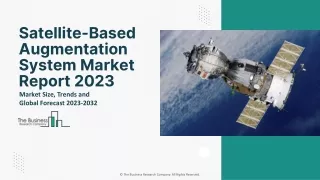
Ground Based Augmentation System Market
The global Ground Based Augmentation System market was valued at approximately USD 800 million in 2024 and is projected to reach USD 1.5 billion by 2032. This growth reflects a compound annual growth rate (CAGR) of 8.3% from 2025 to 2032

Ground Based Augmentation System Market
E N D
Presentation Transcript
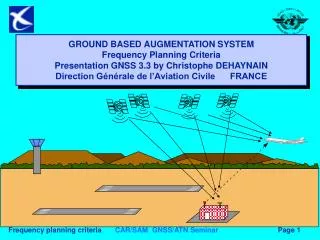
Ground Based Augmentation System Market Set for Significant Growth Amid Advancements in Air Traffic Control Introduction The global Ground Based Augmentation System (GBAS) market is witnessing remarkable growth, driven by technological advancements and the increasing need for enhanced precision in air traffic management. GBAS plays a pivotal role in augmenting the global navigation satellite systems (GNSS) by providing more accurate and reliable signals for aircraft landing, navigation, and position determination. This system is essential for improving airport safety, optimizing air traffic control, and supporting the development of advanced airport systems. With the continuous rise in air traffic and the expansion of airports worldwide, the demand for efficient and reliable systems like GBAS is steadily increasing. The market is also benefiting from the growing trend toward modernization in the aviation industry, particularly in the wake of global recovery post-pandemic. This press release from Market Intelo offers a detailed analysis of the current trends, market size, growth drivers, and future prospects of the GBAS market. Get Sample Report of Ground Based Augmentation System Market @ https://marketintelo.com/request-sample/47199 Market Overview The global Ground Based Augmentation System market was valued at approximately USD 800 million in 2024 and is projected to reach USD 1.5 billion by 2032. This growth reflects a compound annual growth rate (CAGR) of 8.3% from 2025 to 2032. The increasing number of airports adopting advanced navigation and control systems, as well as the rapid development of airport infrastructure globally, is fueling the market's expansion. The GBAS market is primarily driven by the need for enhanced safety and operational efficiency in the aviation sector. Traditional navigation systems, such as Instrument Landing Systems (ILS), are being replaced or augmented with more advanced solutions like GBAS. This shift is largely due to the system's cost-effectiveness, ease of installation, and ability to provide precise navigation data in all weather conditions, improving both landing safety and the capacity of airports. Get Sample Report of Ground Based Augmentation System Market @ https://marketintelo.com/request-sample/47199 Market Drivers and Challenges Several factors contribute to the strong growth of the GBAS market. First and foremost, the increasing demand for air travel has placed substantial pressure on airport authorities and air traffic control systems to enhance efficiency and minimize delays. The adoption of GBAS
allows airports to optimize air traffic flow, reduce congestion, and improve overall operational efficiency by enabling safer and more accurate landings. The environmental benefits of GBAS are also driving its adoption. Unlike traditional ground- based navigation systems that require significant infrastructure and maintenance, GBAS leverages satellite-based technology to provide accurate guidance without the need for additional ground infrastructure. This reduces operational costs and minimizes the environmental footprint of air travel. However, the market is not without its challenges. The high initial investment costs of installing GBAS infrastructure, along with regulatory hurdles in some regions, can act as a barrier to entry for some airports. Moreover, the slow pace of regulatory approvals and standardization processes across global markets may further hinder the widespread adoption of GBAS in the short term. Read Full Research Study: https://marketintelo.com/report/ground-based-augmentation- system-market Technological Advancements in GBAS The GBAS market is experiencing rapid technological innovations that are helping enhance the accuracy and reliability of air navigation systems. The latest systems provide high- precision landing capabilities, reducing the reliance on older systems like ILS and enabling airports to support larger volumes of traffic safely and efficiently. A key technological advancement is the integration of GBAS with other airport systems such as Automatic Dependent Surveillance-Broadcast (ADS-B), which allows for real-time tracking of aircraft and provides an additional layer of situational awareness for air traffic controllers. Additionally, ongoing research in areas like ionospheric corrections and signal interference mitigation is further improving the overall performance and reliability of GBAS, making it even more attractive for airports looking to modernize their air traffic control systems. Moreover, the increasing focus on unmanned aerial vehicles (UAVs) and urban air mobility (UAM) solutions is pushing the boundaries of GBAS technology. As these new types of aircraft become more prevalent, the role of GBAS in providing reliable navigation support in non-traditional airspace is becoming ever more critical. Regional Market Insights North America currently dominates the Ground Based Augmentation System market, accounting for over 35% of total revenue in 2024. This dominance is driven by the large number of airports adopting advanced aviation systems, coupled with substantial investments in airport infrastructure modernization. The U.S. Federal Aviation Administration (FAA) has been a key proponent of GBAS technology, which has further encouraged its adoption across the country.
Europe follows closely, with countries like Germany, France, and the UK leading the way in the adoption of advanced navigation and landing systems. The European Union's commitment to aviation safety and efficiency has also accelerated the deployment of GBAS technology at airports across the continent. Asia-Pacific, however, is expected to exhibit the highest growth rate during the forecast period, primarily driven by the rapidly expanding aviation sectors in countries like China, Japan, and India. As air travel demand surges in this region, the need for advanced air traffic management systems is becoming more pressing, positioning GBAS as a key enabler of future growth. Competitive Landscape The Ground Based Augmentation System market is competitive, with key players focusing on technological innovation, strategic partnerships, and expanding their market presence through regional collaborations. Leading companies in the market include Honeywell International, Thales Group, Raytheon Technologies, and Indra Sistemas, among others. These players are investing heavily in research and development to improve the accuracy, reliability, and cost-effectiveness of their GBAS solutions. Collaborations with airport authorities and government agencies are also playing a significant role in driving the adoption of GBAS technology. Partnerships with airlines and ground service providers are allowing manufacturers to tailor their solutions to meet the specific needs of different regions and market segments. Market Segmentation The market is segmented based on technology, application, and region. By technology, the market is divided into GNSS-based GBAS, which uses satellite signals for navigation, and hybrid GBAS, which combines satellite-based technology with traditional systems to provide greater redundancy. In terms of application, the market is divided into civil aviation and military aviation sectors, with the civil aviation segment accounting for the largest market share. This is due to the widespread use of GBAS in commercial airports for improving landing accuracy and air traffic management. Future Outlook Looking ahead, the Ground Based Augmentation System market is expected to continue growing as airports around the world modernize their infrastructure to meet the demands of increasing air traffic. The system's ability to reduce operational costs, improve landing safety, and minimize environmental impact will continue to drive its adoption. The future of GBAS is closely tied to advancements in satellite-based technologies and the growing need for reliable, high-precision navigation systems. With ongoing investments in
research and development, the market is likely to see even greater integration with next- generation airport systems, including autonomous aircraft systems and advanced traffic management solutions. Related Report •https://dataintelo.com/report/global-solder-paste-and-flux-market •https://dataintelo.com/report/global-barrier-arm-market •https://dataintelo.com/report/global-drones-for-logistics-market •https://dataintelo.com/report/global-fabric-cleaning-machine-market •https://dataintelo.com/report/global-nickel-briquettes-market •https://dataintelo.com/report/global-headsets-for-pc-market •https://dataintelo.com/report/global-two-stroke-oil-market •https://dataintelo.com/report/global-well-logging-service-market •https://dataintelo.com/report/global-automatic-water-pump-controllers-market •https://dataintelo.com/report/global-bio-fet-market •https://dataintelo.com/report/global-remote-launcher-market •https://dataintelo.com/report/global-access-control-keyboard-market •https://dataintelo.com/report/global-container-vans-market •https://dataintelo.com/report/global-housekeeping-storage-service-market •https://dataintelo.com/report/global-pelican-hook-market •https://dataintelo.com/report/global-ultrasonic-receiver-market •https://dataintelo.com/report/global-silicon-carbide-susceptor-market •https://dataintelo.com/report/global-variable-speed-vane-pump-market •https://dataintelo.com/report/global-indigotine-market •https://dataintelo.com/report/global-internal-floating-roof-market









![Satellite-based GNSS Augmentation System Market: [2023-2035]](https://cdn7.slideserve.com/12311638/satellite-based-gnss-augmentation-system-market-dt.jpg)