SlideServe
Menu
Préférences
© SlideServe · v2026

GROUND BASED AUGMENTATION SYSTEM Presentation Overview

dinh avatar
14 diapositives · 372 Views · Oct 01, 2014

GROUND BASED AUGMENTATION SYSTEM Frequency Planning Criteria Presentation GNSS 3.3 by Christophe DEHAYNAIN Direction Générale de l’Aviation Civile FRANCE. GROUND BASED AUGMENTATION SYSTEM Presentation Overview. GBAS principle Why do we need frequency planning criteria ?
GROUND BASED AUGMENTATION SYSTEM Presentation Overview - slide 1
01 / 14GROUND BASED AUGMENTATION SYSTEM Presentation Overview
1 / 17

Télécharger la présentation

GROUND BASED AUGMENTATION SYSTEM Presentation Overview
Une image / un lien ci-dessous est fourni (tel quel) pour télécharger la présentation

Politique de téléchargement : le contenu du site vous est fourni TEL QUEL pour votre information et votre usage personnel ; il ne peut être vendu, concédé sous licence ni partagé sur d’autres sites sans l’accord de son auteur.Le contenu vous est fourni TEL QUEL, pour votre information et votre usage personnel uniquement. Téléchargez la présentation en cliquant sur ce lien. Lors du téléchargement, si vous ne parvenez pas à télécharger une présentation, l’éditeur a peut-être supprimé le fichier de son serveur.Pendant le téléchargement, si vous ne parvenez pas à obtenir une présentation, le fichier a peut-être été supprimé par l’éditeur.

F I N

Plus de contenu associé

Transcription de la présentation
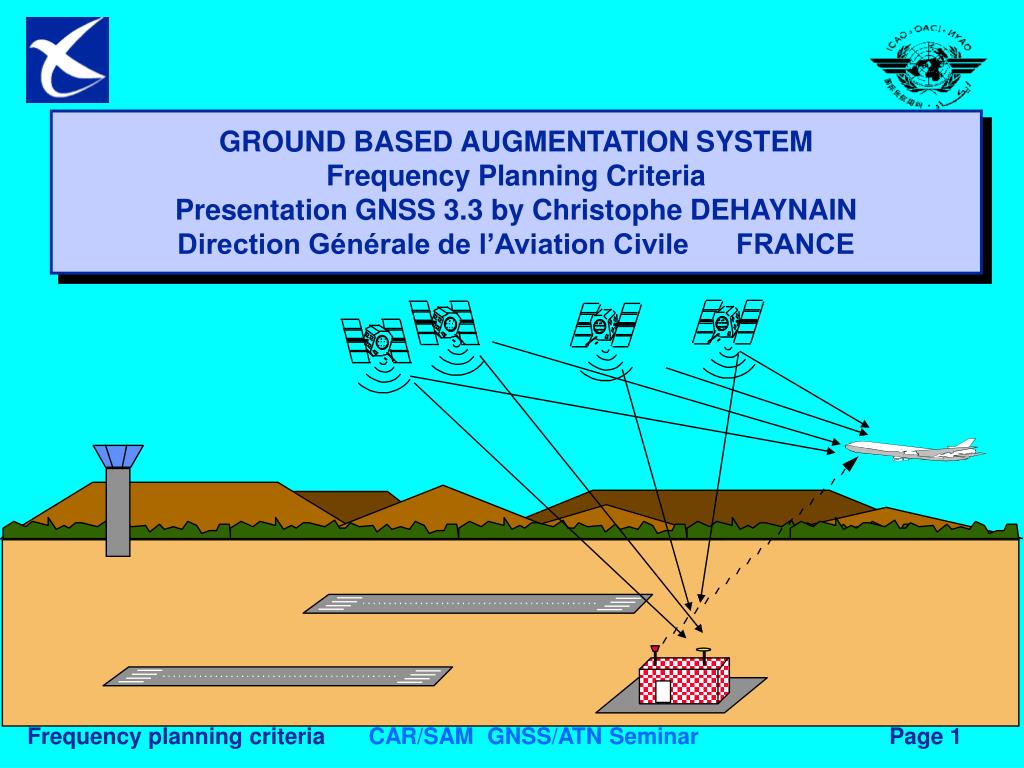
  1. GROUND BASED AUGMENTATION SYSTEMFrequency Planning CriteriaPresentation GNSS 3.3 by Christophe DEHAYNAIN Direction Générale de l’Aviation Civile FRANCE

  2. GROUND BASED AUGMENTATION SYSTEMPresentation Overview • GBAS principle • Why do we need frequency planning criteria ? • How the ICAO criteria have been established ? • What are the current criteria ? • What has still to be done ?

  3. GBAS principle • The Ground Based Augmentation System is composed of 3 segments : • the space segment (GPS, GLONASS, GALILEO satellites) • the ground segment (GBAS ground station) • the airborne segment (the users equipment)

  4. GBAS principle • Objective of the Data Link: • interface between the ground and the airborne segments • Type of transmitted information: • Pseudo Range Corrections (high rate) • Integrity parameters (,B values) (high rate) • Final Approach Segments description (low rate)

  5. ICAO GNSSP choice • ICAO GNSS Panel validated in June 2000 the VHF D8PSK data Link among five considered options : • VHF Nav. 108-117.975 MHz • D8PSK modulation • GFSK modulation • DME UHF band (960-1215 MHz) • GPS L1 band (1575.42 MHz) • C band (5030-5150 MHz)

  6. ICAO GNSSP choice • VHF Navigation band (108-117.975 MHz) • 25 KHz channel spacing • horizontal polarisation (possibility to have vertical also) • D8PSK modulation • 31.5Kbit/s rate • TDMA (Time Division Multiple access) : 8 slots per 0.5 s frame

  7. Why do we need frequency planning criteria ? • GBAS Data Link will use Navigation VHF Band frequencies (108 - 118 MHz) • This frequency band is already used for VOR and ILS localizer assignations • GBAS, ILS and VOR will coexist during a transition phase • The three services need to be protected from mutual interference

  8. How the ICAO criteria have been established ? • Determination of minimum Desired/Undesired signal ratio at which VOR receiver is jammed by GBAS transmission on co- and adjacent channels (and vice- versus) • Use of the GNSS SARPS to determine the minimum Desired/Undesired signal ratio at which GBAS is jammed by VOR or GBAS transmission on co- and adjacent channels • Computation of minimum geographical distance between co- and adjacent VOR/GBAS and GBAS/GBAS channels transmitters

  9. Determination of minimum Desired/Undesired signal ratio at which VOR receiver is jammed by GBAS transmission on co- and adjacent channels VOR/ILS desired signals VOR/ILS receiver under test ILS/VOR indicator VDB undesired signals

  10. Computation of minimum geographical distance between co- and adjacent VOR/GBAS channels transmitters Dw VOR protected volume GBAS protected volume Dvor DGBAS GBAS VOR Dac Minimum separation

  11. Computation of minimum geographical distance between co- and adjacent VOR/GBAS channels transmitters (2) Dac, Dw in km Fdoc in microvolts/meter

  12. What are the current criteria for VOR to GBAS separation ?

  13. What are the current criteria for GBAS to GBAS separation ?

  14. What has still to be done ? • Compatibility criteria for • ILS Localizer and GBAS in the band 108 - 112 MHz have still to be defined (ICAO objectives : 2004-2005) • VHF AM Communications and GBAS have still to be defined (ICAO objectives : 2004-2005) • VHF VDL Mode 4 and GBAS have still to be defined (ICAO objectives : 2004-2005) • Compatibility criteria for elliptical polarised GBAS signals need to be defined (No ICAO plan) • Before these criteria are defined, GBAS Data-link frequencies have to be assigned in a limited band (112.025 - 116.400 MHz)