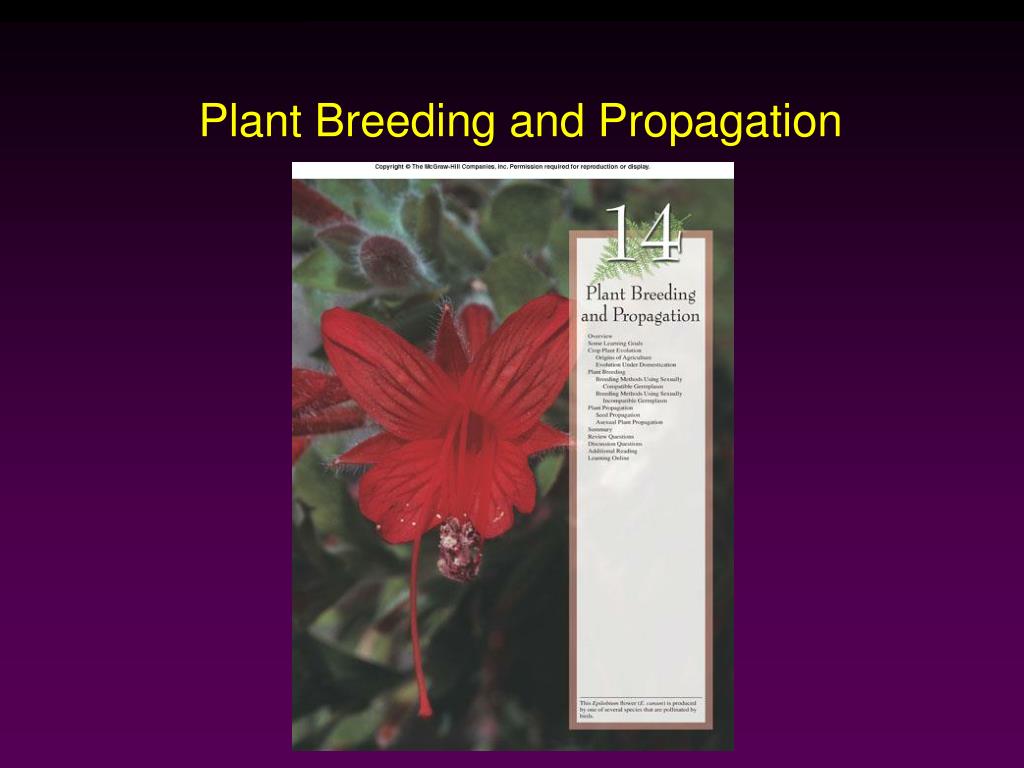
Plant Breeding and Propagation
Outline • Crop Plant Evolution • Plant Breeding • Sexually Compatible Germplasm • Sexually Incompatible Germplasm • Bacterial Gene Cloning • Transgenic Plants • Seed Propagation • Asexual Plant Propagation
Crop Plant Evolution • Approximately 200,000 species of flowering plants. • Six species provide 80% of calories consumed by humans worldwide. • Wheat, Rice, Corn, Potato, Sweet Potato, and Cassava. • Eight additional plants complete the list of major crops grown for human consumption. • Sugar Cane, Sugar Beet, Bean, Soybean, Barley, Sorghum, Coconut, and Banana.
Origins of Agriculture • First plants were domesticated in the Near East around 10,000 years ago. • Root crops and legumes were domesticated 2,000-3,000 years ago. • Plants for forage, decoration, and drugs were first domesticated about 2,000 years ago.
Regions of Domestication
Plant Breeding • Plant breeding is accelerated evolution guided by humans rather than nature. • Breeders replace natural selection with human selection to modify plant genetics. • Primary goal of plant-breeding programs is commonly improved yield. • Disease resistance, pest resistance, and stress tolerance contribute to yield.
Plant Breeding • Strategies • Self-Pollination - Plants are capable of fertilizing themselves. • Tend to be highly homologous. • Significant inbreeding • Wheat, Rice, Peas, Tomatoes • Pure-Line Selection - Collecting seeds from several plants, growing seeds from an individual plant in a row, and then selecting the most desirable row.
Plant Breeding • Cross-Pollination - Plants must be fertilized from other individuals. • Tend to be highly heterozygous. • Corn, Rye, Alfalfa and most Fruit. • Mass Selection - Many plants from a population are selected, and seeds from these plants are then used to create the next generation. • Seeds from the best are used to create the next generation.
Plant Breeding Using Sexually Compatible Germplasm • Outcrossing in cross-pollinated crops often results in hybrid vigor (heterosis). • Cross-pollinated plants tend to exhibit inbreeding depression. • Modern breeders cross pollinate to delete deleterious alleles. • Heirloom Varieties are grown as open-pollinated populations. • Genetic variability allows crop production under different environmental conditions.
Germplasm Collection and Gene Banks • A plant’s germplasm is the sum total of its genes. • Current agricultural varieties are often genetically uniform, and thus may not be good sources of genetic variability. • Gene Banks have been established to meet current and future demands of plant genetic diversity. • Seeds or other propagules are put into long-term storage.
Plant Breeding Using Sexually Incompatible Germplasm • Protoplast Fusion • Cells of each species are grown in a liquid nutrient solution. • Cell walls are chemically stripped to produce protoplasts. • Protoplasts of two species are mixed together and stimulated with the aid of an electric current or chemical solution, to fuse with each other. • Few successes
Plant Breeding Using Sexually Incompatible Germplasm • Gene Splicing and Transgenic Plants • Transgenic Plants are produced by inserting genes from one plant into another. • Recombinant DNA • Restriction Enzymes cut DNA into fragments with sticky ends.
Plant Breeding Using Sexually Incompatible Germplasm • Plasmids are commonly used as cloning vectors. • Small circular bacterial DNA. • After cloning, the gene is inserted into plant cells via transformation. • Agrobacterium tumefaciens • Particle Guns
Bacterial Gene Cloning
Bacterial Gene Cloning
Making A Transgenic Plant
Transgenic Plants • Pros • Transgenic crops are often environmentally friendly. • Farmers can use fewer pesticides. • Cons • Effect on non-target organisms, such as insects, in the food web. • Movement of herbicide resistance to weeds.
Seed Propagation • Hybrid varieties are often grown from seed produced by crosses between two inbred parents. • Inbred line varieties are typically grown from seed and allowed to self-pollinate. • Mature seeds are harvested and stored in a controlled environment. • Viability is best when seeds are maintained in cool, dry storage.
Seed Propagation • In preparation for planting, seeds may be dusted with a protectant, such as a fungicide. • Seeds must be planted in a suitable bed. • Moist soil to allow seeds to imbibe water. • Dry enough to maintain suitable oxygen levels.
Asexual Plant Propagation • Cuttings • Produce adventitious roots. • Cells near the wound must dedifferentiate and create a new meristematic region. • Layering • Tip Layering - Bend tips until they touch the ground, and then cover them with soil. • Air Layering - Wounding or Girdling to produce roots.
Cuttings and Air Layering
Cuttings and Air Layering
Asexual Plant Propagation • Grafting • Segments of different plants are connected and induced to grow together as one plant. • Scion - Top section of a graft. • Rootstock - Bottom section of a graft. • Successful grafting depends on good contact between the vascular cambium of the scion and that of the rootstock.
Asexual Plant Propagation • Micropropagation • Grow and maintain plants in a disease-free status in test tubes. • Grown in-vitro in sterile medium. • Relies on totipotency of plant cells. • Capacity of a cell to give rise to any structure of a mature organism.
Asexual Plant Propagation • Micropropagation usually begins with the establishment of an explant in tissue culture. • Plant parts are disinfested. • Induced to develop multiple shoots. • Microshoots separated and placed in a new medium by subculturing. • Root Formation • Transfer plants back to outdoor environment.
Review • Crop Plant Evolution • Plant Breeding • Sexually Compatible Germplasm • Sexually Incompatible Germplasm • Bacterial Gene Cloning • Transgenic Plants • Seed Propagation • Asexual Plant Propagation
Copyright © McGraw-Hill Companies Permission Required for Reproduction or Display