Understanding Decision Trees and Random Forest Models
We are going to deconstruct the Decision Tree functionality in this blog, explain why a Random Forest is better than most single-task models, and show what you can achieve by practicing them practically.


Understanding Decision Trees and Random Forest Models
E N D
Presentation Transcript
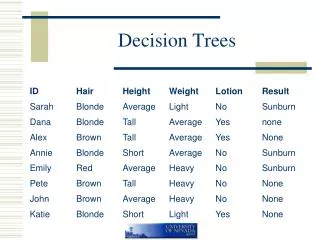
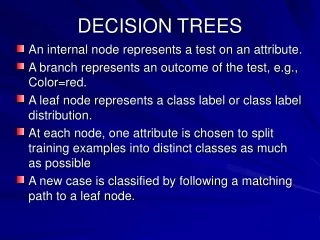
Understanding Decision Trees and Random Forest Models Introduction: Machine Learning (ML) remains at the forefront of industry redesign, enabling smarter decision-making, predictive analytics, and automation. Decision Trees and Random Forests are among the numerous ML algorithms currently used due to their simplicity, interpretability, and high performance worldwide. Be it your first step into ML, or you intend to upgrade your skills by enrolling in the best data science course in Bangalore, a sound knowledge of the two models could put you in a solid position in predictive modelling. We are going to deconstruct the Decision Tree functionality in this blog, explain why a Random Forest is better than most single-task models, and show what you can achieve by practicing them practically. These concepts are mandatory for interviews, projects, and real-time analytics, if you are undertaking the best data science course in Bangalore or elsewhere. What Are Decision Trees? A Decision Tree is a supervised machine learning algorithm that can be applied to classification and regression. It emulates the human decision-making process by decomposing a problem into simple, rule-based steps. Imagine it as a flow diagram with the internal nodes representing the features, the branches representing the choices, and the leaf nodes representing the results. Why Decision Trees Are Popular: The decision trees are mostly embraced because they are: ● User-friendly - even to non-technical audiences. ● Flexible - able to deal with data that is numerical and categorical. ● Non-linear - infer sophisticated patterns in data. ● Model-agnostic: does not require much data preprocessing. ● Transparent - Transparent relationships are interpretable, yet not explainable.
How Decision Trees Work: Step-by-Step: 1. The model is divided into subsets using a feature whose information gain or impurity is the highest or lowest among all features. 2. It keeps splitting until it meets some stopping criterion, such as depth limit, pure nodes, or minimum samples. 3. The last leaf node presents the prediction. Important Concepts Behind Decision Trees: ● Entropy and Information Gain(to classify) ● Gini Impurity ● Chi-square (in some variants) ● Mean Squared Error (of regression trees) Each of them facilitates the choice of the best split that enhances the model accuracy. Strengths and Weaknesses of Decision Trees: Advantages: ● Interpretable Model- It is possible to visualize and describe the trail followed by predictions. ● Processes both Text and Numbers - Mixed Data types perform best. ● No Scaling needed - No normalization or standardization required. ● Fast Training- Applicable to large datasets. Limitations: ● Tendency to Overfitting - This can be caused by a deep tree memorizing data patterns. ● Unpredictable - The slightest changes in the data can alter the entire tree. ● Weaker Accuracy - than Ensemble Algorithms- Works better in combination with other models. Introduction to Random Forests: Random Forest is an ensemble learning method that predicts using multiple decision trees. The concept is not complicated but intense: Create as many decision trees as the group can, vote on them, and take the majority.
Random Forests is one of the most accurate and reliable ML models nowadays, thanks to ensemble methods that help minimize overfitting and improve accuracy. How Random Forests Work: 1. Bootstrapping - Random subsets of the data are developed. 2. Feature Randomness - The trees are trained on random subsets of features. 3. Multiple Decision Trees - Hundreds of little trees are constructed. 4. Aggregation- The outcome is a majority vote (classification) or average (regression). Why Random Forests Are Highly Accurate: ● Reduces overfitting ● Less sensitive to noise ● Deals with missed values well. ● Deals with massive data sets with ease. ● It is effective across finance, healthcare, retail, and cybersecurity. Real-World Applications of Decision Trees & Random Forests: 1. Finance Used in loan defaults forecasting, fraud detection, credit score, and investment. 2. Healthcare Helps predict diseases, classify patients, and evaluate medical risks. 3. Retail & E-Commerce It is used in the recommendation system, customer segmentation, inventory forecasting, and purchase predictions. 4. Manufacturing Help with quality control, machine breakage prediction, and optimization of the processes. 5. Cybersecurity It identifies phishing and malware tendencies. 6. Human Resources Use in predicting attrition, candidate screening, and planning a workforce.
The most effective way of learning decision trees and random forests: Here’s an ideal learning path: 1. Understand the Theory Begin with such simple notions as entropy, information gain, Gini impurity, and ensemble methods. 2. Work on Real Datasets Try datasets such as: ● Survival problem on the Titanic. ● Classification of breast cancer. ● Credit card fraud detection ● Retail sales forecasting 3. Practice in Python Learn libraries like: ● Scikit-learn ● Pandas ● Matplotlib/Seaborn ● NumPy 4. Build Capstone Projects Establish end-to-end data cleaning, model building, hypercolonial fine-tuning, and deployment. 5. Learn from Experts Enrolling in the best data science course in Bangalore can assist you to learn through mentors, real case study work, and tighten your industry preparedness. Conclusion: The ML environment cannot do without Decision Trees and Random Forests. They are simple enough, powerful enough, and relevant to the actual world, which is why they are ideal for both novices and expert practitioners. Be it the behavior of customers, the outcome of a medical procedure, or to detection of fraud, these models perform amazingly with minimal effort.
In case you want to master ML and develop a decent portfolio, it is possible to take a data science course in Bangalore and speed up the process of learning. You will acquire practical skills required to become a competitive employee in the job market (ML) with practical hands-on projects, industry mentorship, real-world case studies, etc.