SlideServe
Menu
Préférences
© SlideServe · v2026

Quality of Life Assessment in Platinum-Resistant Epithelial Ovarian Cancer Patients

aaron-roberts avatar
15 diapositives · 386 Views · Nov 14, 2014

This study aims to evaluate the quality of life (QoL) in patients over 18 years diagnosed with platinum-resistant epithelial ovarian cancer, following up to three lines of therapy. The research will focus on the symptoms and aspects of health-related quality of life (HRQL) deemed most severe by patients. Participants will complete multiple QoL questionnaires assessing symptoms, well-being, and side effects during treatment cycles or until disease progression. Findings will inform optimal measures for QoL improvements in this patient population.
Quality of Life Assessment in Platinum-Resistant Epithelial Ovarian Cancer Patients - slide 1
01 / 15Quality of Life Assessment in Platinum-Resistant Epithelial Ovarian Cancer Patients
1 / 17

Télécharger la présentation

Quality of Life Assessment in Platinum-Resistant Epithelial Ovarian Cancer Patients
Une image / un lien ci-dessous est fourni (tel quel) pour télécharger la présentation

Politique de téléchargement : le contenu du site vous est fourni TEL QUEL pour votre information et votre usage personnel ; il ne peut être vendu, concédé sous licence ni partagé sur d’autres sites sans l’accord de son auteur.Le contenu vous est fourni TEL QUEL, pour votre information et votre usage personnel uniquement. Téléchargez la présentation en cliquant sur ce lien. Lors du téléchargement, si vous ne parvenez pas à télécharger une présentation, l’éditeur a peut-être supprimé le fichier de son serveur.Pendant le téléchargement, si vous ne parvenez pas à obtenir une présentation, le fichier a peut-être été supprimé par l’éditeur.

F I N

Plus de contenu associé

Transcription de la présentation
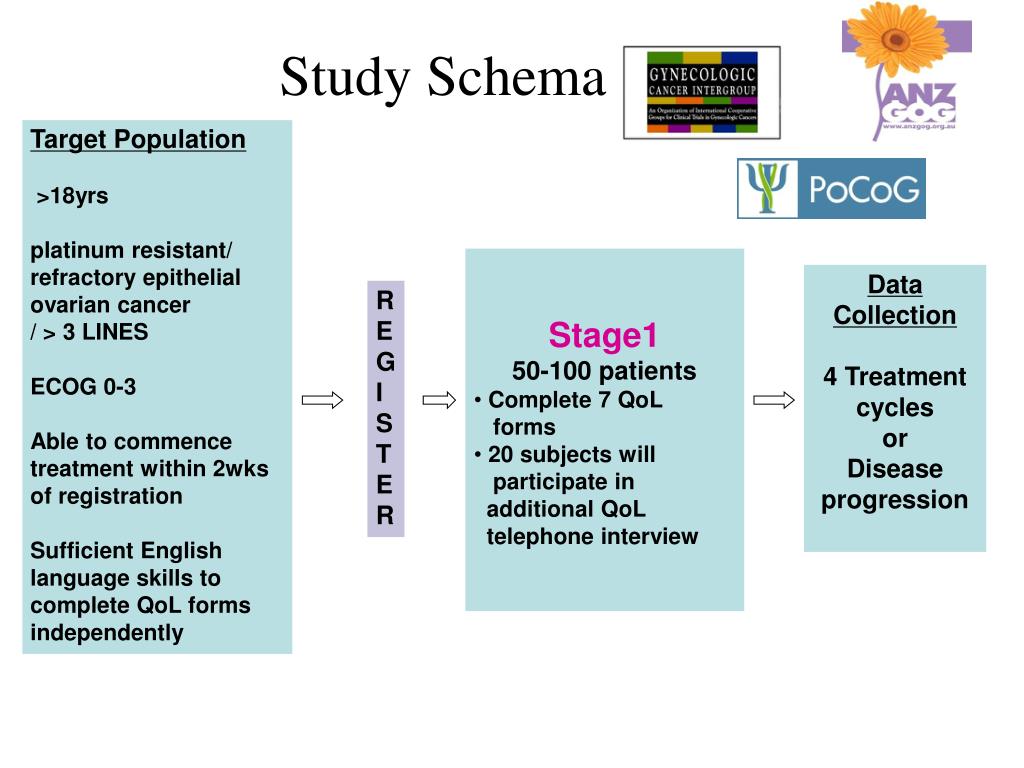
  1. Study Schema Target Population >18yrs platinum resistant/ refractory epithelial ovarian cancer / > 3 LINES ECOG 0-3 Able to commence treatment within 2wks of registration Sufficient English language skills to complete QoL forms independently • Stage1 • 50-100 patients • Complete 7 QoL • forms • 20 subjects will • participate in • additional QoL • telephone interview Data Collection 4 Treatment cycles or Disease progression REGISTER

  2. Stage 1 To Determine • The symptoms and aspects of HRQL that are rated as most severe, troublesome and important by patients. • The optimal items and questionnaires for measuring these improvements.

  3. Stage 1 QoL Questionnaires • Symptom Representation Questionnaire • FACT-O (includes FOSI) • EORTC QLQ-C30 • EORTC QLQ-OV28 • Patient Data Form • Expected and Perceived Benefit Scale • HAD Scale (Baseline & End of Treatment only) • Herth Hope Index (Baseline & End of Treatment only)

  4. Majority Platinum Resistant Compliance All questionnaires were completed to a very high compliance rate with few or no missing data

  5. Number of Lines of Prior Therapy

  6. Reasons for Starting Chemotherapy

  7. Top 3 symptoms nominated by patients at baseline- (77 patients in Stage 1)

  8. Target Population Informed consent ≥18yrs Histologically confirmed epithelial ovarian or primary peritoneal or primary fallopian tube cancers Recurrent or progressive disease ECOG 0-3 Life expectancy > 3 months Able to commence treatment within 2wks of registration Able to complete questionnaires independently R E G I S T E R • Data Collection • Baseline • Each treatment cycle • One month post completion of treatment or until disease progression • Australian patients – telephone interview Schema – Stage 2

  9. MOSTMeasure of Ovarian cancer Symptoms and Treatment concerns Modification of Patient Data Form- COVERS ALL SYMPTOMS AND ASPECTS OF QOL IDENTIFIED IN STAGE 1 and corroborated by an end of life study in 420 women with ovarian cancer Comprises of 35 individual items on a discrete scale of 0-10, where major symptomatic distress is represented by 10. The first 15 items refer to disease symptoms Items 16 and 17 refer to physical and emotional well-being whilst item 18 is a question referring to overall well-being. 19-35 deals with side effects and other concerns The study will examine the extent of clinical improvement by examining changes in these items from baseline at each time point.

  10. MOST Recent Status FormTo be administered before each cycle

  11. Translations • Statistical and Data – CTC Sydney • Contacts- Julie Martyn/Michael Friedlander