Dictatorships and Aggression in World War II: The Rise of Totalitarian States
This chapter explores the rise of totalitarian regimes in the lead-up to World War II, focusing on key figures such as Joseph Stalin in the Soviet Union and Benito Mussolini in Italy. It examines the factors that contributed to their ascent, including economic turmoil and political instability. The narrative details Adolf Hitler’s Nazi Germany, emphasizing its militarism, expansionist policies, and anti-Semitic ideology. The chapter also discusses Japan’s militarism, the concept of aggression between nations, and the significant events that catalyzed the global conflict, including the invasions of Poland and Pearl Harbor.

Dictatorships and Aggression in World War II: The Rise of Totalitarian States
E N D
Presentation Transcript
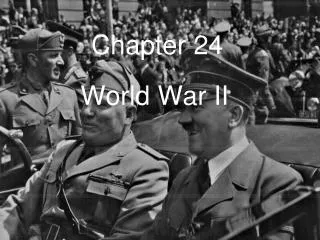
Chapter 24 World War II
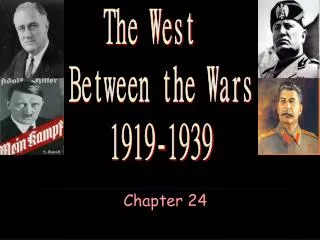
Aggression and Dictators • Communistic Dictatorships • Josef Stalin – Soviet Union • Totalitarian State – a nation in which a single party controls government and every aspect of people’s lives • Benito Mussolini – appointed prime minister after threatening to overthrow the gov’t • Turned Italy into a fascist state • Fascism: a political system based on militarism, extreme nationalism, and blind loyalty to the state and its leader (end to FoP and all other parties)
Germany • WWI frustrations • Reparations • 1921: Adolf Hitler becomes leader of National Socialist Party (Nazi) • Form of facism • Racism at the core (Anti-Semitism) • Hitler blames Jews for loss during WWI • Great Depression = Hitler as Chancellor • Outlawed parties, secret police • Jews banned from schools, med. and law professions
Japan • Militaristic state • Preached racial domination • Thought they needed more land to expand their nation
Military Aggression • Aggression – a warlike act by one country against another without cause • Japan attacks China (1931) • Army acts w/o permission • League of Nations protests but does nothing • Killed 250K+ • Italy Invades Ethiopia (1935) • League of Nations does nothing
German Aggression • Rebuilding of military against Treaty of Versailles • Sent troops into the Rhineland • Then took over Austria • Hitler threatens to invade Czechoslovakia • Fran. and Brit. Protest • Meeting in Munich • Appeasement – a policy of giving in to aggression in order to avoid war
German Aggression Cont. • Munich Pact: Hitler allowed to take over Sudetenland for not seeking any other land • Couple months later, Hitler took over the rest of Czechoslovakia
American Neutrality • Neutrality Act 1935 • Forbids the president from selling arms, making loans, or giving any form of assistance to any nation involved in a war • Good Neighbor Policy • FDR believed this would strengthen ties in Latin America • Frees Cuba • Pulls American direct influence out of Latin America
War in Europe • Sept. 1, 1939: Hitler invades Poland • Nazi-Soviet Pact • Poland split between the two • Surprises the World – WHY? • Stalin invades Finland, Estonia, Lithuania, and Latvia • France and Britain declare war on Germany • April 1940: Denmark and Norway fall to Germany
War cont. • Netherlands, Luxembourg, Belgium fall in May • 6 weeks later, France surrenders • Battle of Britain • Bombing raids by Germany • Germany tries to invade Britain • June 22, 1941: Hitler invades Soviet Union
Congressional Sympathies • Lend-Lease Act • Favored by most Americans – WHY? • Better than Supplies for Cash • Help anyone fighting Nazis • Military Buildup • Cong. Approves more Mil. Spending • Peacetime draft • Af. Am. Mil. Units
Atlantic Charter • Roosevelt and Churchill • Neither nation would seek territorial gain • All people will have right to choose own government • New international organization
Events leading to War • Japan invades Laos, Cambodia, and Vietnam • Roosevelt bans metal trade and oil trade with Japan • So…………..
“Day of Infamy” http://www.archive.org/details/FranklinDelanoRooseveltDayOfInfamySpeech
The War (Eur. Theatre) • 9 countries (Axis Powers) vs. 50 countries (Allied Powers) • Total War: conflict utilizing more than just armed forces • Eastern Front: • Soviet Winter • Stalingrad is held • Ends with Soviet victory in Stalingrad
The War (Eur. Theatre) • Southern Front: • Rommel swept across Tunisia, Libya, and Egypt • Eventually stopped and caused to retreat by the British • Gen. Eisenhower occupies Morocco and Algeria
The War (Pac. Theatre) • Japan takes over Philippines and forces MacArthur to retreat • MacArthur is given command of entire Pacific forces • Bataan Death March • 70K American and Pilipino • 65 mile march
The War (Pac. Theatre) • The Turning Points of the War: • Battle of Coral Sea • US keeps Japan from New Guinea • New style of naval warfare • Battle of Midway • Americans destroy 4 carriers, 322 aircraft
The Domestic War • Building the Military • Draft • 15 million volunteers and draftees • Women • Nurses, pilots, secretaries
Domestic Actions • Economy • War Production Board • Output is doubled • Required Support • Food, clothing, and equipment donated • Victory gardens • War bonds • Rationing: limits on scarce goods • Use of coupons • Coffee, sugar, meat, shoes, gasoline, tires
Women in Industry • What types of Jobs would be open? • Furnace tenders, welders, crane operators • Women gain confidence • How does this affect their future? • Rosie the Riveter – What makes her so important?
Japanese Americans • Intern-temporarily imprison • Exec. Order 9066 – Any proof? • 110K Japanese placed in camps • “take what you can” • Some were given $ upon release • Formal apology in 1990 • 442nd Nisei Regimental Combat Team • Most decorated unit in United States history
Others in Crisis • German and Italian Americans were also placed into internment camps • Curfews • Travel restrictions
African Americans • Injustice in Industry and Military • A Philip Randolph – head of Brotherhood of Sleeping Car Porters • Threatened mass protest unless Roosevelt did something • Fair Employment Practices Committee
Mexican Americans • Braceros - Mexican laborers • Mexican/American agreement
Conclusion of the War • Italy Surrenders • D-Day (June 6, 1944) • Invasion of Normandy • 155K troops • August 1944: Paris is liberated
Battle of the Bulge • German counterattack in Belgium • Germany is short of supplies and troops • Reasons?
Invasion of Germany • January 1945: Soviets enter Germany • April 12, 1945: FDR dies from a stroke • Harry S Truman becomes President • April 16: Soviets begin attacking Berlin • April 30: Hitler commits suicide
Holocaust • Hitler – “the final solution to the Jewish problem” • Genocide: the deliberate attempt to wipe out an entire nation or group of people • Other groups: Poles, Slavs, Gypsies, Communists, and people with physical and mental disabilities • Death Camps: Gas Chambers, torture, medical experiments
Pacific Theatre • Battle of Midway • Last Japanese offensive • Island hopping: Am. Forces capture one Japanese-controlled island at a time • Navaho are key to success • Casualties • 14k in Philippines • 6k in Iwo Jima • 12k in Okinawa
Issues • Japanese willingness to die • Kamikaze - suicide pilots • A-Bomb tested in N. Mexico • Truman advised that invasion may cost ½ million lives
Results • August 6, 1945 • Hiroshima • Killed 130k instantly • August 9, 1945 • Nagasaki • Killed 35K instantly • August 14, 1945 • V-J Day • Formal surrender September 2, 1945 on USS Missouri