Download
1 / 10
100 likes | 202 Vues
Explore the life of John Steinbeck, his literary contributions, and delve into the themes of dreams, friendship, and society in his novella "Of Mice and Men." Learn about Realism and Naturalism in his works.

E N D
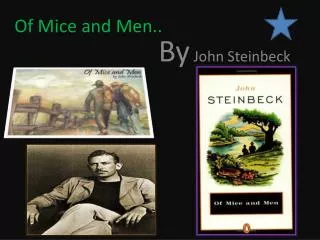
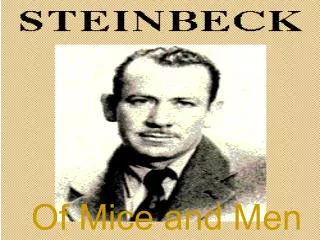
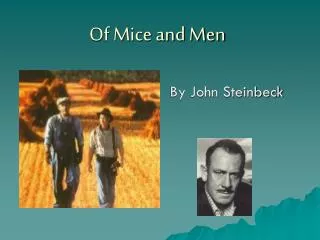
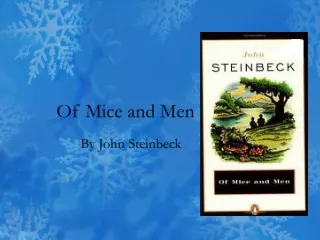
Of Mice and Men By John Steinbeck
Steinbeck Bio • Born in 1902 in Salinas, California • Father a county magistrate • Mother a school teacher • Encouraged to read at a young age • Had few friends • 1920 - enrolled at Stanford University to study English • Worked as a farm worker • 1925 - Leaves college to become a journalist in New York City
Steinbeck Bio continued • Returns to California in 1926 • Published first novel Cup of Gold in 1929 • Published Of Mice and Men in 1937 • Published 27 works, including The Pearl (1947) and The Grapes of Wrath (1939) • Died in 1968 in New York of heart disease
Steinbeck Bio continued • Won the Pulitzer Prize for The Grapes of Wrath • Won the Nobel Prize for Literature • Common themes: setting in California, hard work, striving for dreams, hardship of common people
Of Mice and Men • Published in 1937 • Adapted into a play • Filmed in 1939 • Television movie in 1981 and 1992
Novella • Novella – a shortened form of fictional development lying between novel and short story • 32,000-50,000 words • Limited action • Few conflicts • Usually not divided into chapters
Of Mice and Men • Setting – 1930’s in southern Californian • Point of View – third person omniscient
Essential Questions • Why are dreams important? What impact can dreams have on our lives? • Is euthanasia ever justified? • Why are some people excluded from society and treated cruelly? • What is the meaning of friendship?
Realism and Naturalism • Realism – 1870’s – 1880’s • Middle class America • Exposed hardships and ugliness of human existence • Life depicted as it really is • Naturalism – literary movement 1880’s – 1940’s • Reaction from World Wars and Great Depression • Similar to realism but addressed taboo topics • Reveal lives of America's lower-class • The naturalistic view of humans is that they respond to the natural world much like animals, reacting to natural forces they neither understand nor control • Human beings are often portrayed as victims of destiny or fate • Naturalistic writers portray nature as indifferent • Naturalists are pessimistic about human capabilities • Life is a trap • Naturalists portray humans as animalistic, driven by fear or hunger