The Elements
This guide explores the structure of the periodic table, detailing its vertical columns (groups/families) and horizontal rows (periods). Each group contains elements with similar properties, making it essential for chemistry. Discover the four main types of elements: metals, which are excellent conductors and malleable; non-metals, which are generally poor conductors; metalloids, which exhibit characteristics of both; and noble gases, known for their unreactivity. Additionally, learn about the lanthanide and actinide series, crucial for understanding the broader spectrum of elements.

The Elements
E N D
Presentation Transcript
The Elements 1.3
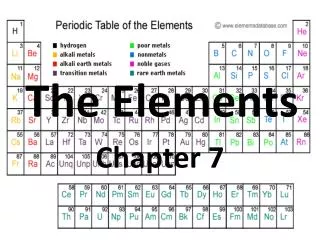
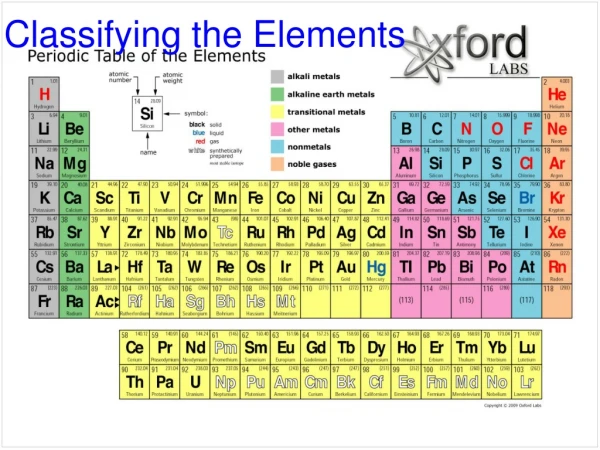
The Periodic Table • Groups – vertical columns on the p.t. #1-18 • AKA Families • Similar Properties • Periods – horizontal rows on the p.t. • Consecutive numbers of p+, e-, n0
Types of Elements • Metals – an element that is a good conductor of electricity and heat • Shiny, malleable, ductile, solids, high tensile strength • There are some exceptions mercury
Periodic Table • Two rows below the periodic table are the lanthanide and actinide series • These rows fit after #57 and #89 • They are only at the bottom to keep the width of the chart smaller
Types of Elements • Non-Metals – element that is a poor conductor of heat and electricity • Mostly gases at r.t. • The ones that are solids are brittle
Types of Elements • Metalloids – element that has some characteristics of metals and some of non-metals • Stair step line • Solids at r.t. • Less malleable than metals, but not as brittle as non’s • Semi conductors of electricity
Types of Elements • Noble Gases – group 18 on the p.t. • Unreactive • Gases at r.t.