The Scientific Revolution
The Scientific Revolution. What Was the Scientific Revolution?. A revolution in human understanding and knowledge about the physical universe 17th century Began with Kepler, Galileo Ended with Newton. “Science” Before the Scientific Revolution. Based almost entirely on reasoning

The Scientific Revolution
E N D
Presentation Transcript
What Was the Scientific Revolution? • A revolution in human understanding and knowledge about the physical universe • 17th century • Began with Kepler, Galileo • Ended with Newton
“Science” Before the Scientific Revolution • Based almost entirely on reasoning • Experimental method or observation wasn’t used at all • Science in medieval times • Alchemy • Astrology A medieval alchemist
Francis Bacon andthe Scientific Method • 1561–1626 • English philosopher and empiricist • Inductive reasoning • Argued for experimental methodology
The Scientific Method Science as a multiple-step process: 1. Observe an object or phenomenon 2. Develop a theory that explains the object or phenomenon 3. Test the theory with experiments
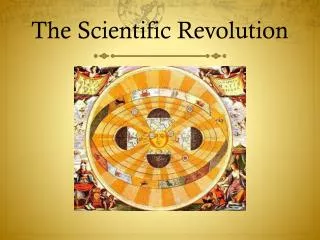
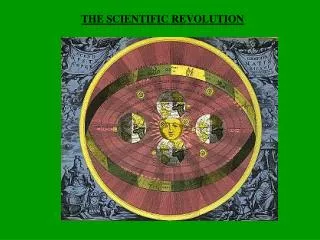
Models of the Universe: Geocentric vs. Heliocentric Geocentric: the Earth is at the center of the universe; all heavenly bodies move around the Earth • Heliocentric: the Sun is at the center of the universe; all heavenly bodies move around the Sun—including the Earth
Nicholas Copernicus (1473–1543) • Polish astronomer and mathematician • Commentariolus (1514) • Concerning the Revolutions of the Celestial Spheres (1543)
Galileo Galilei (1564–1642) • Italian mathematician, astronomer • “Father of Science” • Telescopes and astronomical discoveries • Theory of falling objects; disproved Aristotle Galileo’s telescopic drawing of the moon
Dialogue on the Two Chief Systems of the World • Galileo’s major work • Written in 1632 • Argued in favor of the heliocentric model of the universe Frontspiece from the Dialogue; from left to right, the figures shown are Aristotle, Ptolemy, and Copernicus
Galileo vs. the Catholic Church • The church condemned heliocentric conceptions of the universe • The Roman Inquisition • Galileo’s trial • Galileo recants, put under house arrest 19th-century depiction of Galileo before the Inquisition tribunal
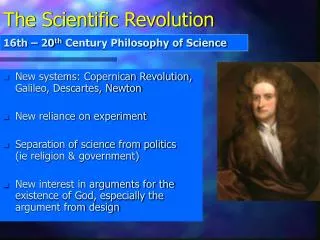
Sir Isaac Newton (1642–1727) • English astronomer, physicist, and mathematician • Synthesized the works of Copernicus, Kepler and Galileo • The Principia
Newton’s Laws of Motion • First Law: Law of Inertia • Second Law: Fundamental Law of Dynamics • Third Law: Law of Reciprocal Actions
Medicine Before the Scientific Revolution • Based on tradition • The Church Illustration depicting a bloodletting, an accepted medical procedure before the Scientific Revolution
William Harvey (1578–1657) • English physician • On the Movement of the Heart and Blood in Animals • Described the functioning of the heart and circulatory system • Disproved Galen’s theories
New Invention: The Telescope • Invented in the Netherlands • Galileo • Newton Illustration of Galileo at his telescope
New Invention: The Microscope • Hans Janssen • Anton Van Leeuwenhoek • Robert Hooke Hooke’s drawing of a flea (from Micrographia) A Janssen microscope, c.1600
New Invention: The Pendulum Clock • Invented by Christiaan Huygens, a 17th-century Dutch scientist • Allowed scientists to more accurately measure time Huygens’s design for a pendulum clock
New Invention: Barometer • Invented by 17th-century Italian physicist Evangelista Torricelli • The barometer measures air pressure Torricelli’s barometer experiment
New Invention: Thermometer • Invented in the 17th century by Santorio Santorio, an Italian scientist • Ferdinand II • Gabriel Fahrenheit • Anders Celsius Santorio Santorio Illustration depicting Santorio’s thermometer
New Invention: Mechanical Calculator • Invented by Wilhelm Schickard, a 17th-century German inventor • Gottfried von Leibniz’s “Step Reckoner” Wilhelm Schickard A 1624 sketch Schickard made of his calculator
The Significance of the Scientific Revolution • Abandonment of ancient and medieval systems • Development of the scientific method • The Enlightenment