The Scientific Revolution: Transforming Knowledge in the Age of Inquiry
The Scientific Revolution, beginning in the mid-1500s, marked a pivotal shift in human thought as scientists began questioning long-held beliefs and embracing experimentation. Inspired by the Renaissance's spirit of curiosity and the Reformation's critiques, scholars challenged ancient authorities like Aristotle and Plato, rejecting the geocentric view of the universe. This new era fostered a careful observation-based approach, leading to groundbreaking discoveries in fields such as astronomy, mathematics, and physics that laid the foundations of modern science.

The Scientific Revolution: Transforming Knowledge in the Age of Inquiry
E N D
Presentation Transcript
The Scientific Revolution By. Janine Hepler
Main Idea • Mid-1500s: Scientists began to question accepted beliefs • New theories were made based on experimentation
The Renaissance & Reformation • The Renaissance inspired curiosity in many fields • Scholars questioned accepted ideas • During the Reformation, religious leaders challenged thinking about God
The Roots of Modern Science BEFORE 1500… • Scholars referred to Ancient Greek or Roman authors • Ex.) Aristotle & Plato • Few questioned ancient thinkers or the Bible
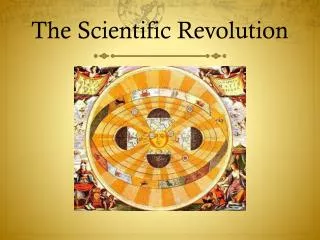
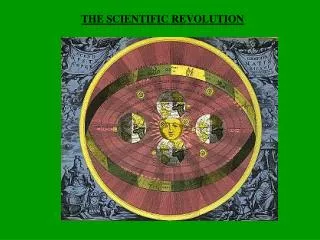
The Medieval View • The Earth was unmoving & the center of the universe • Geocentric theory • Supported by common sense, Aristotle, & Christianity
The Scientific Revolution • Scholars replaced old assumptions with new theories • New way of thinking about the modern world • Based on careful observation
Causes of the Scientific Revolution • New focus on careful observation—Ancient manuscripts didn’t always agree • Willingness to question old beliefs • European explorations (Africa, Asia, Americas) Discoveries led to new courses of study in universities (astronomy, mathematics, physics)
DIRECTIONS • Read aloud assigned section with group • Determine main ideas, key terms, & important people • Organize information onto visual aids • Present information to classmates GROUP WORK Revolutionary Model of the Universe (pg. 546-47) The Scientific Method (pg. 547-48) Newton Explains the Law of Gravity (pg. 548-49) The Scientific Revolution Spreads (pg. 549-50)