Download
1 / 26
260 likes | 365 Vues
World War I, known as The Great War, changed the course of history. The war was ignited by the assassination of Archduke Franz Ferdinand and fueled by militarism, imperialism, and nationalism. The complex web of alliances drew multiple nations into conflict, transforming warfare through trench warfare and new technologies like tanks and submarines. The U.S. remained neutral initially but entered the war after incidents like the sinking of the Lusitania and the Zimmerman Note. The war ended with vast casualties and led to the Treaty of Versailles, reshaping Europe and establishing the League of Nations.

E N D
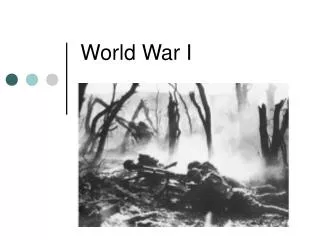
World War I The great war
What caused the war? The three “isms”
What caused the war? Imperialism: A policy of extending a country's power and influence through diplomacy or military force.
What caused the war? • Militarism: • The belief or desire of a government or people that a country should maintain a strong militarycapability and be prepared to use it aggressively to defend or promote national interests.
What caused the war? • Nationalism: • Patriotic feeling, principles, or efforts. An extreme form of this, esp. marked by a feeling of superiority over other countries.
The spark that lit the powder keg Serbian national assassinated Arch Duke Franz Ferdinand of the Austro- Hungarian empire and wife on June 28, 1914 in Sarajevo. War began One month later on July 28, 1914 when Austria-Hungary invaded Serbia.
alliances • Russia allied with Serbia • France allied with Russia • Great Britain allied with France • Austro-Hungary allied with Germany • Germany allied with Ottoman Empire and Bulgaria
World war i Part 2 A new kind of war
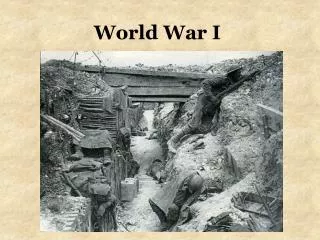
Trench warfare A form of warfare where each side dug trenches. Soldiers stayed in the trenches for protection. Some trenches were as long as 400 miles. The area between the trenches was called “no man’s land.”
New weapons • Submarines • Airplanes • Mustard gas • Tanks • Machine guns • Blimps
battles • Ypres in Flanders: Allies vs. Germany • Verdun in France: Germany vs. France • Somme in France: Britain and France vs. Germany • Marne in France: Britain and France vs. Germany • Gallipoli in Turkey: Britain vs. Ottoman Empire
World war i Part 3 us involvement
America remains neutral “There is such a thing as a man being too proud to fight.” Woodrow Wilson, on May 10, 1915
isolationism Two opposing forces rise in America between 1914-1917 Vs.
The lusitania • British liner • Torpedoed by German U-boat on May 7, 1915 • 1195 passengers died • 128 Americans died • Pushed America closer to war
The zimmerman note • On January 16, 1917, Germany sent letter to Mexico asking for an act of war against the U.S. • British intercepted • This causes the U.S. to declare war on Germany on April 6, 1917
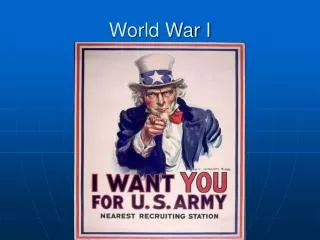
America goes to war • America joins the Allied Powers • Call to arms (draft) • Doughboys/Over there • Gen. John Pershing
America goes to war • http://app.discoveryeducation.com/player/view/assetGuid/1C95A25A-43CD-4670-AEA2-85A7722E48F5
World war i Part 4 The war ends
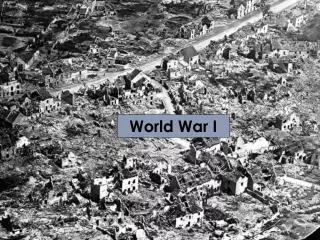
aftermath • 10 million soldiers dead • 21 million wounded • 5 million civilians dead • 116,516 Americans soldiers dead • Europe in ruins
outcomes Wilson’s 14 points: The points encompassed war aims as forwarded by Wilson, and a general guideline for post-war order and frontiers.
outcomes The treaty of Versailles: made Germany pay allied powers back for the cost of war. This caused animosity between Germany and allied powers for years. Also called for an organization to be formed to prevent further war.
outcomes The League of Nations: A world organization established in 1920 to promote international cooperation and peace. It was first proposed in 1918 by President Woodrow Wilson, although the United States never joined the League. Essentially powerless, it was officially dissolved in 1946.