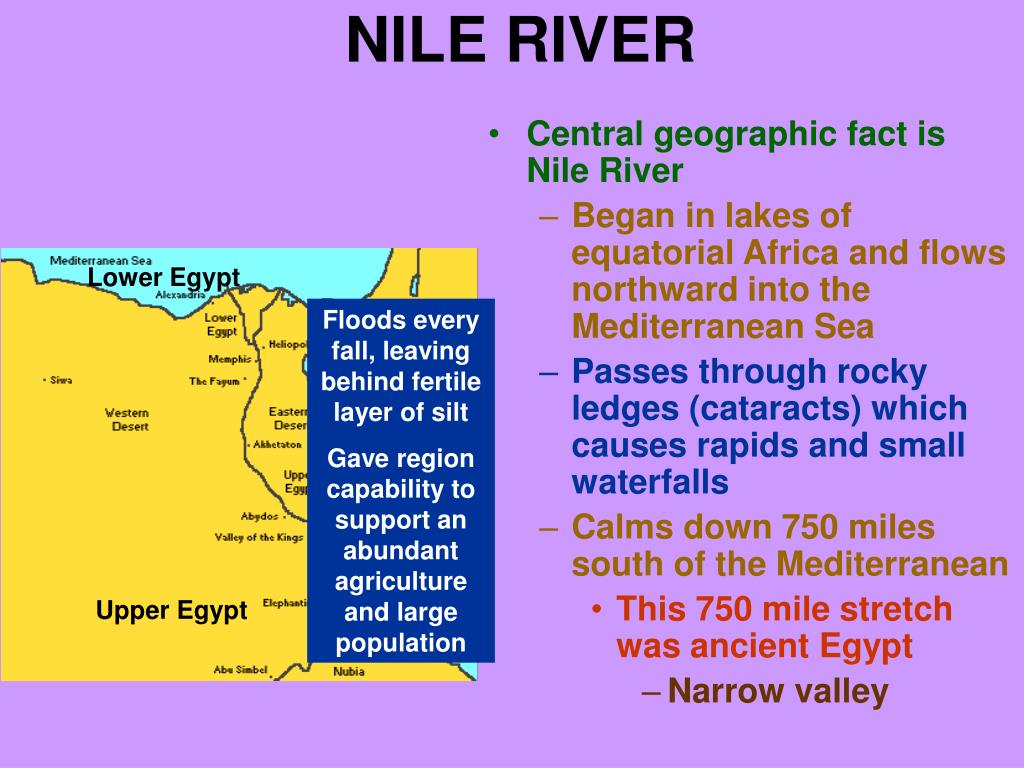
NILE RIVER • Central geographic fact is Nile River • Began in lakes of equatorial Africa and flows northward into the Mediterranean Sea • Passes through rocky ledges (cataracts) which causes rapids and small waterfalls • Calms down 750 miles south of the Mediterranean • This 750 mile stretch was ancient Egypt • Narrow valley Lower Egypt Floods every fall, leaving behind fertile layer of silt Gave region capability to support an abundant agriculture and large population Upper Egypt
MORE GEOGRAPHY • Nile also served as excellent artery of communication • Encouraged early and lasting political unification • Isolated by cataracts in the south, the Mediterranean Sea in the north, and huge deserts to east and west • Would protect Egypt from periodic waves of new people which so often disrupted Mesopotamia • Allowed civilization to develop in relatively peaceful and stable conditions • Gave them cheerful and optimistic outlook
PREHISTORIC EGYPTIANS • Original settlers were a mixture of people from Nubia, Palestine, Syria, and Lybian Desert • Settled in small villages • Gradually cleared valley of swamps and wild animals by 4000 BC • Some evidence of Mesopotamian influence
ZOSER • Settlements along Nile unified into a single kingdom around 3100 BC • Perhaps by Zoser • Egyptian history begins with this act • Old Kingdom (3100-2000 BC) • Middle Kingdom (2000-1575) • Each period divided into Dynasties
OLD KINGDOM • Zoser established capital at Memphis in Lower Egypt • Most records from this period have been lost • Most of our knowledge today comes from monuments and tombs of pharaohs
PYRAMIDS • Pyramids would be normal form of burial for pharaohs until 1500 BC • About 80 are still standing • Most within 70 mile stretch of desert near Memphis • Largest is the Great Pyramid of Cheops • 481 feet high, made from 6 million tons of stone, covering 13 square acres • Foundation is almost perfectly level and its sides perfectly square Great Pyramid
PHARAOHS • Pharaoh was, in theory, all-powerful ruler • But as time went on and government became more complex, he was assisted by growing bureaucracy • Began to dominate pharaoh and act independently towards end of Old Kingdom
REASONS FOR DECLINE IN PHARAOH’S POWER • Partly caused by enormous drain of pharaoh’s resources in maintaining pyramids and priests • Partly due to custom of rewarding loyal officials with large estates and treasure • Partly due to power struggles with the royal family • By 2000 BC, central authority had virtually disappeared and the Old Kingdom was over • Country plagued by anarchy Old Kingdom bureaucrat
MIDDLE KINGDOM • Egypt recovered from decay of Old Kingdom and entered age of tranquility and progress • 2000-1575 BC • Regained strength under 12th Dynasty pharaohs • Large sections of Lower Egypt brought into agricultural productivity by irrigation projects • Pharaoh controlled bureaucracy • Established loose political control over Palestine and trade contacts with Syria and Mesopotamia
FALL OF THE MIDDLE KINGDOM • When power and prosperity of Middle Kingdom began to decay, the country was invaded by the Hyksos • Semitic tribe • Took over northern half of kingdom • Destroyed political unity • Region enter 100-year period of chaos, foreign occupation, and economic stagnation
FUNDAMENTAL RELIGIOUS MYTHS • Sun rose daily in the east and traveled to the west, where it entered a mystical netherworld • Fought off forces of chaos and disorder and then emerged in the east the next morning with renewed strength • Nile river passed annually through a cycle of birth and death • Flooded every fall and then receded, leaving behind fertile silt • These events served as models of the unchanging rhythm of the universe • Egyptians saw themselves as a part of all this
THE DIVINE PHARAOH • Orderly world was conscious creation of the gods • But could be disrupted by evil forces • To make sure that evil forces never succeeded, the gods delegated Horus to guard over the balance and harmony of the universe and serve as pharaoh • Pharaoh was Horus in human form
MUMMIES • When human form died, Horus returned to heaven and then returned in a new human form • In short, Horus continually died and was reborn in an endless cycle of succeeding pharaohs • Explains why Egyptians went to such lengths to preserve the body of a dead pharaoh • To ensure Horus’ safe journey back to heaven • Built pyramids because they were meant to house the physical remains of what had once been a god
PHARAOH’S POWER • Pharaoh’s authority was unchallenged and total (at least in theory) • Charged with being the shepherd of his people • Symbolized by shepherd’s staff • Sole source of law • No written law codes • Obligated to administer law in accordance with the natural order of the universe and with mercy
GODS Popularity of various gods rose and fell with time Seth Nekhbet Wedjet: half woman/half cobra Some had human form: Min, Ptah, Atum, and Amon Hathor
TEMPLES • Temples build of stone and meant to last forever • Laid out in a straight line with one room leading to another • Each one symbolically further removed from the outside world • Last room was were statue of god rested • Only priests could enter this room
PRIESTS • Were not a closed caste set above the rest of society • Ordinary laymen who spent part of the year serving the gods and the rest of their time performing their secular occupations • Played no ethical role, counseled no one, never tried to convert others • Sole function was to see that temple operated properly and that the god was properly taken care of • Religious technicians, not “holy men”
AFTERLIFE • Believed dead person had to be provided with everything he or she might need to survive in the next world • Hence treasures piled in tombs of pharaohs • Hence household items, agricultural implements, tools and weapons in tombs of ordinary people • Not sure what Egyptians thought their afterlife was like • Some believed it was just a repetition of earthly life • Others believed souls became stars after death • Others saw it as escape from hardships of earthly life
ART • Tomb art not intended to be decorative or artistic • Designed to serve a religious purpose • to portray symbolically the things that the dead person’s soul needed to survive in the afterlife • Was also public • Served the needs of the state or the gods • Never considered to be private expression of an individual
HIERIOGLYPHICS • Developed writing around 3000 BC • Always remained a clumsy means of creative expression • Better for bureaucratic reports than for literature • Very complex system • Could only be mastered after years of study at special schools • Because only small elite could read and write, there never was communication between writer and mass audience
LITERATURE • Most concentrated on the greatness of pharaohs and the gods • Consisted of repetitious refrains • Object was to evoke strong feelings; designed for maximum verbal impact • Intended to be read aloud at public events
WISDOM LITERATURE • Developed at the end of the Old Kingdom • Among scribes • Practical advice on how to survive and advance in bureaucracy • As time went on, it went beyond practical advice to aspiring bureaucrats and emphasized moral values
MESOPOTAMIA AND EGYPT I • Both civilizations had powerful religious flavor • Religion dominated all aspects of life to a degree that seldom occurred afterwards • Gods were seen as forces that directed and controlled nature • Their ethical or moral qualities were at best incidental • An ethical god would not appear until the development of YAHWEH by the Hebrews • Had power of life or death over man • Frightened and/or inspired Mesopotamians and Egyptians to devote so much energy, time, and wealth to religion
MESOPOTAMIA AND EGYPT II • Mesopotamians in the grip of deep fear of their capricious and often cruel gods • Egyptians more at ease with their more orderly and peaceful gods • Difference influenced by geography • Wild rivers, rough terrain, and harsh climate of Mesopotamia produced a pessimistic and brooding people • Totally predictable Nile produced a more optimistic and cheerful people • Geography also fomented the early political unity of Egypt and political fragmentation of Mesopotamia • Desire to control harsh environment caused Mesopotamians to focus on science while appreciation of more gentle surroundings caused Egyptians to focus on art