Understanding Equilibrium Law and Reaction Quotient in Chemical Reactions
This text provides an overview of the equilibrium law, explaining how to determine the equilibrium constant (K) for chemical reactions using reaction quotient (Q). It illustrates the general formula for K with examples, including the reactions of hydrogen and oxygen to form water, and nitrogen and hydrogen to form ammonia. The document discusses the significance of large and small K values in determining the position of equilibrium. Furthermore, it examines a specific case of equilibrium calculation with concentration data and explains the shift of the equilibrium towards reactants when Q is not equal to K.

Understanding Equilibrium Law and Reaction Quotient in Chemical Reactions
E N D
Presentation Transcript
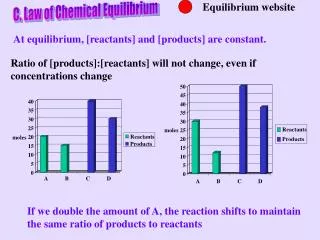
When you use concentration data to FIND OUT whether you can get a constant value by manipulating it, you are finding Q, the reaction quotient. E.g. 2HI H2 + I2 These are all Q values. These constant values indicate the equilibrium law.
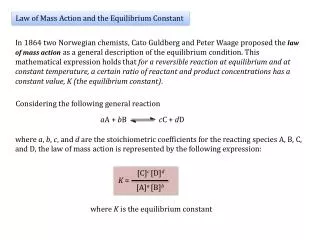
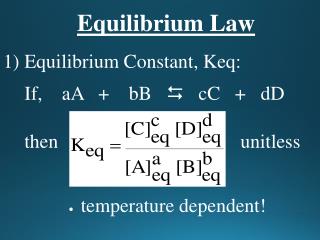
K is the equilibrium constant at a given temperature (no units) General equation: K = Where [X] means molar concentration of X m, n are coefficients from balanced equation
e.g. For 2NO(g) + O2(g) 2NO2(g) K = [NO2]2 [NO] 2[O2] Write the equilibrium law for a) 2H2 + O2 2H2O b) 3H2 + N2 2NH3 a) K = [H2O]2 b) K = [NH3]2 [H2]2[O2 ] [H2]3[N2]
If the concentrations for the substances in the equilibrium 3H2 + N2 2NH3 are [H2] = 0.521 mol/L, [N2] = 0.171 mol/L, and [NH3] = 0.285 mol/L at 300 K, what is the equilibrium constant for that temperature? K = [NH3]2 [H2]3[N2] K = 3.36 What does a large K indicate about the position of the equilibrium? Small K?
If the equilibrium constant for the reaction 2H2 + O2 2H2O at 600C is K=7.32×10⁵, and concentra-tions of these substances in a closed system are [H2] = 5.81×10³ mol/L, [O2] = 9.16×10⁴ mol/L, and [H2O] = 7.33×10⁶ mol/L, is the system at equilibrium? *Find Q and compare to K Q = [H2O]2 [H2]2[O2 ] Q = 1.74×10³ K not at eqbm.
In what direction must the water system shift to attain equilibrium? The position of the equilibrium must shift toward reactants, so that the value of Q gets smaller.