Enhancing Student Learning in Geology with Classroom Response Systems
360 likes | 484 Vues
This study explores the integration of Classroom Response Systems (CPS) in a Physical Geology course at the University of Wyoming, aimed at improving student engagement and learning outcomes. With a traditional lecture-lab format, challenges included low attendance and involvement. By redesigning course components into integrated learning modules, utilizing technology for interactive lectures, and incorporating hands-on lab activities, we observed increased student participation and improved exam performance. CPS facilitated immediate feedback and formative assessment, transforming passive learning into an engaging and dynamic classroom experience.


Enhancing Student Learning in Geology with Classroom Response Systems
E N D
Presentation Transcript
Using a Classroom Response System (CPS) to Improve Student Learning James D. Myers Erin A. Campbell-Stone & James E. McClurg Department of Geology and Geophysics University of Wyoming
Physical Geology: GEOL1100 • 180-200 students per semester • traditional lecture-lab • one lecture section • 10-13 lab sections with < 20 students • low student attendance/involvement • instructor, full-time lab coordinator, 4-5 TAs
Physical Geology - Redesign • integrate reading-lab-lecture • three-week integrated learning module • extensive use of technology • lectures reorganized to combine variety of educational techniques • lab incorporates: group learning, hands-on, reading assignments • reading assignments mandatory
Physical Geology – Learning Modules • consists of: • week 1: reading questionnaire • week 2: lab activities • week 3: lecture • different modules overlap • single week do parts of three different modules • each concentrates on different subject
Physical Geology – Reading Questionnaires • introduces topics • done individually • submitted online • insures background preparation done
Physical Geology – Lab • uses • collaborative learning • hands-on activity • strong web component • virtual experiments • multimedia
Physical Geology – Lab • each lab group has work station with dedicated, networked computer
Physical Geology – Lecture • final component of learning module • follows first two components • student applies their new knowledge • variety of goals • relies heavily on Web site • lecture format varied • introduced limited active learning sessions
Physical Geology – Lecture Changes • some changed from passive to active learning environment • increased student-instructor and student-student interaction during lecture • provided limited formative assessment • engaged a larger percentage of the students in lecture – not just the “responders”
Physical Geology – Lecture Outcome • student involvement grew during semester • improved performance on exams for students attending lecture
Physical Geology – Lecture Limitations • many students still not engaged • active learning only small percentage of lecture sessions • lots of added administrative work • formative assessment limited • real-time monitoring of student learning limited
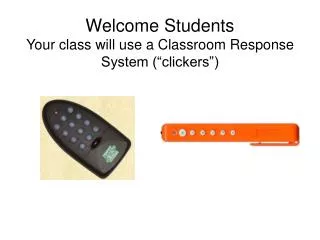
Solution: Classroom Response Systems • record and analyze student response in real time • Classroom Response System from eInstruction • two modes: bookstore, standalone • student key pads with receiver – infra-red system
CPS Demonstration • do quick demonstration
Lecture: Enhancing with CPS • better in class feedback on student learning • ability to “chunk” lectures more effectively • reduction of administrative tasks and paper collection • permanent quantitative record of student performance • more focused assessment of effectiveness
Lecture - Types • expository: typical lecture • enhanced: mini-lectures separated by active learning (CPS) tasks • focused: active learning class session focused on single concept/technique
Lecture - Expository • instructor talks, students listen • passive environment • benefits • low “risk” for students • provides breather • easy fall back position
Lecture - Expository • introduce ourselves • describe regional, national or international geologic events • discuss local, state or national policy issues related to geology • cover information/topic not in textbook • tie current events to subject
Lecture – Expository w/ CPS • uses CPS for: • opinion surveys • knowledge assessment • benefits • no right/wrong answer • provides attendance data • refocuses students without “risk” on their part • http://www.gg.uwyo.edu/geol1100
Lecture – Enhanced: Details • series of mini-lectures separated by activities • activities occupy only 5-10 minutes • refocus attention • combine formative assessment (feedback) and/or active learning exercises • done individually or in pairs/groups • type of activity varied
Lecture – Enhanced: Timeline http://www.gg.uwyo.edu/geol1100
Lecture - Focused • focused on a single concept/technique • employs multiple active learning tasks • think-pair-share always important • a worksheet is completed individually and turned in • occupies entire class period • maximum of one focused lecture per subject topic
Lectures – Enhanced w/ CPS • mini-lectures separated by active learning tasks • tasks use CPS • topic: groundwater • timeline • Mini-lecture: The Water Table • Quick-Thinks (CPS) • Mini-lecture: Aquifers and Aquicludes • ConcepTest – Artesian Wells (CPS)
Lecture – Focused: Functions • summation: used to wrap up a topic, e.g. structural geology • extension: introduces concept not previously covered in reading, lab or lecture • application: applies previously learned principles/concepts to new situation
Lectures – Focused: Example • topic: structural geology • function: summation • timeline • introduction • terminology review (CPS) • vertical motion problem • map details quiz (CPS) • map exercise • core-information exercise • wrap-up (CPS) http://www.gg.uwyo.edu/geol1100
CPS Results: Changes • lots of more preparation time – 2-3x • less content covered • content presented in greater depth • better chance students will retain the information (hope) • teaching style must be adjusted • flexible, spontaneous • have to “re-educate” students • not used to working in lecture • attitude your are not teaching them – they are getting short changed • tell them up-front why you are making these changes
CPS Results: Formative Assessment • done early in semester (2/19)
CPS Results: Summative Assessment • conducted at end of semester (5/9)
CPS Results: Adjustments • reduce grace period to one week • increase attendance points (5 to 20) • emphasize academic dishonesty • permanent log for sign-ins
CPS Results: Recommendations • equip all large classrooms in classroom building • encourage adoption by other instructors - particularly of large classes • explore ways of supporting faculty adopting CPS
Suggestions: Implementation • alternate CPS function (polls, opinions, learning activities, assessment) • credit participation not accuracy (no risk) • vary question difficulty • limit each CPS session to < 5 questions • have a back-up plan (technology & content) • if for points, have a sign-in sheet • don’t ignore results • useful to monitor attendance
Suggestions: Getting Started • plan ahead • provide student grace period • conduct technology assistance sessions • contact bookstore early (for bookstore model only) • practice before hand • technology & style • instructor & students
Suggestions: Classroom Environment • instructor flexibility essential • class “out” of control • class size dictates applications • students more involved/animated • greater understanding of less material • formative/summative assessment
Suggestions: Potential Problems • technology glitches • key pad vulnerability • complaints about cost • potential for cheating
Summary • active learning makes lecture time more effective • engages student’s brain • keeps them focused on task • breaks monotony • students need to “adjust” lecture behavior • CPS improves the delivery and effectiveness of active learning • ensures all students participate • provides quantitative formative & summative assessment • reduces administrative overhead • CPS is just a tool. Its effectiveness is determined by how well you wield that tool