Line
Discover the fundamental role of line in art as we explore its various forms, from vertical and horizontal to diagonal and curved lines. Each type of line conveys specific emotions and movements—vertical lines symbolize strength, horizontal lines evoke tranquility, diagonal lines create tension, and curved lines suggest fluidity. Learn about the concept of implied lines and zigzag patterns, and how artists skillfully lead the viewer's eye through their compositions. Unearth the five line variations: length, width, texture, direction, and curve, and enhance your understanding of visual dynamics in art.

Line
E N D
Presentation Transcript
Line Element of Art
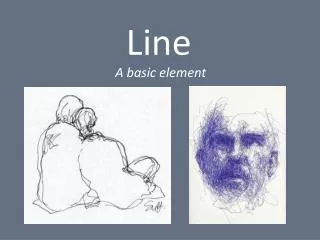
Line • Element of Art (EOA ) that is the path of a moving point through space. • It takes movement to make a line, our eyes follow it’s movement.
Vertical Lines • Move straight up and down • Parallel to the edge of the page • Strength • Power • Dignity • Poise • Stiffness • Formality
Horizontal Lines • Parallel to the horizon • Peace, rest, quiet • Tranquility • Stability • Boring • Static • Permanence, solidarity • Content, relaxed, • calm • Draw some now….
Diagonal Lines • Slant • Between a vertical and horizontal line • Uneasiness, unsteadiness • Rising, falling • Uncomfortable • Activity • Instability • Tension • Draw some now….
Curved Lines • Change direction gradually. • Movement • Activity • Degree of the curve can change – slight or intense. • Less of a curve = calmer • Spiral curves = hypnotic and draw eyes to the center • Used in decorative arts
Curved Lines • Eye follows line
Artists use line to lead the viewers eye through a piece of work.
Implied Lines • A series of points that the viewer’s eyes automatically connect. • Suggested lines • Not really there but guide the eye or organize the image
Zigzag • Made from a combination of diagonal lines. The diagonals form angles and change direction suddenly. • Confusion • Excitement • Nervousness • Most movement
Leading Lines are lines within an image that leads the eye to another point in the image, or occasionally, out of the image
How can we change a line???? FIVE LINE VARIATIONS: (what are they?) 1. 2. 3. 4. 5.
Line Variation • Length • Width • Texture • Direction • Degree of Curve