SlideServe
Menu
Préférences
© SlideServe · v2026

Understanding the Importance of Line in Art: Characteristics, Types, and Emotional Impact

herrod-barnes avatar
32 diapositives · 474 Views · Nov 13, 2014

Lines are fundamental elements in art that convey direction, emotion, and texture. Artists use lines to create outlines and contours, suggesting feelings and visual movement. Depending on their characteristics—length, width, direction, and curvature—lines can evoke calmness (horizontal), strength (vertical), or dynamism (diagonal). Curved lines can suggest comfort or chaos, while different types, such as outlines, contour lines, and gesture lines, serve various artistic purposes. This exploration highlights the versatility and significance of lines in artistic expression.
Understanding the Importance of Line in Art: Characteristics, Types, and Emotional Impact - slide 1
01 / 32Understanding the Importance of Line in Art: Characteristics, Types, and Emotional Impact
1 / 17

Télécharger la présentation

Understanding the Importance of Line in Art: Characteristics, Types, and Emotional Impact
Une image / un lien ci-dessous est fourni (tel quel) pour télécharger la présentation

Politique de téléchargement : le contenu du site vous est fourni TEL QUEL pour votre information et votre usage personnel ; il ne peut être vendu, concédé sous licence ni partagé sur d’autres sites sans l’accord de son auteur.Le contenu vous est fourni TEL QUEL, pour votre information et votre usage personnel uniquement. Téléchargez la présentation en cliquant sur ce lien. Lors du téléchargement, si vous ne parvenez pas à télécharger une présentation, l’éditeur a peut-être supprimé le fichier de son serveur.Pendant le téléchargement, si vous ne parvenez pas à obtenir une présentation, le fichier a peut-être été supprimé par l’éditeur.

F I N

Plus de contenu associé

Transcription de la présentation
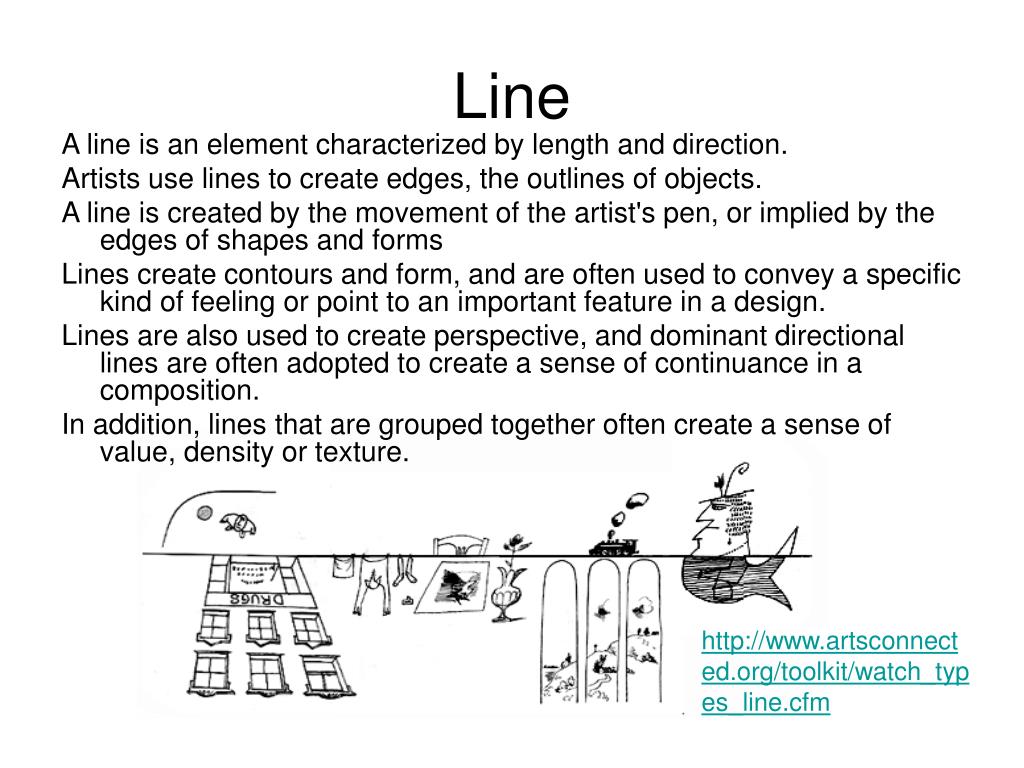
  1. Line A line is an element characterized by length and direction. Artists use lines to create edges, the outlines of objects. A line is created by the movement of the artist's pen, or implied by the edges of shapes and forms Lines create contours and form, and are often used to convey a specific kind of feeling or point to an important feature in a design. Lines are also used to create perspective, and dominant directional lines are often adopted to create a sense of continuance in a composition. In addition, lines that are grouped together often create a sense of value, density or texture. http://www.artsconnected.org/toolkit/watch_types_line.cfm

  2. Characteristic of Line • Width- thick, thin, tapering, uneven • Length - long, short, continuous, broken • Direction- horizontal ( ), vertical( ), diagonal ( ), curving( ), perpendicular( ), oblique ( ), parallel ( ), radial ( ), zigzag( ) • Focus- sharp, blurry, fuzzy, choppy • Feeling- sharp, jagged, graceful, smooth

  3. Line Direction • The direction of a line can convey mood Picasso- The Bullfight Munch- Litho- The Scream

  4. Horizontal Lines • Horizontal lines are calm and quiet. • Horizontal line suggests a feeling of rest or repose. Objects parallel to the earth are at rest. Therefore compositions in which horizontal lines dominate tend to be quiet and restful in feeling.

  5. Local artist Jennifer Amenta- Linear landscapes showing at the Atrium Gallery in Centrepointe this September.

  6. Vertical Lines • Vertical lines suggest more of a potential for movement • Vertical lines express strength • Vertical lines communicate a feeling of loftiness and spirituality . Erect lines seem to extend upwards beyond human reach, toward the sky

  7. Diagonal Lines • Diagonal lines suggest a feeling of movement or direction. Since objects in a diagonal position are unstable, being neither vertical nor horizontal, they are either about to fall, or are already in motion • ZIGZAG and DIAGONAL lines are read as energetic, explosive, and dramatic.

  8. Claudia Salguera: showing at the atrium December 14, 2007 to January 16, 2008 Diagonal lines are dynamic, directiomal and action-oriented.

  9. Horizontal and vertical lines in combination communicate stability and solidity. Rectilinear forms stay put in relation to gravity, and are not likely to tip over. This stability suggests permanence, reliability and safety. In the case of the man in this family group, the lines seem to imply stability to the point of stodginess. • Deep, acute curves, on the other hand, suggest confusion, turbulence, even frenzy, as in the violence of waves in a storm, the chaos of a tangled thread, or the turmoil of lines suggested by the forms of a crowd. The complicated curves used to form the mother in the family group shown above suggest a fussy, frivolous personality. http://char.txa.cornell.edu/language/element/element.htm

  10. Curved lines do vary in meaning, however. Soft, shallow curves suggest comfort, safety, familiarity, relaxation. They recall the curves of the human body, and therefore have a pleasing, sensual quality • CURVING lines often create the appearance of harmony, rhythm and gracefullness. Henri Matisse

  11. Henri Matisse

  12. THICK lines often make the work of art appear aggressive and strong. • THIN lines are sometimes read as delicate and fragile

  13. Name the type of line and feelings.

  14. Claude Monet Poplars

  15. Thomas Hill Benton- I Got A Girl on Sourwood Mountain (1938)

  16. The Sleeping Gypsy –Henri Rousseau

  17. Roussesau- Alley in the Park St. Cloud

  18. Great Wave at Kanagana (Katushika Hokusai)

  19. "The Funeral of Phocion" Nicolas Poussin

  20. Rape of the Sabine Women by Nicholas Poussin

  21. Christ on the Cross 1632Velazquez, Diego

  22. Peter Paul Rubens's The Raising of the Cross

  23. Salvador Dali-Christ of St John of the Cross

  24. Lawren Harris

  25. Piet Mondrian

  26. Starry Night- Vincent van Gogh

  27. Types of Line • Outlines- Lines made by the edge of an object or its silhouette. • Contour Lines- Lines that describe the shape of an object and the interior detail. • Gesture Lines- Line that are energetic and catches the movement and gestures of an active figure. • Sketch Lines- Lines that captures the appearance of an object or impression of a place. • Calligraphic Lines- Greek word meaning “beautiful writing.” Precise, elegant handwriting or lettering done by hand. Also artwork that has flowing lines like an elegant handwriting.