Breakout Summary
This summary explores the importance of international collaboration in research, with a focus on three levels of collaboration: PI-to-PI, institution-to-institution, and funding agency interactions. It highlights current bottom-up collaboration trends, the necessity for tailored NSF policies to incentivize international collaboration, and examples from the EU. Additionally, it addresses challenges such as language, logistics, and political climates. Proposed mechanisms for improvement include joint proposals and emphasizing international components in funding evaluations.

Breakout Summary
E N D
Presentation Transcript
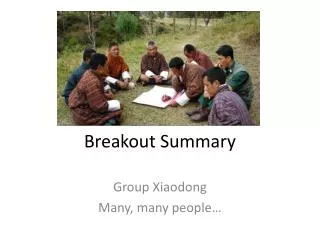
Breakout Summary Group Xiaodong Many, many people…
General Thoughts • Three levels of collaboration • PI to PI, institution-to-institution, Funding agencies • Current collaborations largely bottom-up • Need assistance w/ funding, clear mechanisms • General incentives for international collaboration • Tailor NSF policies to incentivateintl collaboration • Example from EU, select programs w/ $ for travel • Influence the “future” of China now…
Challenges • Language, logistics, cultural norms • Sustaining long term collaborations • Must be aware of political climate / concerns • Clarifying NSF policies w.r.t. international issues • Diverging incentives (models for acad evaluation) • Papers vs. national project funding vs. student count • Funds often restricted to local expenditures • Must demonstrate “necessity” of International involvement (harder in computer science)
Mechanisms • Joint proposal call w/ joint panel (already in NSF Bio)likely long term FY13 or FY14 • International REUs • EAGERs and RAPIDs (already exist) • Matching funds from OISE (visibility w/in NSF an issue) • Consider/emphasize International component as part of broader impact evaluation • Already the case for new CAREER awards • A “Best Practices” manual from NSF • Logistics, visa, equipment shipping, IP, what is fundable …
Thanks for all your input • That’s it for today • Dinner is on your own, informal • Agenda continues tomorrow morning • Breakfast at 8:30 • Talks start at 9AM by (James Wang) OISE • Administrivia • Reimbursement process on workshop websitehttp://current.cs.ucsb.edu/nsf-uschina11 • All presenters: Please email me your slides ravenben@cs.ucsb.edu