Download
1 / 5
50 likes | 170 Vues
The B Breakout session focused on the nuances of chemical exposure modeling, highlighting the importance of substance-specific approaches. Key points included the distinction between local hot spots and average regional concentrations, the need for standardized scaling methods for air and water emissions, and the role of dietary exposure assessments. Recognizing the uncertainties in psychochemical data, speakers emphasized the potential benefits of increased industry collaboration, improved data collection, and innovative modeling techniques. Future interactions aim to refine key questions for model development and address exposure assessments effectively.

E N D
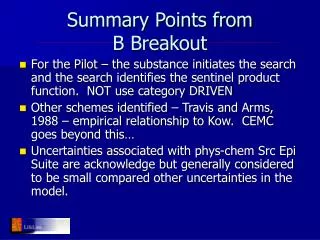
Summary Points from B Breakout • For the Pilot – the substance initiates the search and the search identifies the sentinel product function. NOT use category DRIVEN • Other schemes identified – Travis and Arms, 1988 – empirical relationship to Kow. CEMC goes beyond this… • Uncertainties associated with phys-chem Src Epi Suite are acknowledge but generally considered to be small compared other uncertainties in the model.
Summary Points from B Breakout • Local hot spots versus average region concentration seen as large issue. • Substance Specific Approach • AIR, WATER, Food (with food being least effected) • Standardized approach scaling local modeling concentration from stack or fugitive air emission versus general regional model estimate. Do a similar treatment for water. • Per capita Approach
Summary Points from B Breakout • Suggested there could be less detail in the human dietary exposure assessment for the FFComET especially relative to game. • Incentives are obvious – more data means less assumptions and low exposure estimate; however, it is extremely difficult to do for a single company in today’s environment. • Even generic information on mode of entry could be important and helpful information for the model. • Building on this workshop to develop further interaction with industry on “identifying key questions” for model development.
Summary Points from B Breakout • Quantities and mode of entry remain significantly uncertain input – further complicated by competitive pressure. • Possibilities of using “read across” for DSL substances with similar use and structure. • “Testing” , “validation”, “ground-truthing” of FFComET as a possibility. • Backcalculating from an Allowable Daily Intake to an environmental emission rate.
Summary Points from B Breakout • Question of when preliminary FFComET model and documentation will be available.