Comprehensive Analysis of Dosage Response for Probe Selection and CN Estimation
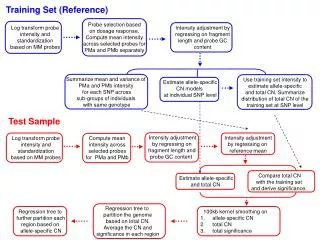
This study focuses on the selection of probes based on dosage response, utilizing a training set to compute mean intensity for PMa and PMb separately. It involves log transformation and standardization of probe intensity, adjusting for fragment length and GC content. The analysis summarizes mean and variance of intensity across sub-groups based on genotype, estimating allele-specific and total copy number (CN) at the SNP level. Additionally, we utilize regression trees and kernel smoothing for spatial partitioning and significance evaluation of CN and allele-specific variations.

Comprehensive Analysis of Dosage Response for Probe Selection and CN Estimation
E N D
Presentation Transcript
Training Set (Reference) Probe selection based on dosage response. Compute mean intensity across selected probes for PMa and PMb separately Log transform probe intensity and standardization based on MM probes Intensity adjustment by regressing on fragment length and probe GC content Summarize mean and variance of PMa and PMb intensity for each SNP across sub-groups of individuals with same genotype Use training set intensity to estimate allele-specific and total CN. Summarize distribution of total CN of the training set at SNP level Estimate allele-specific CN models at individual SNP level Test Sample Intensity adjustment by regressing on fragment length and probe GC content Intensity adjustment by regressing on reference mean Log transform probe intensity and standardization based on MM probes Compute mean intensity across selected probes for PMa and PMb Compare total CN with the training set and derive significance. Estimate allele-specific and total CN Regression tree to partition the genome based on total CN. Average the CN and significance in each region Regression tree to further partition each region based on allele-specific CN • 100kb kernel smoothing on • allele-specific CN • total CN • total significance