Simple Trig Identities
This guide introduces trigonometric identities, starting with the definition of an identity: an equation true for all values in its domain. It outlines key types of identities, including Pythagorean, reciprocal, and ratio identities. The document provides examples and strategies for proving identities by transforming one side into another, identifying common factors, and substituting parts of expressions. Practice problems encourage application of these concepts. This comprehensive approach equips learners with the skills needed to tackle trigonometric proofs effectively.

Simple Trig Identities
E N D
Presentation Transcript
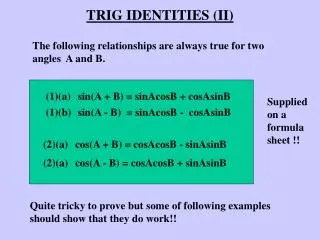
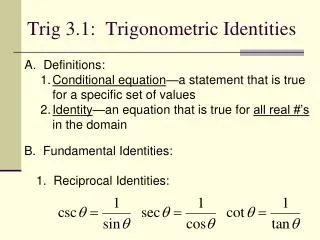
Definition of An Identity • Any equation that is true for every number in the domain of the equation. • Example • 2x + 12 = 2(x + 6) • Trig identities • Pythagorean Identities • Reciprocal identities • Ratio identities
Pythagorean Identities 90º (x,y) r y θ 0º • Consider that • then 180º x 360º 270º
Ratio Identities • Since we know that and
Working with Identities • Start with one side and turn it into the other • If you get stuck work on the other side and see if you can make them the same
Example • Prove
Working with Identities • Tips • In an expression, look for a part of the expression that looks like part of one of the identities • Substitute that in • Look for factors to cancel • Look for terms of an expression that can be combined to form one of the identities • Also possible to look at identities in different forms
Example • Prove
Example • Prove
Your turn • Prove