Color
Explore the fascinating world of color theory, where we delve into the science of how objects reflect light and how we perceive color. From primary and secondary colors to complementary contrasts, this guide unravels concepts such as achromatic tones, monochromatic schemes, and the significance of color value and intensity. Discover how different color combinations can evoke emotions, set the mood in art, and enhance visual depth. Embrace artistic techniques that utilize color effectively, including blending, pointing, and sgraffito. Enhance your artistic skills with a foundational understanding of color relationships.

Color
E N D
Presentation Transcript
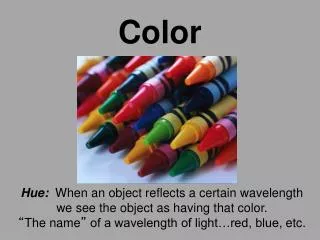
Color Hue: When an object reflects a certain wavelength we see the object as having that color. “The name” of a wavelength of light…red, blue, etc.
Achromatic “No color” Using only black, white and greys to create art
Cool Colors Greens, Blues, Purples Think “water”
Warm Colors Reds, Pinks, Yellows, Oranges Think “fire”
Monochromatic Using ONE color, and various values of that color to create art
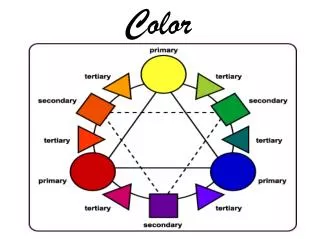
Primary Colors Red, Yellow, Blue Colors that cannot be made
Secondary Colors Orange, Green, Purple Colors that are created by mixing neighboring primary colors together
Tertiary Colors (Also known as Intermediate Colors) Created by mixing a secondary with a neighboring primary Usually have hyphenated names, i.e. yellow-orange, blue-green, red-violet
Complementary Colors Colors that appear directly across from one another on the color wheel. Orange and Blue. Green and Red. Yellow and Violet. Even Intermediate have complement colors…such as Red-orange and Blue-green
ValueThe lightness and darkness of a color or tone Shades occur when you mix black with a color making it darker Tintsoccur when you mix white with a color making it lighter
Using Value Art with mostly Light values is said to be “High Key” Art with mostly Dark values is said to be “Low Key”
Intensity or Saturation • How bright or dull a color is; it’s visual strength. • A color’s purity High Intensity Low Intensity
Depth of an Image Background Middleground Foreground
Pablo Picasso, Old Guitarist (from his Blue Period), 1903 Pablo Picasso, Femme aux Bras Croises (from his Blue Period), 1901
Dana Showers, Caught Color Study, 2003
Vincent Van Gough Café Terrace on the Place du Forum, 1888
Vermeer, The Milkmaid, 1658 – 60
Monochromatic Complement Paintings • Choose 2 complementary colors • Acrylic paints • Mix paints in range of values • Subject of your choice • Various paint application techniques Lily Smith
Mo Hagen Jay Eberhardt
Kari Dyreson Sarah Jackson
MikaylaMrochek Jesse Jones
Painting Techniques http://www.youtube.com/watch?v=3_5Z-eH6OKk
Sgraffito Scratching through the top layer of paint to show the layer below