
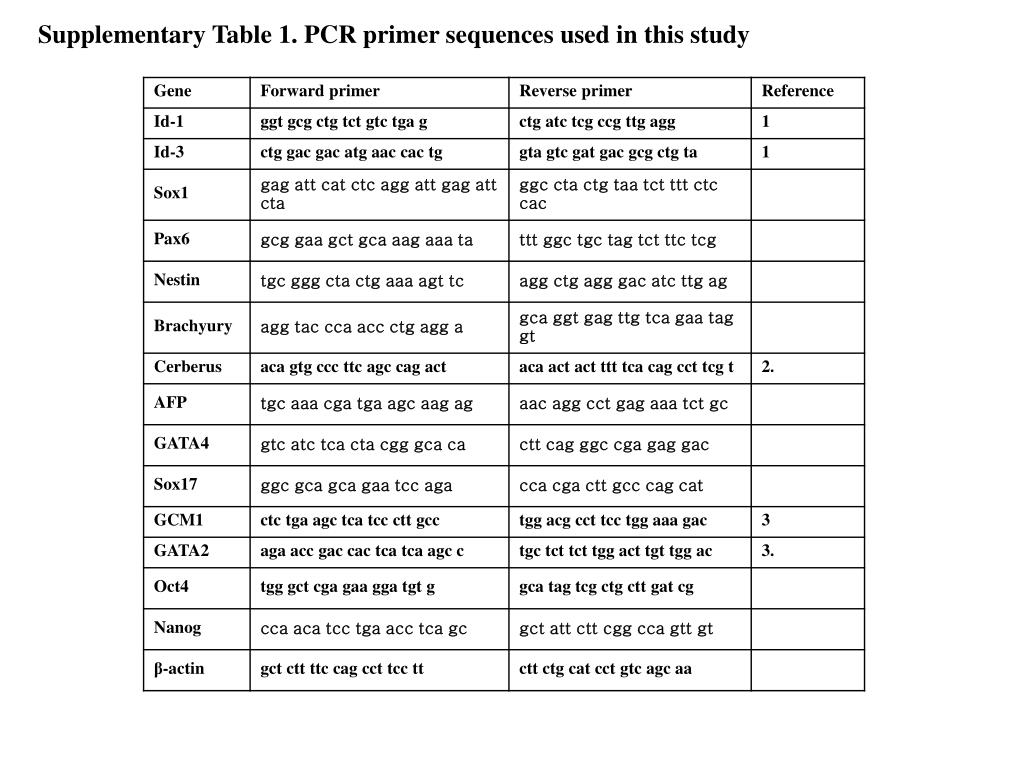
PCR Primer Sequences for Human Embryonic Stem Cell Research

This study presents supplementary data pertaining to PCR primer sequences utilized in the analysis of human embryonic stem cells (ES cells). The sequences are derived from various references, highlighting key research that elucidates the mechanisms of stem cell proliferation and differentiation. Notable studies include the effects of Basic FGF and BMP signaling on ES cell maintenance, as well as the generation of insulin-secreting cells from pancreatic endoderm derived from human ES cells. This resource serves as an essential tool for researchers in the field of regenerative medicine.
Télécharger la présentation 
Politique de téléchargement : le contenu du site vous est fourni TEL QUEL pour votre information et votre usage personnel ; il ne peut être vendu, concédé sous licence ni partagé sur d’autres sites sans l’accord de son auteur.Le contenu vous est fourni TEL QUEL, pour votre information et votre usage personnel uniquement. Téléchargez la présentation en cliquant sur ce lien. Lors du téléchargement, si vous ne parvenez pas à télécharger une présentation, l’éditeur a peut-être supprimé le fichier de son serveur.Pendant le téléchargement, si vous ne parvenez pas à obtenir une présentation, le fichier a peut-être été supprimé par l’éditeur.
F I N