Download
1 / 14
140 likes | 281 Vues
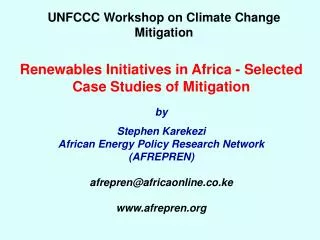
This report by Stephen Karekezi, presented at the UNFCCC Workshop, highlights the renewed interest in renewable energy in Africa amidst rising oil prices and significant unemployment rates. It explores successful initiatives in geothermal energy in Kenya and co-generation in Mauritius, showcasing their potential for job creation, technological development, and energy security. The document emphasizes the importance of crafting effective policies for renewable resources to address climate change and promote sustainable development in Africa.

E N D
Renewables Initiatives in Africa - Selected Case Studies of Mitigationby Stephen Karekezi African Energy Policy Research Network (AFREPREN)afrepren@africaonline.co.kewww.afrepren.org UNFCCC Workshop on Climate Change Mitigation
Renewed Interest in Renewables in Africa $ • Increasing oil prices & pressure on convertible currency reserves ($40/barrel) • Attractive job generation (unemployment/under employment rates 50-60%), technological development & enterprise creation potential of renewables
Renewed Interest in Renewables in Africa • Rio Conference/Climate Change Convention • Johannesburg WSSD Conference • Bonn 2004 Renewables Conference • Decision makers rarely want to be 1st, prefer to be 2nd or even better, 3rd • Growing importance of renewables in industrialized countries such as Austria, Germany (renewable energy industry has over 100,000 employees), Iceland and Denmark • Success stories in selected African countries (Kenya & Mauritius)
Geothermal - Kenya • Large potential along the great Rift Valley (9,000MW - hot water/steam option only) • Significant exploitation, largely in Kenya • Large potential for grid-connected electricity generation from geothermal in Ethiopia, Tanzania and Uganda
Limitations of Geothermal • Region-specific: Not available in all regions but non-hot water/steam option available throughout the world • High up-front drilling costs - equivalent to that of oil wells but lower risk • Cost competitive - least cost power development option for Kenya and cost even lower if heat application included
Benefits of Geothermal • Security of supply - Close to 100% availability: Not affected by climatic changes such as drought & strengthens system balance • Recent drought in Kenya, Tanzania and Ethiopia led to 8 hour power cuts resulting in close to 1% drop in GDP • Attractive heat applications potential - Reduces poverty through rural jobs and enterprise creation • Technology development - Kenya offering technical support to neighboring countries & in a few cases participated in technical missions to industrialized countries • Equitable negotiation - Geothermal industry composed of small to medium sized companies which allows developing Governments to negotiate equitable arrangements
Co-generation: Mauritius Combined Heat and Power (CHP) • Substantial potential in agro & forest-based industries, e.g. sugar, paper and pulp, wood and rice industries • Most sugar industries currently practicing co-generation for own use • Grid-connected co-generation not widespread in the region • Successful in Mauritius (40% of power supply of which 25% bagasse) • Promising developments in Uganda, Kenya and Tanzania Power Generation - Mauritius Sugar Industry Others
Limitations of Co-generation • Intermittent biomass feedstock - Can be addressed through dual-fuel boilers • Fixing price of co-generated power - Need pro-active and balanced Government or regulatory intervention to fix price agreeable to key stakeholders • Need a robust agro or forest industry: However, co-generation can improve viability of agro or forest industry
Benefits of Co-generation • Cost-competitive - combined cost of heat & electricity very low • Local resource and strengthens system balance- security of supply and enhances rural energy service • Reduces in poverty - attractive job generation (at the sugar cane plantation level) and enterprise creation potential (local technology development) • Can lead to equitable sharing of benefits: Mauritius case • Incremental and modular - can start small (1 or 2MW investment to 50-70MW installations) which lowers initial risks and facilitates local participation
Potential (Low Case): Bagasse-Based Cogeneration(% of current installed power generation capacity)
Self Sustaining Small Scale Renewable Industry: <1% of Electricity Bill
Key Challenge • Articulate a convincing policy case for renewables aimed at Ministries of Finance, Ministries of Energy & Utilities • Focus on technological and economically proven renewables with near-term tangible benefits • Energy security vis a vis fluctuating oil prices and drought related hydro shortages • Enterprise creation • Jobs • Local technological development • Exploit existing and planned climate-related financing opportunities

![United Nations Framework Convention on Climate Change [UNFCCC]](https://cdn0.slideserve.com/833451/united-nations-framework-convention-on-climate-change-unfccc-dt.jpg)