Assessment of Ecological Status of Surface Waters: CIS Workshop Insights & Follow-Up
40 likes | 154 Vues
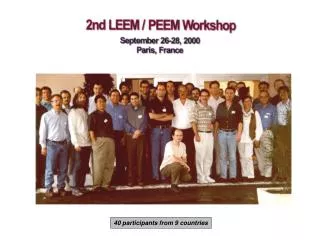
The CIS workshop held in Paris on June 11-12, 2007, gathered 50 participants from 18 countries, including the European Commission. The workshop focused on national classification systems for assessing the ecological status of surface waters. It included presentations from various countries addressing the ecological significance of biological quality elements, physico-chemical elements, and the effects of data aggregation and uncertainty. Key discussions emphasized the need for comparability among member states and proposed follow-ups for harmonizing classification practices.


Assessment of Ecological Status of Surface Waters: CIS Workshop Insights & Follow-Up
E N D
Presentation Transcript
CIS workshop – 11&12 June 2007 - Parisnational classification systems for the assessment of ecological status of surface waters CIS workshop : assessment of the ecological status. 50 participants from 18 countries + EC 11 presentations : DGENV, Austria, Estonia, Czech Republic, Germany, the Netherlands, Sweden, UK, France 3 sessions : ecological significance and combination of the biological quality elements role and place of the physico-chemical elements effect of aggregation, uncertainty, confidence & precision
General principles set in the guidance are valid • Differencies in implementing in practice the guidance • Part of those differencies is coming from different levels of maturity • How to ensure the comparability of MS approach for classification • Focus on practical aspects • Selection of QE can influence the results of the classification CIS workshop : assessment of the ecological status.
Main conclusion • State of play : different approaches and methods within national classification systems (aggregation of data, combination of QE, automatic OOAO on BQE, use of expert judgement, place of chemistry…) • Therefore, despite the huge ongoing work in the frame of IC, we have no final guarantee of « comparable levels of ambition » between MS CIS workshop : assessment of the ecological status.
Possible follow-up • Need for common views about the classification : « complement » to the classification guidance (in the frame of ECOSTAT activity 4) ? • If agreement, the complement could be based on practical case-studies, in 3 directions : • How to ensure comparability between MS whereas different QE can be used for the classification ?? • How to manage risks of misclassification (combination of biological elements, checking procedure for chemistry) ? • How to better communicate about the results of the final assessment ? CIS workshop : assessment of the ecological status.