SlideServe
Menu
Préférences
© SlideServe · v2026

Forest Fire Hazard Assessment in the Upper Konto River Watershed, East Java, Indonesia

adolfo avatar
32 diapositives · 520 Views · Aug 14, 2014

This study focuses on the Upper Konto River watershed in East Java, Indonesia—an area of approximately 233 km² encompassing parts of the Pujon and Ngantang sub-districts. Utilizing Landsat TM imagery, the research employs a comprehensive forest fire hazard model composed of three main sub-models: fuel risk, detection risk, and fire response. The region is characterized by a tropical climate with distinct wet and dry seasons, mountainous terrain, and significant erosion issues. The findings aim to enhance fire management strategies in this critical watershed.
Forest Fire Hazard Assessment in the Upper Konto River Watershed, East Java, Indonesia - slide 1
01 / 32Forest Fire Hazard Assessment in the Upper Konto River Watershed, East Java, Indonesia
1 / 17

Télécharger la présentation

Forest Fire Hazard Assessment in the Upper Konto River Watershed, East Java, Indonesia
Une image / un lien ci-dessous est fourni (tel quel) pour télécharger la présentation

Politique de téléchargement : le contenu du site vous est fourni TEL QUEL pour votre information et votre usage personnel ; il ne peut être vendu, concédé sous licence ni partagé sur d’autres sites sans l’accord de son auteur.Le contenu vous est fourni TEL QUEL, pour votre information et votre usage personnel uniquement. Téléchargez la présentation en cliquant sur ce lien. Lors du téléchargement, si vous ne parvenez pas à télécharger une présentation, l’éditeur a peut-être supprimé le fichier de son serveur.Pendant le téléchargement, si vous ne parvenez pas à obtenir une présentation, le fichier a peut-être été supprimé par l’éditeur.

F I N

Plus de contenu associé

Transcription de la présentation
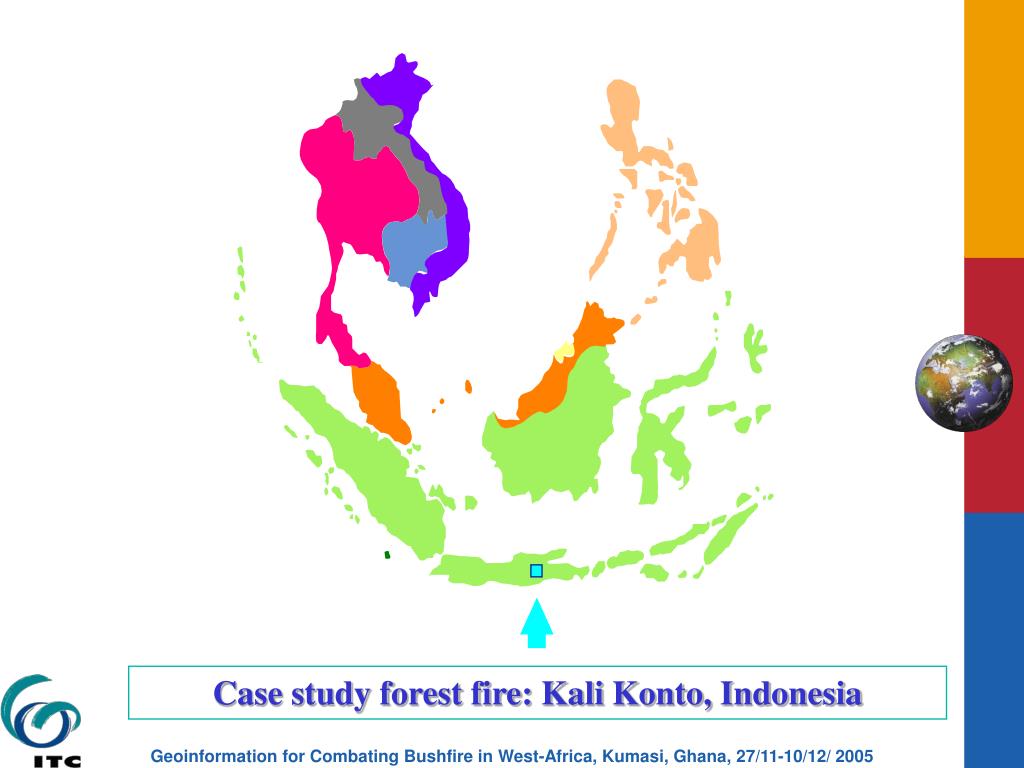
  1. Case study forest fire: Kali Konto, Indonesia

  2. Study Area

  3. Our area of interest is in the upper Konto river watershed, with an area of approximately 233 km2, which is part of the Brantas watershed in East Java. The Konto river is a tributary to the Brantas river, which drains most of East Java. The 233 km2 upper watershed is situated in the Kecamatans (sub-districts) of Pujon and Ngantang, which are part of the Kabupaten (district) Malang. The Kecamatan Ngantang consists of 12 villages, and the Kecamatan Pujon consists of 10 villages.

  4. The area ranges in altitude from 620 to 2650 meter above sea level. At the lowest part of the upper watershed the Selorejo dam and lake are found. The dam has been constructed in 1970 and is part of a much larger complex of engineering works to control and regulate the Brantas river system. Three mountain systems of volcanic origin shape the area into a landscape that can be characterized as an upland plateau surrounded by steeply sloping mountains. Signs of gully erosion and sheet erosion are very common, especially in the agricultural area.

  5. Climate The climatic characteristics of the area are typical for the higher elevations in the tropics, showing a distinct dry and wet season. The wet season commonly occurs from mid November to the end of March, and the dry season occurs from early June to the end of September. April-June and October-November are transitional periods.

  6. Methods • The forest fire hazard model is calculated from three sub-models which deal with different aspects of the outbreak of forest fires. They are: • Fuel Risk Sub-model (fuel type, slope of area etc.) • Detection Risk Sub-model (can the fire be seen?) • Fire Response Sub-model (how quick can fire fighters reach the fire?)

  7. Data Used • Landsat TM (bands 1,2,3,4 and 5). These images are used to classify the land and forest cover in the area. The output land cover classes (forest cover type classes) can be compared to a land cover map of the area to see how the land cover classes correspond. Ground verification is also necessary before it is used in the Forest Fire Hazard Model. • Land Cover map (or a forest cover type map). This is the combined output map from the classification process, comparison to other land cover maps as well as ground verification. This map will be used extensively in the Forest Fire Hazard Model.

  8. DEM (Digital Elevation Model). This dataset is created from the contour map by means of the Line Interpolation function in ILWIS. The contours can be digitized from a topographical map of the area, or be obtained from local geographical data suppliers. The DEM is then used for the generation of gradient maps, slope maps and an aspect map of the area which will all be used in the Forest Fire Hazard Model.

  9. Roads. They can be digitized from a topographical map of the area, or be obtained from local geographical data suppliers. This dataset is used in the Detection Risk Submodel (viewshed analysis). • Villages. They can be digitized from a topographical map of the area, or be obtained from local geographical data suppliers. This dataset is used in the Detection Risk Submodel (viewshed analysis). • A map of the location of the Head Quarters of the fire department. This will be used in calculating the distance from the Head Quarters to all pixels in the map.

  10. Kali Konto: land cover

  11. Kali Konto: forest types For Agr Agr For

  12. Kali Konto, Village area location(non-forest)

  13. RESULTS

  14. LANDSAT MSS COLOUR COMPOSITE 754 RGB

  15. VEGETATION COVER RISK MAP

  16. ASPECT RISK MAP

  17. ELEVATION RISK MAP

  18. SLOPE RISK MAP

  19. THREE DIMENTION VIEW OF THE STUDY AREA

  20. DETECTION RISK SUB MODEL

  21. FIRE RESPONSE SUB MODEL

  22. FUEL RISK SUBMODEL

  23. FINAL FIRE RISK OR HAZARD MODEL