Download
1 / 13
130 likes | 250 Vues
Explore the fascinating concepts of lens behavior, Fraunhofer patterns, and the Rayleigh criterion. This study guide discusses how lenses interact with light at different focal lengths and introduces key aspects like Fourier transforms and imaging resolution. It provides essential details for exam preparation and includes quizzes based on the material. Gain insights into resolving power, diffraction patterns, and the role of polarization in optics. Perfect for students and enthusiasts eager to deepen their understanding of optical phenomena.

E N D
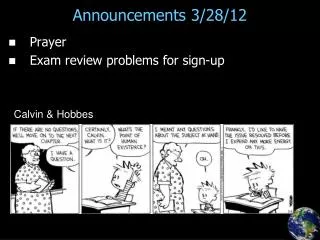
Announcements 3/28/12 • Prayer • Exam review problems for sign-up Calvin & Hobbes
Reading Quiz • A lens placed after a diffraction aperture causes the Fraunhofer pattern to be produced: • before the focal length • at the focal length • after the focal length (but at a finite distance) • at infinity
f f f f Lenses • What it object is not at infinity? • What appears at q? • What appears at f? Object at f: “Fourier transform plane”
Lens Fourier Transforms at focus of lens From Hecht
“Fourier Transform smoothing” Before After From Hecht
Reading Quiz • What does the “Rayleigh criterion” tell us? • The angle at which both light polarizations have equal reflection coefficients • The angle at which p-polarized light has minimum reflection • The angular separation resolvable by an imaging system • The number of orders produced by a diffraction grating
Reading Quiz • The Rayleigh criterion for resolving two point light sources comes from: • Fourier transforms of delta functions. • Jinc functions’ maxima and minima. • Lagrange multipliers. • Parallax of stars.
What do you get in this situation? board with hole • What if there’s a lens in the hole? • What if there isn’t a board? • What if you have two light sources? superimposed patterns at focus pattern at infinity pattern at focus f
Rayleigh Criterion Curve is (J1(x)/x)2 plotted vs (krb/f), = qD/l (using sinq q) Mathematica “FindRoot” command: q/l = 1.21967… (= first zero of J1(x)) Rayleigh Criterion