Download
1 / 27
270 likes | 409 Vues
Important announcements for Earth Science students: the last day to submit work is 12/6, with specific assignments due soon, including Sea Floor (11/26) and Lab Practical (12/9). The transition from continental drift to plate tectonics is highlighted, focusing on Alfred Wegener's theory and the evidence supporting plate movement. Key processes like convection currents that drive tectonic activity and the three types of plate boundaries—divergent, convergent, and transform—are explained, along with associated geological phenomena like earthquakes and volcanoes.

E N D
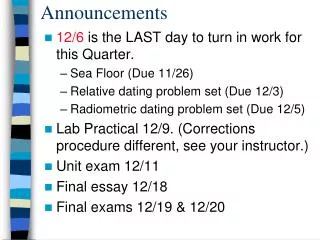
Announcements • 12/6is the LAST day to turn in work for this Quarter. • Sea Floor (Due 11/26) • Relative dating problem set (Due 12/3) • Radiometric dating problem set (Due 12/5) • Lab Practical 12/9. (Corrections procedure different, see your instructor.) • Unit exam 12/11 • Final essay 12/18 • Final exams 12/19 & 12/20
Earth Science A study in change: Plate Tectonics
Plate Tectonics: History • Began as continental drift • Suggested by Alfred Wegener. • Continental drift is the theory that all of the continents used to be one large landmass, called Pangaea.
Continental Drift evidence • Jigsaw Puzzle-shapes of continents fit. • Fossil Evidence-matching fossils on separate continents. (Mesosaurus) • Geologic Features-mountain ranges, ages and kinds of rocks match along edges of continents. (Diamonds) • Ancient climates- glacier markings match on separate continents, some in areas that are now tropical.
Continental Drift- a science failure! • Wegener couldn’t figure out HOW it worked! He had no driving force. • No reason for how it worked meant that people could find other reasons for his “proof”. • Science community needed a reason for making continental drift GO.
Plate tectonics replaced continental drift • The theory of plate tectonics: • Lithosphere (solid crust and upper mantle) is broken into plates. • Tectonic Plate- A large, solid piece of the earth’s crust that includes the continents and ocean floor. • These plates float or ride on the asthenosphere.
The main difference between plate tectonics and continental drift = Plate tectonics has a driving force = convection currents. (Demo)
How does it work? • Mantle is a liquid. • Recall: Temperature of Earth becomes warmer as you go deeper into Earth. • So, mantle rock near the core heats up and rises. As the rock rises, it cools; cool mantle rock then sinks. (Sound familiar? Like the atmosphere!) • Convection currents within the mantle drive the plate movement. IT’S ALL ABOUT DENSITY! • Hot fluids rise, cold fluids sink. • Think: Grocery store conveyor belt, and we are the groceries!
So what? • Fun stuff happens when the plates move!
Fun stuff like. . . • Earthquakes • Volcanoes • Mountains • Islands
Plate Boundaries - where the action occurs (3 types) • Divergent- a place where 2 plates move away from each other. • Convergent- a place where 2 plates move towardeach other. • Transform-a place where 2 plates slide past each other.
Transform Boundary Plate Boundaries
Transform Boundaries • Areas where two plates slide past each other. • Not a smooth movement • Slip and stick pattern. • Cause of earthquakes! • San Andreas fault in California • Crust conserved (not created or destroyed)
Divergent Boundaries Plate Boundaries
Divergent Boundaries • Divergent- a place where 2 plates move away from each other. • Places where new crust is formed! • On land = Rift valley • In water = Mid-ocean ridge
Divergent Boundaries • Mid-ocean ridges- underwater mountain ranges. (larger than the ones on land!) • Have a rift(tear) in the center - allows magma to flow to the surface. • Newest crust is in the center. (Igneous rock) • New crust forces old crust away from the ridge. • Earthquakes and volcanoes common.
How do we know? • Last week = Sea floor lab: • Magnetic field tells us!(Paleomagnetism) • Earth’s magnetic field changes! Reverses! Every so often. . . • As new igneous rock forms, magnetic minerals will line up with Earth’s magnetic field. • Bandsof rock along rift valleys and mid-ocean ridges alternate N/S directions!
Other ways we know: • “Old” rock is found farther from a rift valley or mid-ocean ridge than “new” rock. • Fossils help us know this. • Fossils from recent eras are close to the boundary • Fossils from older eras are far from the boundary.
Convergent Boundaries Plate Boundaries
Convergent Boundaries • Convergent- a place where 2 plates move toward each other. • Places where crust is destroyed and recycled • Continent + continent = mountain • Continent + ocean = subduction zone/volcanoes • Ocean + ocean = island arc
Subduction Zones • Continent + ocean = subduction zone • Continental crust is less dense and “floats”, oceanic crust is more dense and“sinks”. • Due to DENSITY! • The oceanic crust will get pushed underneath the continental crust. • Causes melting • Associated with volcanoes • Andes Mountains of South America.
Plate Boundaries - Convergent Oceanic + Continental = subduction zone + mountain (So. America) Oceanic + Oceanic = subduction zone + island arc (Japan, Alaska) Continental + Continental = mountains (Mt. Everest)
Mountains • Continental crust moving toward continental crust • Convergent boundary • No place to go, but UP! • Mt. Everest (29,035 ft; or 8,850 m)