Translations
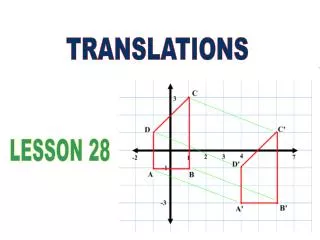
This section explores the concept of translation in geometry, illustrating how shapes can 'slide' without rotation or reflection. It includes clear examples and practice exercises to reinforce learning, such as identifying images and preimages of shapes, working with vertices using prime notation, and defining translation rules. The component form of vectors is explained, combining horizontal and vertical components. Engage with practical examples to grasp translations and vector representations effectively, enhancing your geometric skills.

Translations
E N D
Presentation Transcript
Translations Unit 2 Section 1
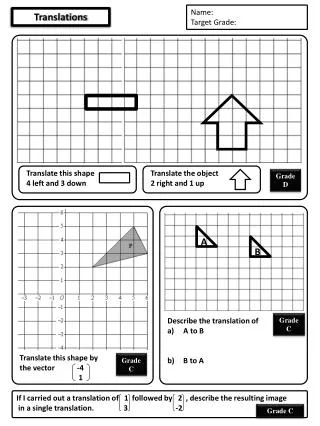
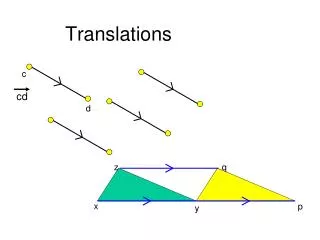
What is a translation? • Moving a shape, without rotating or flipping it. "Sliding". The shape still looks exactly the same, just in a different place.
Example 1.) Use the translation What is the image of ?
Practice 1.) Use the translation What is the image of ?
Example 2.) Use the translation What is the preimage of ?
Practice 2.) Use the translation What is the preimage of ?
Example 3.) The vertices of Graph the image of the triangle using prime notation.
Practice 3.) The vertices of Graph the image of the triangle using prime notation.
Example 4.) Write a rule for the translation.
Practice 4.) Write a rule for the translation.
Vectors Initial Point G Vertical Component (3 units up) F Horizontal component (5 units right) The component form of a vector combines the horizontal and vertical components. So, the component form of is
Example 5.) Name the vector and write its component form B A M N
Practice 5.) Name the vector and write its component form E F
Example 6.) The vertices of Translate the triangle using the vector
Practice 6.) The vertices of Translate the triangle using the vector
Example 7.) Use the point A(-2,5). Find the component form of the vector that describes the translation to P’. A.) P’(3,-2) B.) P’(-4,5) C.) P’(2,4) D.) P’(-1,-6)