Translations
This section focuses on geometric transformations, specifically translations. A transformation alters a figure's position, shape, or size, involving pre-images and images. The original figure is called the pre-image, while the result of transformation is the image. Translations are described as slides, depicted using vectors that indicate movement in the horizontal (x) and vertical (y) directions. Examples illustrate how to find images of triangles through translations, emphasizing the step-by-step process to write translation rules.

Translations
E N D
Presentation Transcript
Translations Chapter 3 Section 6
Transformations Transformation- is a change in a figures position, shape or size.
Pre-images and Images The original image is the pre-image . * notated as point P or P The resulting figure after you flip, turn or slide is the image. * notated as P’
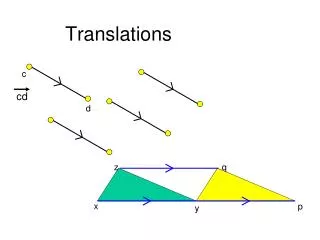
Translation A translation- is a slide * Same distance in the same direction.
Vectors To describe the translation we use a vector. < x units, y units> X- shows us how it moves left(-) or right(+) Y- shows us how it moves up(+) or down(-) Example: <-2, 3> <2, -3>
Give the directions that the vector represents • <-3, 9> • <1, -7> • <0, 6>
Example T<4, -2>(ABCD)
Finding an Image T <1, -4> of ΔABC A B C
Finding an Image T <2, 3> of ΔPQR
Finding an Image T <-1, -2> of ΔABC
Finding an Image T <3, 1> of ΔLMN
Finding an Image T<3, 1> of ABCD A B D C
Writing a Rule for the Translation First, decide how many spaces you move left or right. Then, decide how many spaces you move up or down. <right/left , up/down>
Writing a Rule for the Translation A A’ B C B’ C’
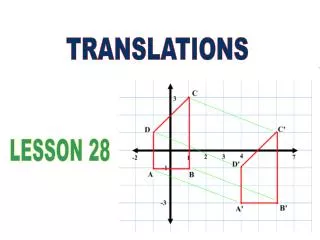
Writing a Rule for the Translation B A B’ A’ C D C’ D’
Writing a Rule for the Translation A B A’ B’
Write a rule to get someone from The History Museum to the Cable Car
Translation Reflection Rotation Dilation