Download
1 / 16
160 likes | 290 Vues
This overview explores the foundational concepts of Western imperialism, detailing various forms of territorial control, including settlement and dependent colonies. It highlights the economic motives driven by industrialization, the cultural justification known as the "White Man's Burden," and the role of missionaries in spreading European culture. The narrative also covers significant events in regions such as North Africa, West Africa, and South Asia, illustrating the dynamics of power, competition, and the consequences of imperialism on native populations and governance structures.

E N D
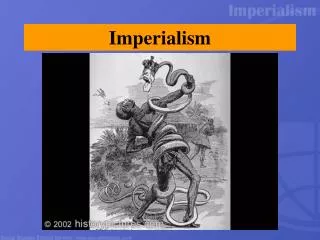
Roots of Western Imperialism Imperialism
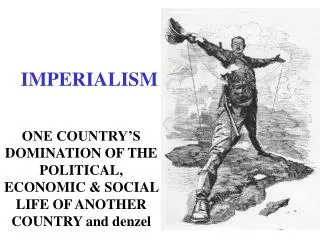
Imperialism • One country takes control of another country • Government, trade, Culture • Types of Control • Settlement Colonies: large groups of people from one country living together in a new place. • Ex: Australia/settlement for Great Britain • Dependent Colonies: few European officials ruled non-European people. • Protectorates: Ruler kept title, but Europeans controlled area. • Spheres of Influence: area one nation had special interest.
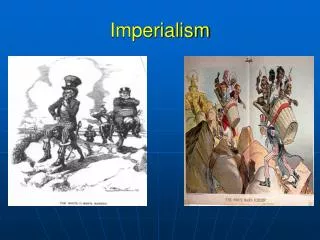
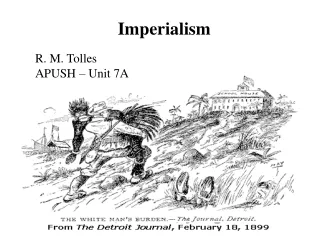
Economic Motives: One word: INDUSTRIALIZATION • Control regions with the raw materials country needed • New markets in Asia, Africa, and Latin America (Control) • Ex: Shirt and Ties in Africa • Cultural Motives for Imperialism • “White Man’s Burden” by Rudyard Kipling: “half devil and half child.” Europeans were “helping” or “improving” them. • Missionaries: convert people to Christianity • Helped build schools to teach new culture • Medicine, Hygiene, and sanitation
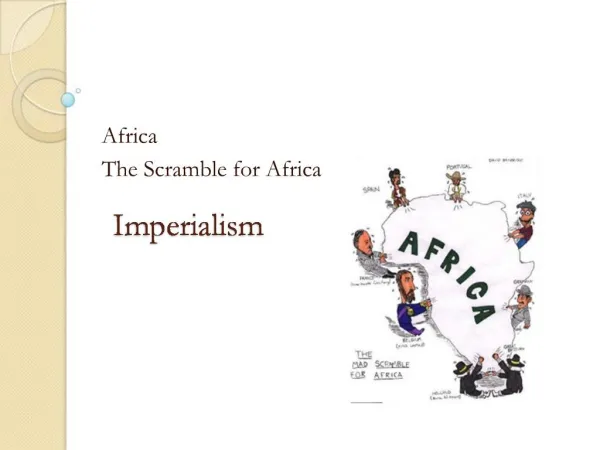
North Africa • French: forced occupied Algiers (Ottoman Empire state) • Went after small state of Tunis (East of Algiers) • Tunis: Became a French protectorate. (Turkish Ruler, French government) • Morocco: appealing b/c of Strait of Gibraltar • Deal with Britain, Spain, and Italy (French take Morocco) • Not get in way of Britain (Egypt) or Italy (Libya), or Spain (Sphere of Influence with North Morocco) • British: Wanted Egypt • Suez Canal: through the Isthmus of Suez to connect to the Mediterranean Sea and Red Sea. Egypt bough half stock • Egypt on verge of bankruptcy, so British buys and owns most of stock. (Sea route to India, Australia, and New Zealand). • Rebellion begins (British navy and troops were sent)
Fashoda Crisis: • Sudan: Egyptian colony that Britain and France wanted • Al Mahdi (expected one): led revolt against Egypt gaining control of major cities (Khartoum-Sudan capital) • British: invaded Sudan and defeated Mahdist army • French: Two years earlier, wanted to gain control of upper Nile (Jean-Baptiste Marchand). • French reached Fashoda • British arrive 2 months later (Both expected to go to war) • France yielded Sudan to Great Britain • Result: Great Britain and Egypt won joint control of area. • Great Britain: clearly the dominant partner (Anglo-Egyptian Sudan).
West Africa • Slave Trade (Most were abolished) turned to other trades: • Palm, Oil, Feathers, Ivory, Rubber • French: fought for control of Senegal for years. • Samory Toure: led revolt against France until captured • Claimed Senegal and area called French West Africa • Britain: went up against Ashanti • Took over Ashanti and Gold coast (Ghana) • France, Great Britain, Germany, Spain, and Portugal • Controlled most of West Africa • Liberia: independent state (United States helped)
Central and East Africa • Henry Stanley: wrote articles about his search of “Dr. Livingstone I presume” • King Leopold II of Belgium: personal colony of 900,000 in Central Africa. Only interest: Become wealthier • Sold business people rubber, slave labor • Turned over to Belgian government (Belgian Congo) • East Africa: famine helped colonize • Nations divided similar way of West Africa
South Africa: Competition • British seize Cape Colony: British possession • Boers: people that left colony that moved to the North and East in a mass migration. • Carved three states: Natal (SE), Orange Free State (W), and Transvaal (N). • Run into Zulu: fought for years over land (Britain helps Boers and Zulu are defeated) • Competition starts with diamonds found in Orange FS • Cecil Rhodes: British businessman who takes control of South African diamond production. • Expands production to the North Rhodesia (Zimbabwe) • Boer War: Boers in Transvaal kept British from opening mines. This led to war, and British defeated Boers • Allowed Boers to keep language in schools.
Effect of Imperialism on Africa • Europeans • Controlled all levels of government usually • Paternalism: belief that Africans could not govern themselves. • New farming, crops, medicine, roads and railroads • Sought out alliances (Europeans tried to take advantage) • Hoped for Assimilation: give up own culture and adopt another.
Asia • Nature of British Rule: • Roman Method: Divide and Rule • Granted Favors to Princes or Dealt Harshly • Active Rulers in India • Some made India permanent home • Two different cultures: British put themselves higher in society (Social circles of Europeans) • Western-Style Schools • Taught in English • Western Ideas • Regular school subjects • Either self-rule or Break all ties with Britain • British kept under tight rein
Japan-Imperialism • Meiji Restoration: group of samurai overthrew the Tougawashogunate then they returned the power to emperor. • Wanted government and social system similar to West. • Social Classes eliminated: Free to choose work • Voting=large amount of land owned • Two-house National Assmbly called Diet (The Elected) • Industrialization: new factory machinery from West • Sent students to West to learn about Western ideas. • Railroads and Telephones, Factories, Textile Industry • Raw materials: iron, ore, crude oil (Steel and build ships) • Wanted Korea • Rebellion in Korea led to Sino-Japanese War: China versus Japan. China was defeated by Japan. • Treaty of Shimonoseki: Korean Independence/Japan: Taiwan and area by Manchuria/Could trade in Chinal.
Southeast Asia • British Colonies: Two colonies: Manchuria and Sigapore • Singapore: Tip of Malay Peninsula/Strait of Malacca • French Gains: Siam • British had interests on one border, French on other • King Mongkut: helped modernize his country • Independent Siam was useful as a Buffer • Dutch East Indies: 1800’s, several revolts (Became Indonesia)
U.S Interest in Pacific Islands • Samoa Islands: U.S vs. Germany vs. Britain • U.S received Tutuila and six other small islands. • Germany: All other islands in Samoan group • Hawaiian Islands: US sugarcane and pineapple plantation. • Queen Liliuokalani: did not want foreigners to control Hawaii. • Business leaders gained control (US takeover)
Imperialism in Latin America • Spanish-American War: Spain vs. Cuba (Independence) • Maine: American battleship exploded in Havana harbor killing 260 Americans. Declared war on Spanish. • War begins in Philippines: Admiral Dewey: launches attack and Spanish fleet destroyed in seven hours • In Cuba, T. Roosevelt led “Rough Riders in San Juan Hill • U.S fleet sunk remaining ships • Treaty of Paris: Cuban Independence • Gave up Philippines, Guam, and Puerto Rico (For 20 million) • Uncorporated territories of United States. • Platt Amendment: • Cuba not to enter any agreements with foreign powers • United States could intervene with Cuban affairs if necessary • Must least Guantanamo Bay to U.S
Panama Canal: • Needed quicker way to move ships between Atlantic and Pacific. • Opened in 1914: world’s greatest engineering feats at time • Shortened sea rout from NY to San Francisco by 8,000 miles • Roosevelt Corollary: • If any countries on W. Hemisphere in danger, U.S would come to its protection. • Latin American countries would repay their loans.
Mexico Revolution • Porfirio Diaz: dictator for 30 years (Rich Mexicans control) • Jailed Francisco Indalecio Madero (opponent for presidency) which started a rebellion. • Victoriano Huerta: Madero’s own govt betrayed him and seized control of government. Madero prisoned and shot • Venustaiano Carranza: revolt against Huerta which caused civil war (millions of lives lost). • When US soldiers were arrested, Wilson took action • Pancho Villa: continued to fight Carranza for control of revolution. • Villa raided small town of Columbus, New Mexico more than a dozen American soldiers. • John Pershing: captured Villa and troops • US went deeper into Mexico but withdrew in 1917 (WW1 in Europe).