Download
1 / 11
110 likes | 235 Vues
This resource delves into the concept of electric fields, illustrating their behavior from single point charges to parallel charged plates. Utilizing a Java applet simulation from the University of Colorado, users can visualize electric fields and forces acting on test charges. Through the manipulation of nearby charges, learners can observe the direction and strength of electric fields, as well as the cancellation effects that arise between like charges. The simulation provides a deeper understanding of how electric fields behave in various configurations, helping students grasp fundamental physics concepts.

E N D
Electric fields- from single charge to charged plates Mr Ang JL 27 Feb 2010
Creating the slides • Using the Java applet simulation fromhttp://phet.colorado.edu/simulations/sims.php?sim=Charges_and_Fields • The simulation allows the user • to view the electric field around a charge or charges, and • explore electric force on a positive test charge
Two positive test charges are placed near it. • The arrows indicate the direction of the forces. • The length of the arrows indicate the strength of the force
The small arrows around the positive charge represent the electric field • Direction & • Magnitude (the fainter the weaker the field) • Electric field is a vector A radial field
For two neighbouring like charges, the fields “cancel” each other in the region between them, so it appears to be “horizontal”, instead of radial
Bringing the two neighbouring like charges closer, the “canceling” effect become clearer.
Adding more like charges, observe that the field “lines” are perpendicular to each row of like charges. • Near the ends of each row, the field is more radial
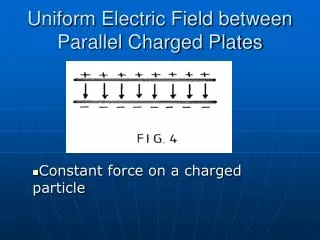
Bringing the two rows of charges closer, does the field look like that for two charged plates?