
Heterochronic Parabiosis Enhances Muscle Regeneration in Aged Mice
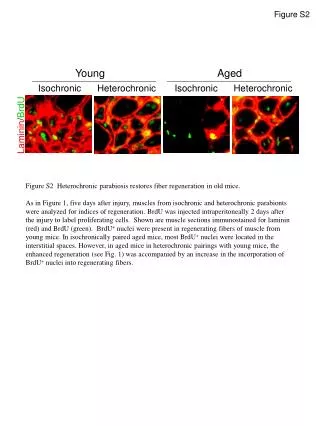
This study examines the effects of heterochronic parabiosis on muscle regeneration in aged mice. Five days post-injury, muscle sections from both isochronic and heterochronic parabionts were analyzed. BrdU was administered to label proliferating cells. Results showed that while most BrdU+ nuclei in aged isochronic mice were found in interstitial spaces, heterochronic pairing with young mice resulted in improved muscle regeneration, marked by an increase in BrdU+ nuclei incorporated into regenerating muscle fibers.

Heterochronic Parabiosis Enhances Muscle Regeneration in Aged Mice
E N D
Presentation Transcript
Young Aged Laminin/BrdU Figure S2 Isochronic Heterochronic Isochronic Heterochronic Figure S2 Heterochronic parabiosis restores fiber regeneration in old mice. As in Figure 1, five days after injury, muscles from isochronic and heterochronic parabionts were analyzed for indices of regeneration. BrdU was injected intraperitoneally 2 days after the injury to label proliferating cells. Shown are muscle sections immunostained for laminin (red) and BrdU (green). BrdU+ nuclei were present in regenerating fibers of muscle from young mice. In isochronically paired aged mice, most BrdU+ nuclei were located in the interstitial spaces. However, in aged mice in heterochronic pairings with young mice, the enhanced regeneration (see Fig. 1) was accompanied by an increase in the incorporation of BrdU+ nuclei into regenerating fibers.