Exploration and Expansion: Europe's New World Encounters
This chapter explores the motives, means, and impact of European exploration and expansion in the New World from 1500-1800. It discusses the Portuguese and Spanish empires, the voyages of Columbus and other explorers, the Spanish conquests, and the establishment of the slave trade. The chapter also covers the Dutch, French, and English rivalries in the New World.

Exploration and Expansion: Europe's New World Encounters
E N D
Presentation Transcript
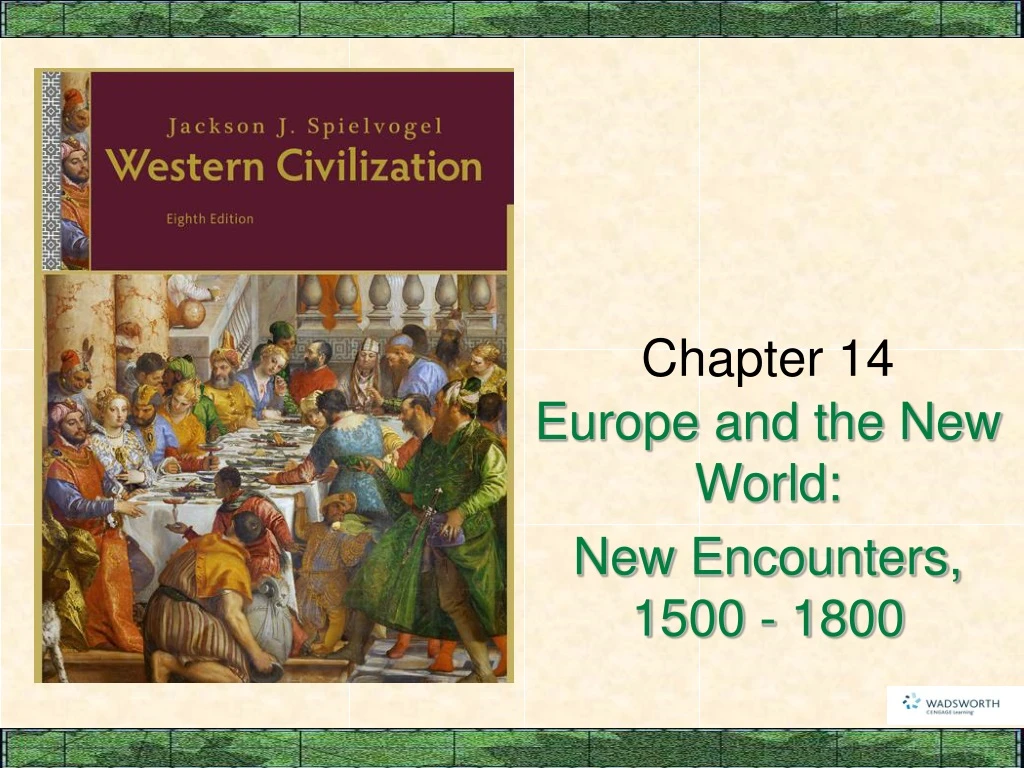
Chapter 14 Europe and the New World: New Encounters, 1500 - 1800
On the Brink of a New World • Motives and Means • Catholic Europe had been largely confined to the continent (exception of the Crusades, which failed) • The Travels of John Mandeville (14th century)-Fantastic lands of legend and myth • Access to the East • The Polos-Popularized China in Europe through descriptions of Kublai Khan and Mongol courts • Economic Motives-Primary motive for European exploration • Religious Zeal-Particularly strong motivation for Portugal and Spain • Centralized Monarchies • Ptolemy’s Geography (1477) • Development of seaworthy ships and new navigational techniques • Old techniques, such as using the Pole Star to determine position was useless below the equator
Portuguese Exploration • Portuguese fleets had begun sailing south along the western coast of Africa in early 15th century • In search of commerce and trade • Precious metals and goods such as gold and ivory from parts of Morocco and the “Gold Coast” • 1440s-Portuguese begin profiting from the selling of African slaves through their maritime exploration
New Horizons: The Portuguese and Spanish Empires • Prince Henry the Navigator (1394 – 1460) • Established first school for mariners in Portugal • The Development of a Portuguese Maritime Empire • Bartholomeu Dias • Vasco da Gama • Reaches India by rounding Cape of Good Hope • Direct voyage from Europe to India • Viceroys • Alfonso d’Albuquerque (1462 – 1515) • Commercial – Military bases • Reasons for Portuguese Success • Able to defeat Muslim opposition and control trade with India (Accomplished this with arms and technique)
Destruction of Muslims at Malacca • Encompassing and controlling Malacca and the Malay peninsula meant: • Destroying Arab spice trade • Providing a way station on route to the Spice Islands and China
Voyages of the New World • Christopher Columbus (1451 – 1506) • Reached the Bahamas (Oct. 12, 1492) • Additional voyages (1493, 1498, and 1502) • Additional Discoveries • John Cabot-Venetian that sailed for England • Pedro Cabral-Discovered South America in 1500 • Amerigo Vespucci- America=New Lands • Nun˜ez de Balboa • Ferdinand Magellan • Ferdinand Magellan (1480 – 1521) • First known circumnavigation of the earth • Treaty of Tordesillas (1494)-divided the New World between Spain and Portugal
The Spanish Empire in the New World • Early Civilizations in Mesoamerica • The Maya (civilization of sophistication) • The Aztec were the prominent rulers of much of Mexico at the time of Euro exploration • The Spanish Conquest of the Aztec Empire • Hernan Cortés (1485 – 1547) • Best exemplifies Spanish exploration and expansion of the New World • Moctezuma (Montezuma) • Aztec Empire overthrownby Cortez • Capital city (Tenochtitlan) located in Central Mexixo
The Spanish Empire (Cont) • The Inca (Ruler) and the Spanish • Pachakuti-Inca leader (Led campaign bringing entire region under control) • Inca buildings and roads • Francisco Pizarro (c. 1475 – 1541) • Conquered and plundered Inca empire in 1531 • Smallpox- European disease contributing to high mortality rates among natives of the New World • Incas overthrown (1535)- Pizzaro establishes new Spanish Empire at the capital city of Lima • No immunity for epidemic • Death of the emperor • Civil war between two sons of the Inca Emperor • Incan soldiers outmatched • Armed with stones, arrows, and light spears
The Spanish Empire (Cont) • Administration of the Spanish Empire • Queen Isabella proclaimed the natives to be subjects of Castile • Encomienda- Social and Economic System under Castile • Conquistadors collected tribute from the natives and used their labor • Spaniards abused Indians, ignoring their government • Put to work on plantations and in gold and silver mines • Bartolome de Las Casas was a major public critic of Spanish treatment of the Indians • Viceroys • Ruled over New Spain and Peru • The Church • Catholic Monarchs of Spain given extensive rights of Holy affairs in the New World
New Rivals • Dutch, French, and English • Dutch East India Company 1602 • Established a settlement at the Cape of Good Hope • Trade in slaves increases with European exploration and settlement • Most Africans taken from coastal areas and shipped to plantations in the NW (Middle East and Europe previously) • Discovery of the Americas changed the slave trade drastically
Africa: The Slave Trade • Sugar Cane and slavery • European diseases set an early expiration date for many Indians • Plantations needed more labor than natives could supply • Growth in the Slave Trade • Up to 10,000,000 African slaves taken to the Americas between the Sixteenth and Nineteenth Centuries • New Atlantic Economy represented by Triangular Trade • European Merchants from England, France, Spain, Portugal, and the Dutch Republic • Facilitated trade between European, African, and American continents
The Slave Trade (cont) • Each cargo contained around 300-450 • Rate of death could exceed 10% on longer journeys due to adverse conditions • Suffering endured for Africans who survived the middle passage as they had little or no immunity to NW sicknesses
Effects of the Slave Trade • The Slave Trade increased war and violence in Africa among natives • Prisoners of War • Crippled African economies • Depopulation of African communities • Demoralization
Conflicting Views of Slavery • Western society tended to accept slavery • Blacks viewed as inferior beings meant for dull labor • Beginning in the 1770s the Society of Friends (Quakers) publicly abhorred slavery
The West in Southeast Asia • Portugal • Too weak at home to dominate empire abroad • Spain • Established Pacific base in the Philippines • The Dutch and the English • Dutch seize the spice trade, in SE Asia, from Portugal in the early 17th century • Dutch bring most of Indonesia under its control by the end of the 18th century
The West in Southeast Asia (cont) • Mainland SE Asia was not impacted as much by European arrival • More success in resisting European intrusion because they had strong monarchies and were more politically cohesive • Cooperation helped states drive Europeans out • Local Kingdoms (Burma/Myanmar), Siam (Thailand), Angkor (Cambodia), and Vietnam)
The French and the British in India • The Mughal Empire • Mongol in origin • Babur-Founder of dynasty • Akbar (1556-1605) Grandson of Babur • Brought more systematic and centralized rule to India • Under Akbar and the Mughal Empire, India enjoyed economic progress and relative peace
The French and the British in India • The Impact of the Western Powers • Portugal-Original European power in India • England-Steady increase in British presence • French-Major western rival to the British in India • Sir Robert Clive • Thwarted the French threat in India • The East India Company • Company in which stakes can be bought and owned by shareholders • Local British population in India’s Fort William imprisoned in the black hole of Calcutta
China • China • In 16th century Portugal became the first European state to make direct contact with China since the travels of M. Polo • Ming Dynasty (1369 – 1644) • Qing Dynasty • Originated from Manchuria and replaced the Ming in the 17th century • Overthrow of the Ming created opportunity for Manchus who conquered Beijing and Li Zicheng • Limited Contact with Europeans • Lord Macartney compared the Chinese empire to “an old, crazy, first-rate man of war destined to be dashed to pieces on the shore” • Due to incompetent leadership
Japan • Japan • Shogun Tokugawa Ieyasu (1543 – 1616) • Shogun, meaning general, achieved the unification of Japan • Most powerful and longest lasting of all Shogunates • Opening to the West • The Portuguese • Initially visitors welcomed • Catholic Missionaries • Interfered in local politics • Tokugawa Ieyasu expelled all missionaries in Japan and persecuted Christians
The Americas • The Spanish and Portuguese were challenged by European rivals • British and French found success in the W. Indies • North America • The Dutch settle the Hudson River Valley • The English • Jamestown (1607)-First permanent English settlement in N. America • The French • Canada- Jacques Cartier discovers St. Lawrence River in 1534 and claims Canada as a French possession
The Impact of European Expansion: The Conquered • Devastating effects to local populations in America and Africa • Less impact in Asia • China and Japan were two nations barely impacted by European power and influence • Multiracial society first appeared in Latin America • Catholic Missionaries • Conversion of native populations • Hospitals, orphanages and schools • The Jesuits • Allowed new converts to practice ancestor worship • Catholicism failed to disperse in China because of the opposition by the Pope to ancestor worship
The Impact of European Expansion: The Conquerors • Europeans lusted for gold and silver • Opening of Potosi mines in Peru (1545) the value of precious metals imported into Europe quadrupled • Exchange of plants and animals • Columbian Exchange • European brought cattle, horses, and wheat to NW • Took potatoes, chocolate, corn, tobacco back to Europe • European rivalries • New views of the world • Gerardus Mercator’s (1512 – 1594) work is the most famous map projection in history • A Mercator projection shows the true shape of landmasses in a limited area
Toward a World Economy • Economic Conditions in the Sixteenth Century • Inflation • Major economic problem in Europe; created price instability • Wages failed to keep up with price increases • Decline in the standard of living for working class • The Growth of Commercial Capitalism • Joint stock trading companies • Commercial organization benefitted commercial expansion • Individuals bought shares in companies and received dividends on their investments • Raise of spectacular sums of capital for world trading
Toward a World Economy • The financial center of Europe in the 17th century was Amsterdam • New industries tied to banking firms • Jacob Fugger was given a monopoly over silver, copper, and mercury mines in the Habsburg possessions of central Europe • These possessions produced profits of 50%, annually
Mercantilism • Total volume of trade unchangeable • Economic activity = war through peaceful means • Importance of bullion (gold and silver) and favorable balance of trade • Exported goods more valuable than imported goods • State intervention • Governments should stimulate and protect export industries and trade
Overseas Trade and Colonies: Movement Toward Globalization • Transoceanic trade very valuable • Goods consumed by affluent, merchants, and artisans • Intra European trade • By the end of the 17th century local, regional, and intra-European trade was greater than international trade • Trade patterns interlocked Europe, Africa, the East and the Americas