

SlideServe
Menu
Préférences
© SlideServe · v2026

Transformations

alban avatar
23 diapositives · 1.1K Views · Sep 27, 2014

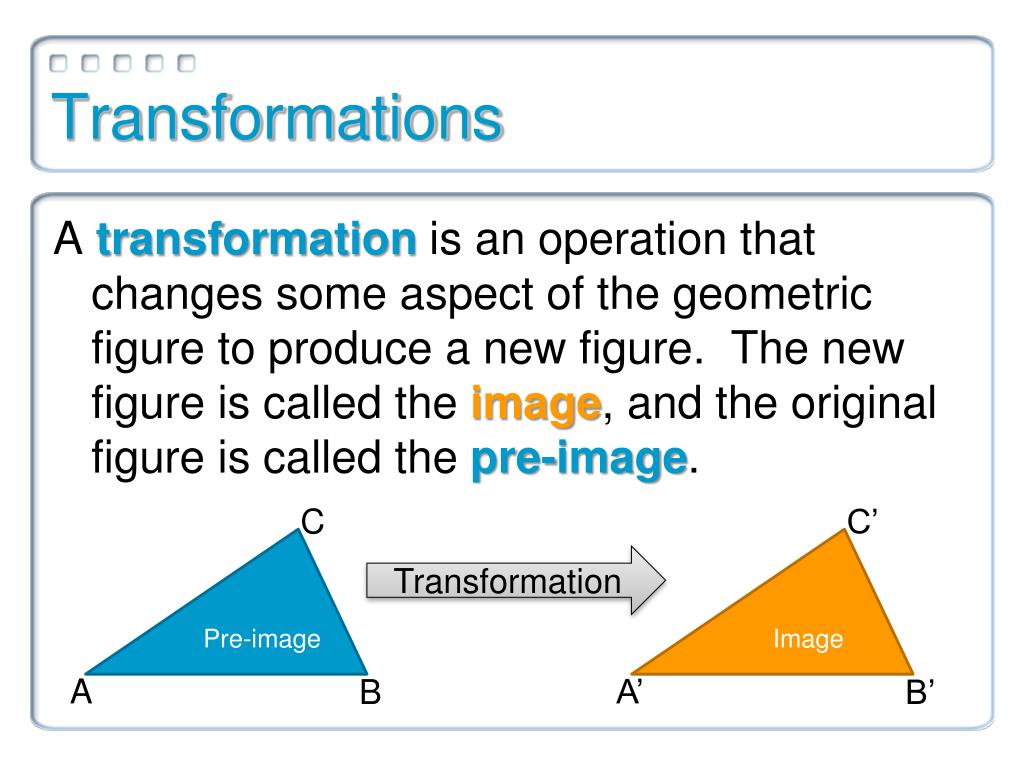
Transformations. A transformation is an operation that changes some aspect of the geometric figure to produce a new figure. The new figure is called the image , and the original figure is called the pre-image. C. C’. Pre-image. Image. Transformation. A. A’. B. B’.
Transformations - slide 1
01 / 23Transformations
1 / 17

Télécharger la présentation

Transformations
Une image / un lien ci-dessous est fourni (tel quel) pour télécharger la présentation

Politique de téléchargement : le contenu du site vous est fourni TEL QUEL pour votre information et votre usage personnel ; il ne peut être vendu, concédé sous licence ni partagé sur d’autres sites sans l’accord de son auteur.Le contenu vous est fourni TEL QUEL, pour votre information et votre usage personnel uniquement. Téléchargez la présentation en cliquant sur ce lien. Lors du téléchargement, si vous ne parvenez pas à télécharger une présentation, l’éditeur a peut-être supprimé le fichier de son serveur.Pendant le téléchargement, si vous ne parvenez pas à obtenir une présentation, le fichier a peut-être été supprimé par l’éditeur.

F I N

Plus de contenu associé

Transcription de la présentation
  1. Transformations A transformationis an operation that changes some aspect of the geometric figure to produce a new figure. The new figure is called the image, and the original figure is called the pre-image. C C’ Pre-image Image Transformation A A’ B B’

  2. Congruence Transformations A congruence transformation, or isometry, is a type of transformation that changes the position of a figure without changing its size or shape. • In other words, in an isometry, the pre-image is congruent to the image. • There are three basic isometries…

  3. Isometries Which of the following transformations is not an isometry?

  4. Tessellations An interesting application of transformations is a tessellation. A tessellation is a tiling of a plane with one or more shapes with no gaps or overlaps. They can be created using transformations.

  5. Tessellations

  6. Tessellations

  7. Vectors Translations are usually done with a vector, which gives a direction and distance to move our shape.

  8. Vectors Translations are usually done with a vector, which gives a direction and distance to move our shape.

  9. Transformation Coordinate Rules What are the new coordinates of the point (x, y) under each of the following transformations? • Translation under the vector a, b • Reflection across the x-axis Reflection across the y-axis • Reflection across the line y= x Reflection across the line y = -x • Rotation of 90° around the origin

  10. Transformation Coordinate Rules Coordinate Notation for a Translation You can describe a translation of the point (x, y) under the vector a, b by the notation:

  11. Transformation Coordinate Rules Coordinate Notation for a Reflection

  12. Transformation Coordinate Rules Coordinate Notation for a Rotation

  13. Example 1 Draw and label ABC after each of the following transformations: • Reflection across the x-axis • Reflection across the y-axis • Translation under the vector -3, 5

  14. Example 2 What translation vector was used to translate ABC to A’B’C’? Write a coordinate rule for the translation. Vector: a, b = 10, -2 Rule: (x, y)  (x + 10, y – 2)

  15. Example 3 Draw the image of ABC after it has been rotated 90° counterclockwise around the origin.

  16. Example 3 Draw the image of ABC after it has been rotated 90° counterclockwise around the origin.

  17. Example 4a Does the order matter when you perform multiple transformations in a row?

  18. Example 4b Does the order matter when you perform multiple transformations in a row?

  19. Example 4c Does the order matter when you perform multiple transformations in a row?

  20. Composition of Transformations Two or more transformations can be combined to make a single transformation called a composition of transformations.

  21. Composition of Transformations When the transformations being composed are of different types (like a translation followed by a reflection), then the order of the transformations is usually important.

  22. Glide Reflection A special type of composition of transformations starts with a translation followed by a reflection. This is called a glide reflection.

  23. Glide Reflection A special type of composition of transformations starts with a translation followed by a reflection. This is called a glide reflection.