Understanding IP Addressing: Structure, Purpose, and Future of Network Addresses
This lesson explores the fundamental concepts of IP addressing, focusing on the purpose and structure of an IP address. You will learn how an IP address functions like a postal address, identifying devices on a network. Understanding the binary representation of IP addresses and the limitations of IPv4, including reserved addresses, will provide you with a solid foundation. We will discuss the impending scarcity of IPv4 addresses and introduce IPv6, which offers an astonishing number of unique addresses, ensuring the growth and sustainability of internet connectivity.

Understanding IP Addressing: Structure, Purpose, and Future of Network Addresses
E N D
Presentation Transcript
IP Addressing The in’s and out’s
Lesson Objectives • Know the purpose of an IP address • Understand the structure of an IP address
Basics of IP’s • You can think of an IP address as a letter. • On the letter there will be an address and postcode • The postcode is a high precision location system to identify houses in the UK (and world)
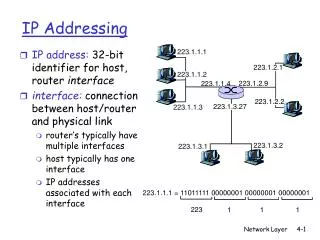
An IP address • Every machine that needs to be connected to the internet or on a network will be given an IP address 216.27.61.137 • To make it easier for us to read the address, they are broken up into 4 blocks.
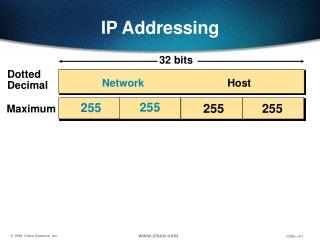
Binary Version • As computers deal in 1’s and 0’s the IP address will look something like this: 11011000.00011011.00111101.10001001 Each block is a byte (8 bits), giving you 256 unique addresses per block. A block is called an octet
Challenge What’s the maximum number of addresses you can get from this type of address system?
Reserved Addresses • Out of the 4,294,967,296 unique addresses that you can have using IPv4 there are a couple of addresses that are unavailable to use publically. • Broadcast address – 255.255.255.255 • Network address – 0.0.0.0 • Broadcast address is a way in which to contact all of the computers in a group • Network address is a default address that scoops up any messages to an undefined IP
IP’s Running out • We are getting close to running out of IPv4 addresses! • http://www.bbc.co.uk/news/technology-19600718 • The next option is IPv6 and it has 340 282 366 920 938 463 463 374 607 431 768 211 456 unique addresses IPv6 Address 2001:0db8:85a3:0042:1000:8a2e:0370:7334