Understanding Integer Addition: Properties, Examples, and Guided Practice
This comprehensive guide explores the process of adding integers, including examples that illustrate how to handle different signs. It explains key concepts like the properties of addition: the inverse property, identity property, and the significance of absolute values. Example scenarios, such as fundraising for a school fair, provide practical applications of these principles. Various guided exercises help reinforce learning through practice. By using a number line and following the order of operations, learners can master the addition of integers effectively.

Understanding Integer Addition: Properties, Examples, and Guided Practice
E N D
Presentation Transcript
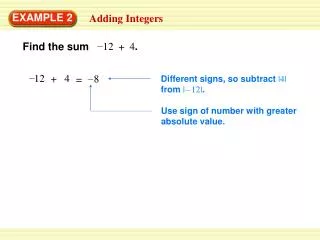
– Find the sum 12 4. + – 12 4 – + 8 = Different signs, so subtract |4| from | 12|. – Use sign of number with greater absolute value. EXAMPLE 2 Adding Integers
Use a number line to find the sum. EXAMPLE 2 Adding Integers Check
EXAMPLE 3 Adding More Than Two Integers Find the sum using the order of operations. (–7 + 7) + (–8) +(–5) = 0 + (–8) + (–5) Inverse property of addition = –8 + (–5) Identity property of addition Same sign, so sum has common sign = –13
EXAMPLE 4 Adding More Than Two Integers School Fair Your class has a fair to raise money for a field trip. The table shows the incomes and expenses for the fair. How much money was raised?
ANSWER Your class raised$835. EXAMPLE 4 Adding More Than Two Integers SOLUTION First, add the positive integers. Then add the negative integers. 750 + 36 + 625 + (–16) + (–60) + (–500) = 1411 + (–576) = 835
for Examples 2, 3, and 4 GUIDED PRACTICE Find the sum. Identify any addition properties you use. 3. –20 + (–15) –20 + (–15) = –35 Same sign, so sum has common sign 4. 18 + 0 + (–54) = 18 + (–54) Identity property of addition = –36 Add.
for Examples 2, 3, and 4 GUIDED PRACTICE Find the sum. Identify any addition properties you use. 5. 300 + 111 + (–44) + (–256) = 300 + 111 + (–300) Add negative numbers. Inverse property of addition. = 111
for Examples 2, 3, and 4 GUIDED PRACTICE Find the sum. Identify any addition properties you use. 6. –230 + (–512) + 178 + 94 = –742 + 178 + 94 Add negative numbers. = –742 + 272 Add positive numbers. = –470 Add.
ANSWER Your class raised$870. for Examples 2, 3, and 4 GUIDED PRACTICE 7. What If? Suppose in Example 4 that games made $825 and the decorations cost $100. How much money did your class raise? SOLUTION Add the positive integers. Then add the negative integers. = 825 + 625 + 36 + (–100) + (–16) + (–500) = 1486 + (–616) = 870