Understanding Biological Systems: A Holistic View of Life
This text explores the concept of systems, emphasizing their presence at all levels of biological organization. From atoms to ecosystems, systems comprise groups of related parts that interact to form a cohesive whole. Each system has defined boundaries, inputs, and outputs, crucial for understanding life’s complexity. By examining examples like human skin or ecological communities, we can appreciate how different levels of organization contribute to the functioning of life on Earth. The biosphere represents the ultimate biological system, encapsulating all ecosystems.

Understanding Biological Systems: A Holistic View of Life
E N D
Presentation Transcript
Systems • All levels of life have systems of related parts. • A system is an organized group of related parts that interact to form a whole. • Task: With your tablemate, write down one example of a system and explain why you think it is a system.
Systems in Biology • Systems can be as small as atoms and molecules to as big as the universe. • Systems have boundaries • E.g. Human skin that surrounds and holds together our internal organs. • Systems have inputs and outputs • matter and energy coming into and of the system boundaries
Levels of Organization in BiologyAll levels of biology contain systems. Atom Molecule Cell Tissue Organ Organ Systems Organism Population Community Ecosystem Biosphere ECOLOGY
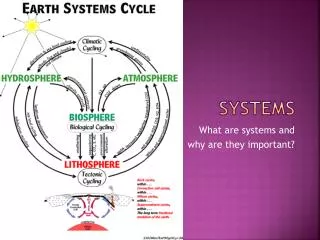
The Biosphere • The thin layer of earth and it’s atmosphere that supports life. • 8 km up and 10 km down from sea level. • Made up of all the earth’s ecosystems combined • living and non living factors • contain a finite limited supply of certain resources and living species.
Systems • Systems are a unifying theme in biology. We will be talking about it all year long. • Exit Slip: What 3 ways is a cell a system?