
SlideServe
Menu
Préférences
© SlideServe · v2026

Exploring Weather and Atmosphere: From Land to Ocean

alessandra-tandy avatar
51 diapositives · 690 Views · Nov 20, 2014

Discover the dynamics of heat transfer, wind patterns, water cycles, and atmospheric phenomena like clouds, air masses, thunderstorms, hurricanes, and tornadoes. Learn about the differences in heating and cooling rates between land and water, various heat transfer processes like convection, radiation, and conduction, as well as the role of jet streams, wind patterns, and ocean currents. Explore how air pressure, temperature differentials, and weather systems influence our climate. Dive into the water cycle, air mass interactions, and severe weather events such as hurricanes and tornadoes. Gain insights into the fascinating world of meteorology and atmospheric science.
Exploring Weather and Atmosphere: From Land to Ocean - slide 1
01 / 51Exploring Weather and Atmosphere: From Land to Ocean
1 / 17

Télécharger la présentation

Exploring Weather and Atmosphere: From Land to Ocean
Une image / un lien ci-dessous est fourni (tel quel) pour télécharger la présentation

Politique de téléchargement : le contenu du site vous est fourni TEL QUEL pour votre information et votre usage personnel ; il ne peut être vendu, concédé sous licence ni partagé sur d’autres sites sans l’accord de son auteur.Le contenu vous est fourni TEL QUEL, pour votre information et votre usage personnel uniquement. Téléchargez la présentation en cliquant sur ce lien. Lors du téléchargement, si vous ne parvenez pas à télécharger une présentation, l’éditeur a peut-être supprimé le fichier de son serveur.Pendant le téléchargement, si vous ne parvenez pas à obtenir une présentation, le fichier a peut-être été supprimé par l’éditeur.

F I N

Plus de contenu associé

Transcription de la présentation
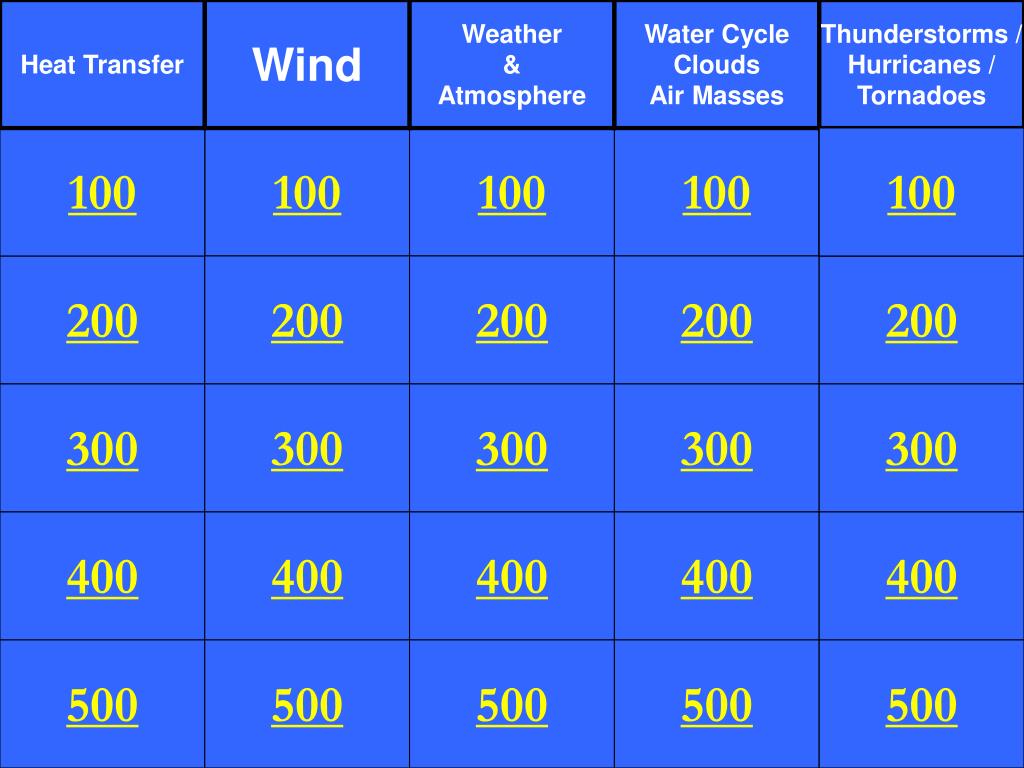
  1. Heat Transfer Wind Weather & Atmosphere Water Cycle Clouds Air Masses Thunderstorms / Hurricanes / Tornadoes 100 100 100 100 100 100 100 200 200 200 200 200 300 300 300 300 300 400 400 400 400 400 500 500 500 500 500

  2. Which heats and cools faster land or water?

  3. What is land?

  4. Give a definition and example of heat transfer by convection

  5. Convection: What is heat transfer through water or air in a circular motion. • Ex. Convection: • land breeze • sea breeze • The water in the pot of water on the stove boiling. • .

  6. Give an example and definition of heat transfer by radiation

  7. Radiation: What is heat transfer through space which heats up the land/object without touching. Ex.Radiation: Feeling really hot sitting next to a campfire

  8. Give a definition and example of heat transfer by conduction.

  9. What is heat transfer by direct contact. Ex. 1: When a person walks barefoot on the beach on a hot summer day.Ex. 2: Your little brother touches the frying pan on the stove. (ouch!)

  10. Define Jet Stream.

  11. What is a long narrow current of very strong winds in the upper troposhphere?

  12. What is the main cause of wind?

  13. What is the uneven heating of the earth’s surface

  14. Identify and describe what is happening in this picture.

  15. What is a land breeze?The flow of air from land to water.(happens at night)

  16. What causes weather systems to travel from west to east across the United States?

  17. What are the westerlies and jetstream.

  18. What is the main cause of surface ocean currents?

  19. What is wind

  20. What causes air pressure?

  21. The weight of the air above pushing down.

  22. Describe the weather result during a low pressure.

  23. What is cloudy skies, possible rain/snow?

  24. Describe the temperature and motion of air over a hot surface and cold surface?

  25. What is a cold surface What is a hot surface Air move up Air moves down

  26. Give the name and location of the layer of the Earth’s atmosphere where most weather occurs.

  27. What is the troposphere.

  28. Look at the weather map. Use the symbols on the map to Describe what Mrs. Miller and Mrs. Pitt can expect the weather to be like in NJ tomorrow and in about 3 days.

  29. Tomorrow: rainy & cloudyDay 3: cooler and maybe stormy (cold front)

  30. What do we call the movement of water through the environment?

  31. What isthe water cycle?

  32. The process by which water changes from a liquid to an invisible gas called water vapor.

  33. What is evaporation?

  34. When warm water vapor rises and releases heat, what process occurs to form clouds?

  35. What is condensation?

  36. If the wind is blowing in the direction of the arrow, what type of air would be carried to New Jersey?

  37. What is a warm, moistair mass?

  38. Which two air masses would contain polar, chilly air?

  39. What is the dark blue and light blue air masses?

  40. Define a vortex.

  41. What is the movement of liquids or gases in a spiral around a central axis?

  42. What is a thunderstorm?

  43. A disturbance in the earth’s atmosphere that involves lightning, thunder, and sometimes gusty surface winds with heavy rain and hail.

  44. In what ways are a hurricane and tornado alike?

  45. What is they both contain winds that spiral very rapidly?

  46. Describe a hurricane and what causes it to form.

  47. What is a massive rotating storm that forms over warm, tropical waters.

  48. Describewhat causes a tornado to form.

  49. What is when air masses of very different temperature and humidity conditions meet.(happen over land & form from thunderstorms)

  50. Draw graphs to show what water heated and cooled for 10 minutes would look like and what land heated and cooled for 10 minutes would look like.