Skeletal System
Skeletal System. Functions. Support: body structure and shape Protection: vital organs surrounded Movement/Anchorage of Muscles Mineral Storage: calcium & phosphorus Blood Formation. Formation and structure.

Skeletal System
E N D
Presentation Transcript
Functions • Support: body structure and shape • Protection: vital organs surrounded • Movement/Anchorage of Muscles • Mineral Storage: calcium & phosphorus • Blood Formation
Formation and structure • Composed of connective tissue called osseous tissue and rich supply of blood vessels and nerves • Osseous tissue is composed of : _______________
Bone Formation • Skeleton fully formed by 2nd month of fetal development (all cartilage) • Ossification (replacement of cartilage with bone cells and calcium salts) begins after 8th week of fetal development • Childhood and adolescence: ossification ______ bone loss • Early adulthood through middle age: ossification ______ bone loss • After age 35: bone loss _______ ossification
Bone Formation/Ossification Ossification: replacement of cartilage with bone • Cells: • osteoblast: produce immature bony tissue that replaces cartilage (the “builders”) • osteocyte: nourishes and maintains bone • osteoclast: reabsorb or digest bone (the “remodelers”) • Osteoblasts and osteoclasts work to deposit and tear down bone throughout life
Bone Growth • Grow in length at the epiphyseal line • Grow in width by addition of bone to the surface • Controlled by anterior pituitary (GH)
Bone Composition • Proper formation of bone depends on sources of calcium, phosphorous, and vitamin D. • Vit. D helps with absorption of ________ • Once Calcium and phosphorous are in the blood osteoblastic activity forms the enzyme Calcium phosphate • Calcium phosphate: gives bone its characteristic _________________ • Collagen: chief organic constituent (protein)
Bones (cont’d.) • Bone is the reservoir for calcium storage • Calcium necessary for nerve transmittal to muscle When insufficient, it interferes with nerve transmission causing muscle weakness and spasms • Ca level maintained by the _______________, which secretes a hormone to release calcium from bone
Types of Bones Based on Composition • Compact • Cancellous
Compact Bone (Cortical) • Dense, Stress Bearing • Haversian Systems: system of small canals which contain blood vessels that bring _____and _____ to bone and remove waste products • Medullary cavity: central shaft of long bone composed of _______ marrow (stores fat cells)
CancellousBone (spongy/trabecular) • Light, spongy • Found at ____________, ribs, sternum, hips, vertebrae, cranium spaces • Contain red bone marrow with elements for blood formation
Bone Markings - Purpose • Join one bone to another • Provide a surface for attachment of muscles • Create an opening for passage of blood vessels and nerves • Use as landmarks
Major types of Bone Markings •Processes/Projections: serve as attachments for muscles and tendons • Depressions: openings or hollow regions help join bones or serve as passageways __________________ • Ridges - ____________________
Bones by Shapes Reference: Gerdin, Judith. Health Careers Today. 3rd edition. Mosby, 2003
Extremities (Femur, tibia, fibula, humerus, ulna, radius, clavicle Act as ______ Epiphysis: at the _____; covered with hyaline cartilage for articulating bones (provides ______); cancellous bone Epiphyseal line or plate: growth plate Diaphysis: shaft, covered with periosteum, contains ______bone marrow Medullary cavity – located in the shaft of a long bone. This cavity is surrounded by compact bone and lined with endosteum and contains _______ bone marrow Metaphysis: flared portion of the bone Long Bones
Periosteum • Dense, fibrous membrane covering bone • Contains blood vessels • Essential for bone cell survival and bone formation
Bone Structure (cont’d.) (A) Divisions of a long bone and interior structure (B) composition of compact (cortical) bone
Short Bones • _____-shaped • Allows ____________ • Cancellous bone covered by compact bone • Carpals, metacarpals, tarsals, metatarsals, phalanges
Flat Bones • Flat plates • Protect ____________ • Provide broad surface area for attachment of ________ • Cranial bones, Facial bones, Scapula, Sternum
Irregular Bones • Peculiarly shaped to provide support and protection with ____________ • Vertebrae, Ribs, Ear, Hip, Hyoid • Includes Sesamoid bones
Sesamoid Bones • Extra bones found around ________i.e. Patella
CARTILAGE • Smooth, rubbery, white connective tissue • Acts as a _____________ between bones • Makes up the flexible parts of the skeleton as well as the ____________________ • ___________– covers the surfaces of the bones that form joints • __________– curved, fibrous cartilage found in some joints (knee and jaw)
JOINTS • _________ – jagged lines where bones joint that does not move (top of an adult’s skull – coronal /Sagittal sutures) • __________ –Cartilaginous joint –2 bones join and are held firmly together; function as one (pelvic symphyses) • ______________– movable • Ball and socket (hip) • Hinge (knee, elbow)
Bursae • Closed sacks of synovial fluid with a synovial membrane located near, but not within a joint. Needed where sliding must take place • Common sites: • between tendons (connective tissue connecting muscle to bone) and bones • between ligaments (binding bone to bone) and bone • between skin and bones (with prominent bony anatomy)
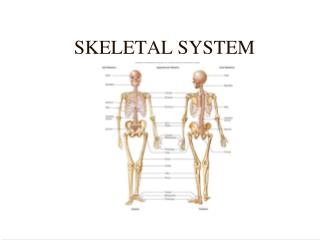
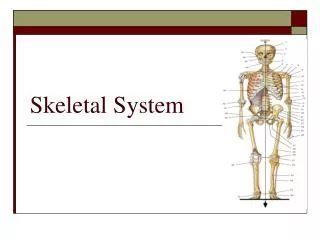
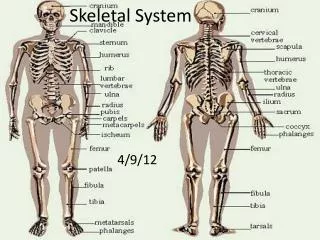
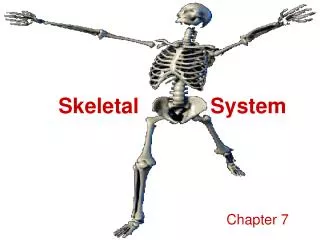
SKELETON • AXIAL SKELETON (80 BONES) • Skull • Spinal Column • Ribs • Sternum • APPENDICULAR SKELETON (126 bones) • Upper extremities • Lower extremities
Skull - Cranium • Houses and protects the brain • _______: forms forehead • ________: forms roof of nasal cavity • _______right & left; form sides and roof of skull • ________: right & left; forms temple, cheek, ear openings
_______: back of skull; inferior portion has foramen magnum (opening for spinal cord) and 2 condyles to articulate with atlas • _________: fills space between orbital plates; depression called sella turcica holds the pituitary gland; bat shaped
Cranial Sutures • Unite the bones of the cranium • As the child grow, irregular bands of connective tissue ossifies and turns into hard bone
Sutures • _________Suture: between the frontal and parietal bones • _________ Suture: between right and left parietal bones • ________Suture: between the parietal and occipital bones • _________ Suture: between temporal and parietal bones
Fontanels • Fusion of the cranial bones is not complete at birth • Space between the bones remains • Anterior (Bregmatic): “soft spot”, closes at ___months • Posterior (Occipital): triangular, closes at _____ months
Facial Bones Continued • ______ (2): cheek bones • ______ (2): small bones form medial wall of each eye socket • _______ (2): forms back roof of mouth and floor of nose • ________(2): forms curved ledge inside side wall of nose
Ear Bones • Malleus (2): the hammer • Incus (2): the anvil • Stapes (2): the stirrup
Hyoid Bone • U-shaped bone • In neck • At base of tongue • Only bone in body that does NOT articulate with another bone
SPINAL/VERTEBRAL COLUMN • 26 Vertebrae • Five divisions • C1 to C7 = Cervical • T1-T12 = Thoracic • L1-L5 = Lumbar • Sacrum (5 bones fuse when young) • Coccyx (4 bones fused together)
Functions • Supports trunk and _____. • Protects ____________ • Multiple joint spaces allow for ______ and twisting
BONES OF THE THORACIC CAVITY • RIBS – 12 pairs, called ______ (first 7 = true, RIBS 8-12 = false ribs; last 2 pairs = floating) • _________– breast bone • Manubrium • Body • Xiphoid process (cartilage)
Functions • Protect and support heart and ______ • Supports bones of pectoral girdle • Plays leading role in ________ • Ribs and sternum aid in RBC formation
Shoulder Girdle • Clavicles (2): collar bones • ________(2): shoulder blades • Acromion: extension of the scapula/high pt
Upper Extremities • Humerus: ____________ • Radius: _____side of forearm • ______: little finger side of forearm • Olecranon process (funny bone)
WRISTS AND HANDS • Carpals (8) = ______ • Metacarpals (5) = _______________ • ______ (14) = fingers • Distal • Medial • Proximal
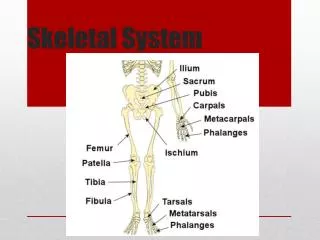
Os Coxae (2): contains the acetabulum (hip socket) 3 components: _________ – upper blade of the pelvic girdle Sacroiliac – slightly moveable articulation betw. sacrum and ilium Ischium – ______, posterior portion Also, contains the sacrum PELVIC GIRDLE
LOWER EXTREMITIES • Femur: ________ • Patella: kneecap • Tibia: _________ • Fibula: lateral bone of lower leg