Contemporary Languages in Parallel Computing
Contemporary Languages in Parallel Computing. Raymond Hummel. Current Languages. Standard Languages. Distributed Memory Multiprocessors MPI Shared Memory Multiprocessors OpenMP pthreads Graphics Processing Units CUDA OpenCL. MPI. Stands for: Message Passing Interface Pros

Contemporary Languages in Parallel Computing
E N D
Presentation Transcript
Contemporary Languages in Parallel Computing Raymond Hummel
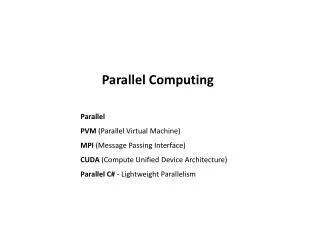
Standard Languages • Distributed Memory Multiprocessors • MPI • Shared Memory Multiprocessors • OpenMP • pthreads • Graphics Processing Units • CUDA • OpenCL
MPI • Stands for: Message Passing Interface • Pros • Extremely Scalable • Portable • Can harness a multitude of hardware setups • Cons • Complicated Software • Complicated Hardware • Complicated Setup
OpenMP • Stands for: Open Multi-Processing • Pros • Incremental Parallelization • Fairly Portable • Simple Software • Cons • Limited Use-Case
POSIX Threads • Stands for: Portable Operating System Interface Threads • Pros • Portable • Fine Grained Control • Cons • All-or-Nothing • Complicated Software • Limited Use-Case
CUDA • Stands for: Compute Unified Device Architecture • Pros • Manufacturer Support • Low Level Hardware Access • Cons • Limited Use-Case • Only Compatible with NVIDIA Hardware
OpenCL • Stands for: Open Compute Language • Pros • Portability • Heterogeneous Platform • Works with All Major Manufacturers • Cons • Complicated Software • Special Tuning Required
Developing Languages • D • Rust • Harlan
D • Performance of Compiled Languages • Memory Safety • Expressiveness of Dynamic Languages • Includes a Concurrency Aware Type-System • Nearing Maturity
Rust • Designed for creation of large Client-Server Programs on the Internet • Safety • Memory Layout • Concurrency • Still Major Changes Occurring
Harlan • Experimental Language • Based on Scheme • Designed to take care of boilerplate for GPU Programming • Could be expanded to include automatic scheduling for both CPU and GPU, depending on available resources.