Download

1 / 22
220 likes | 343 Vues
The scientific method is a systematic approach utilized in scientific inquiry, comprising essential steps such as observation, problem formulation, hypothesis creation, experimentation, data analysis, and conclusion drawing. Key features of effective experiments include controlling variables, utilizing independent and dependent variables, and ensuring repeatability. Observations can be both qualitative and quantitative, and data interpretation often involves graphs. Understanding these fundamental concepts is crucial for conducting rigorous scientific investigations and forming reliable conclusions based on evidence.

E N D
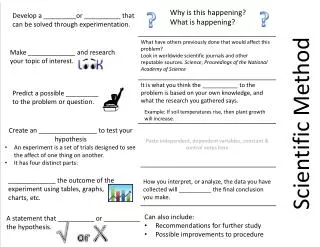
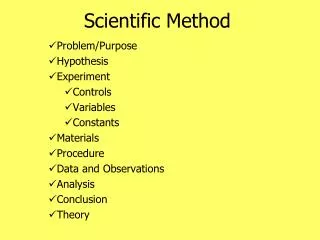
There is no single scientific method, but most contain these basic steps:
3. Hypothesis: an explanation for a question or a problem that can be formally tested.
4. Experiment: tentative procedure or policy
5. Analyze & Interpret Data: to explain or tell the meaning of - present in understandable terms
6. Conclusion: a final summation
I. Observations must be accurate, free of bias, & recorded.
2 Types • Qualitative: non-numerical observations B. Quantitative: numerical observations
II. A hypothesis is: a testable explanation for a question or problem and is based on logic, observations, andresearch
III. Experimentation A. Controlled- an experiment in which all variables are the same except the one being tested B. Independent variable: the variable being tested; in a controlled experiment, only this changes
Quiz Numerical Data is • Qualitative • Quantitative
C. Dependent variable: any change that results from manipulation of the independent variable D. Experimental Group: the group in which the independent variable is changed
E. Control Group: the group in which all the variables remain the same, including the independent variable
IV. Good design features: - well planned, detailed - only 1 variable /Constants - collect data at regular intervals - large sample size - use metrics for quantitative data - repeatable
V. Interpreting & Analyzing Data A. Graphs: 1. Line graph: data for the independent variable is placed on the horizontal, or x-axis, and data for the dependent variable are plotted on the vertical, or y-axis.
2. Bar graph: Use bars instead of data points to plot the data and are a good way to show comparisons among groups when data are not dependent on one another. 3. Pie graph: show which percentage, out of 100, a specific piece of information represents
VI. Conclusion describes if the data collected supports the hypothesis
VII. Scientific Theory time- tested major hypothesis that explains an aspect of nature
VIII. Scientific Law a principle that describes an aspect of nature
IX. Inference logical interpretation based on prior knowledge and experience