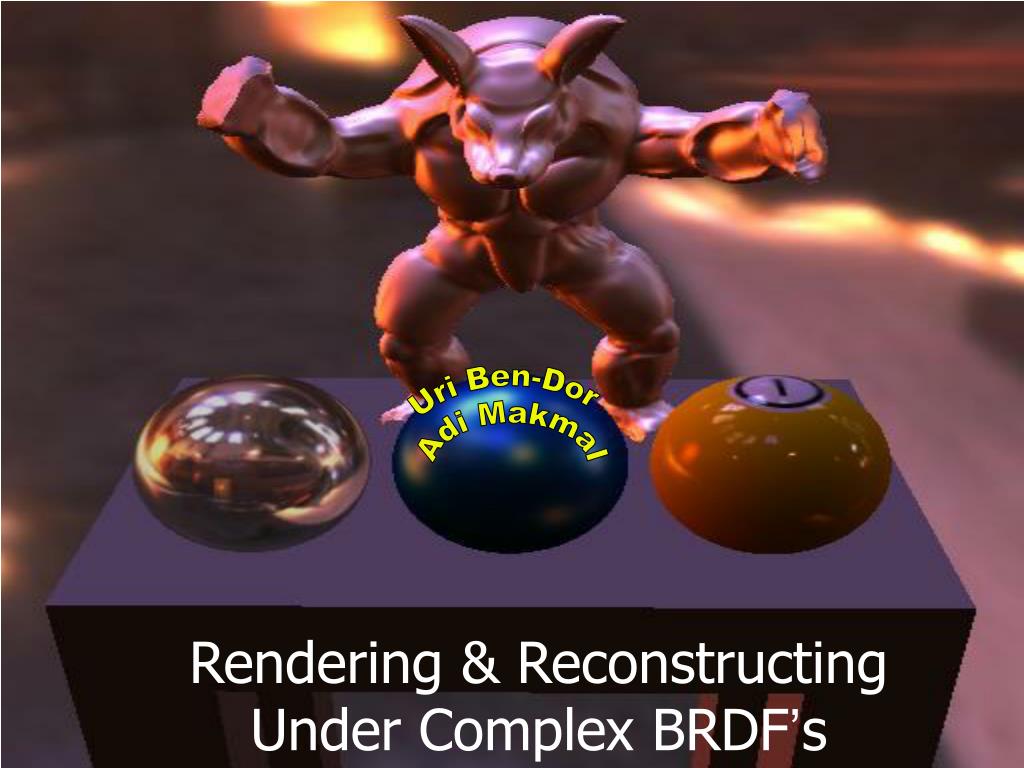
Rendering & Reconstructing Under Complex BRDF ’ s. Uri Ben-Dor Adi Makmal. AGENDA. Introduction Motivation Basic concepts Photometric Stereo Image Based Rendering (IBR) Summary. Introduction. In this lecture we will discuss the way light interacts with matter and how to improve
01 / 156Rendering & Reconstructing Under Complex BRDF ’ s
1 / 17
Télécharger la présentation
Rendering & Reconstructing Under Complex BRDF ’ s
Une image / un lien ci-dessous est fourni (tel quel) pour télécharger la présentation
Politique de téléchargement : le contenu du site vous est fourni TEL QUEL pour votre information et votre usage personnel ; il ne peut être vendu, concédé sous licence ni partagé sur d’autres sites sans l’accord de son auteur.Le contenu vous est fourni TEL QUEL, pour votre information et votre usage personnel uniquement.Téléchargez la présentation en cliquant sur ce lien.Lors du téléchargement, si vous ne parvenez pas à télécharger une présentation, l’éditeur a peut-être supprimé le fichier de son serveur.Pendant le téléchargement, si vous ne parvenez pas à obtenir une présentation, le fichier a peut-être été supprimé par l’éditeur.
Introduction In this lecture we will discuss the way light interacts with matter and how to improve realism in CV and in other related areas such as computer graphics, using this knowledge.
Motivation (1) – Constructing Geometry of an Object • Left: no light . • Right: A spot light is pointing down on the object from above and behind, reflecting off the surface of the sphere. • This simple highlight gives the viewer a completely different reading of the scene.
Motivation (2) – Giving Clues To an Object's Material • The objects reflects highlights differently. • Left: soft - as though the object were made of chalk. • Right: glossy - creates the perception of very shiny plastic.
Basic Concepts • Radiometry • Solid angle • Radiance • Irradiance • Radiosity & Exitance • BRDF • “Helmholtz” Reciprocity Rule • Isotropic vs. Anisotropic • Special BRDF • Diffuse surface & Lambertian Low • Specular surface & Fong Model • Local vs. Global Illumination
Deals with the following Questions: How do we measure light? How “bright” will surfaces be? How does light interacts with surfaces? Radiometry
L N Radiometry – Some Answers.. Brightness of a surface How much light the surface receives How much of the received light is reflected Surface material
Example Same light source hitting two different surfaces: Light hits the surface directly Light hits the surface at an angle As a result the right surface receives less light per square inch !
Fluorescence Absorbing light at one wavelength, and radiate light at different wavelength.
Simplifying Assumptions • The light leaving a point on a surface is due only to light arriving at this point. • No Fluorescence • Surfaces do not generate light internally - treating sources separately.
Basic Concepts • Radiometry • Solid angle • Radiance • Irradiance • Radiosity & Exitance • BRDF • “Helmholtz” Reciprocity Rule • Isotropic vs. Anisotropic • Special BRDF • Diffuse surface & Lambertian Low • Specular surfac & Fong Model • Local vs. Global Illumination
Intro. To Solid Angle Light is form of energy light is measured in terms of flow through an area light coming from a single direction light coming from a small region
Solid Angle - Definition • The solid angle is the area of the projection of the object onto the unit sphere. • Units : steradians, abbreviated sr.
Basic Concepts • Radiometry • Solid angle • Radiance & Irradiance • Radiosity & Exitance • BRDF • “Helmholtz” Reciprocity Rule • Isotropic vs. Anisotropic • Special BRDF • Diffuse surface & Lambertian Low • Specular surfac & Fong Model • Local vs. Global Illumination
Radiance Amount of energy traveling at some point in a specified direction, per unit time, per unit area perpendicular to the direction of travel, per unit solid angle • Denoted:L(x,,) • Units: Wm-2sr-1 .
d cos d Irradiance • How much light is arriving at a surface. • A surface experiencing radiance L(x,q,f) coming in from dw experiences irradiance: • Note: While the radiance is per area perpendicular to the direction of travel, the Irradiance is not. • Units: W*m -2
Basic Concepts • Radiometry • Solid angle • Radiance • Irradiance • Radiosity & Exitance • BRDF • “Helmholtz” Reciprocity Rule • Isotropic vs. Anisotropic • Special BRDF • Diffuse surface & Lambertian Low • Specular surfac & Fong Model • Local vs. Global Illumination
Radiosity Total power leaving a surface, per unit area on the surface. To get it, integrate radiance over the hemisphere of outgoing directions: X
Exitance • Light sources emit light, they are sources of radiance • Exitance is the equivalent of radiosity for emitters:
Basic Concepts • Radiometry • Solid angle • Radiance • Irradiance • Radiosity & Exitance • BRDF • “Helmholtz” Reciprocity Rule • Isotropic vs. Anisotropic • Special BRDF • Diffuse surface & Lambertian Low • Specular surfac & Fong Model • Local vs. Global Illumination
Bidirectional Reflectance Distribution Function Intuition: BRDF is a function that specifies the ratio between the incident light in one direction and the emitted light in a second direction. The function defines properties of the surface (shininess,..)
Outgoing radiance irradiance BRDF – more formally the ratio of the radiance in the outgoing direction to the incident irradiance at a point on the surface Range: [0,infinity] (surprising?) Units: inverse steradians = sr -1
Basic Concepts • Radiometry • Solid angle • Radiance • Irradiance • Radiosity & Exitance • BRDF • “Helmholtz” Reciprocity Rule • Isotropic vs. Anisotropic • Special BRDF • Diffuse surface & Lambertian Low • Specular surfac & Fong Model • Local vs. Global Illumination
Basic Concepts • Radiometry • Solid angle • Radiance • Irradiance • Radiosity & Exitance • BRDF • “Helmholtz” Reciprocity Rule • Isotropic vs. Anisotropic • Special BRDF • Diffuse surface & Lambertian Low • Specular surfac & Fong Model • Local vs. Global Illumination
Isotropic vs. Anisotropic • Isotropic reflection - reflection that does not vary as the surface is rotated about the normal (the angle). • Isotropic – useful assumption.
Basic Concepts • Radiometry • Solid angle • Radiance • Irradiance • Radiosity & Exitance • BRDF • “Helmholtz” Reciprocity Rule • Isotropic vs. Anisotropic • Special BRDF • Diffuse surface & Lambertian Low • Specular surfac & Fong Model • Local vs. Global Illumination
Diffuse Light • Illumination that a surface reflects equally in all directions. • BRDF is constant: • The brightness is independent of the observer position. • Also called “Lambertian” Reflection.
Ideal Diffuse Surfaces – ALBEDO definition • Albedo - The fraction of the incident radiance in a given direction that is reflected by a point on diffuse surface (in all possible directions). • Denoted d. • Also called diffuse reflectance.
N L radiant Unit normal albedo intensity of light source Light unit vector Lambert’sLaw • The radiant energy I from a diffuse surface:
Specular Surface • Light reflected from the surface unequally to all directions. • These are the bright spots on objects (polished metal, apple ...).
Different BRDF Incident LightRay SurfaceNormal ReflectedLight Slightly scattered Specular:
Different BRDF Incident LightRay SurfaceNormal perfectly Diffuse
Different BRDF SurfaceNormal Incident LightRay Combination of Diffuse and Specular
Basic Concepts • Radiometry • Solid angle • Radiance • Irradiance • Radiosity & Exitance • BRDF • “Helmholtz” Reciprocity Rule • Isotropic vs. Anisotropic • Special BRDF • Diffuse surface & Lambertian Low • Specular surfac & Fong Model • Local vs. Global Illumination
Local vs. Global Illumination Local illumination • Local illuminationEverything is lit only by light sources • Global illumination Everything is lit by everything else global illumination
Connexion au compte
Connectez-vous pour publier votre contenu sur SlideServe.