Effective Team Member Expectations and Communication
200 likes | 229 Vues
Define clear expectations for team performance and behavior. Learn to observe objectively, encourage participation, and improve listening skills. Overcome communication barriers for successful teamwork.


Effective Team Member Expectations and Communication
E N D
Presentation Transcript
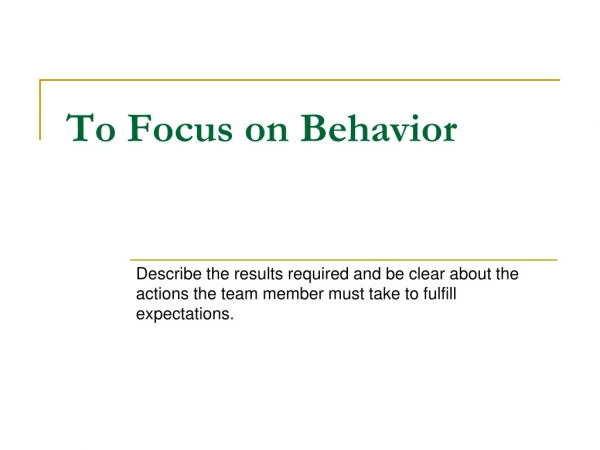
To Focus on Behavior Describe the results required and be clear about the actions the team member must take to fulfill expectations.
Focus on Behavior: Set Expectations • What steps should the team member perform? • What materials or process should be used?
Focus on Behavior: Set Expectations • Where is the work to be done? • When should the assignment start?
Focus on Behavior: Set Expectations • When is the project expected to be completed? • What should the finished project look like? Providing this information sets the basis for: • Comparing results to standards. • Objective information about the quality of performance.
Focus on Behaviors • Observe vs. infer. • Observe: watch carefully, with attention to details or behavior to arrive at a judgment • Infer: to guess, surmise, or derive as a conclusion • Distinguish between what we know objectively vs. what we believe subjectively. • Objective: ability to be known through observation, without distortion by personal feelings or prejudices • Subjective: one’s own perception, affected by personal views, experience, or background
Focus on Behaviors • Fact vs. opinion. • Avoid judgments about attitudes & personalities. • Examples: • A person is quiet, so he/she doesn’t care or have an opinion • Tattoos, hair or clothing styles • What is legal and can be or is documented. • i.e., sexual harassment
Encourage Participation Why is it difficult? What is the value?
Encouraging Participation:Why is it so Difficult? • Some leaders “guard” their power • don’t want to give up authority • The problem with that: • no room for contribution of ideas • cuts-off valuable ideas & suggestions • Effective Managers encourage the team to identify and resolve problems.
Encouraging Participation:What is the Value? • Personal commitment to the outcome rather than only the mechanical relationship of the task. • Team members accept responsibility more readily. • Team members maintain self-discipline more consistently than with an authoritarian leader. • Ownership.
Encouraging Participation:What is the Value? • Gives team members a greater sense of control. • Satisfies individual needs for self-esteem. • Higher quality decisions often result from contributions from the “experts.”
Encouraging Participation:What is the Value? • Aligns individuals with the group’s goals. • If they are involved in the plan of action, they are concerned about its success. • Creates team work.
Fundamentals of Communication Listening Designing clear messages Non-verbal clues Overcoming barriers
Listen to Motivate • Careful! - Hearing isnotlistening. - Listening is not passive, it takes energy. • Satisfies need for recognition and self-esteem – “I value you.” • Motivates creativity & generates energy – you are open to new ideas.
Listening Skills • Reflecting • Repeat the speaker’s message back • Probing • Asking questions for clarity • Supporting • Empathizing with or showing understanding of the speaker’s situation
Listening Skills • Advising • Responding by providing new information or to reinforce or change a person’s perspective • Attention • Provide your undivided attention during communications • Eye contact, nodding, etc. • Concentration • Focus on speaker & the message related
More Thoughts on Listening • Use of silence • Is the silence “cold” perhaps hostile or resistant? • An indication of misunderstanding or confusion? • “Thinking” silences to compose thoughts. • Remain quiet to allow time for team member to adequately express thoughts/feelings.
More Thoughts on Listening • Serve as a “Sounding Board” • Be a non-directive listener • Encourage him/her to talk freely • Never lose faith in the employee’s ability to solve his/her own problem.
Design Clear Messages! The key to effective oral communication is to apply the same planning and forethought that we use for writing messages.
Nonverbal Clues • Facial expressions • Gestures • Verbal intonation • Body language • Posture • Dress
Overcoming Barriers to Understanding • Communication: words can have several meanings. • Physical barriers • Personal – psychological distance between people • Lack of clarity in the message • Inability to establish rapport or credibility • Intercultural issues